

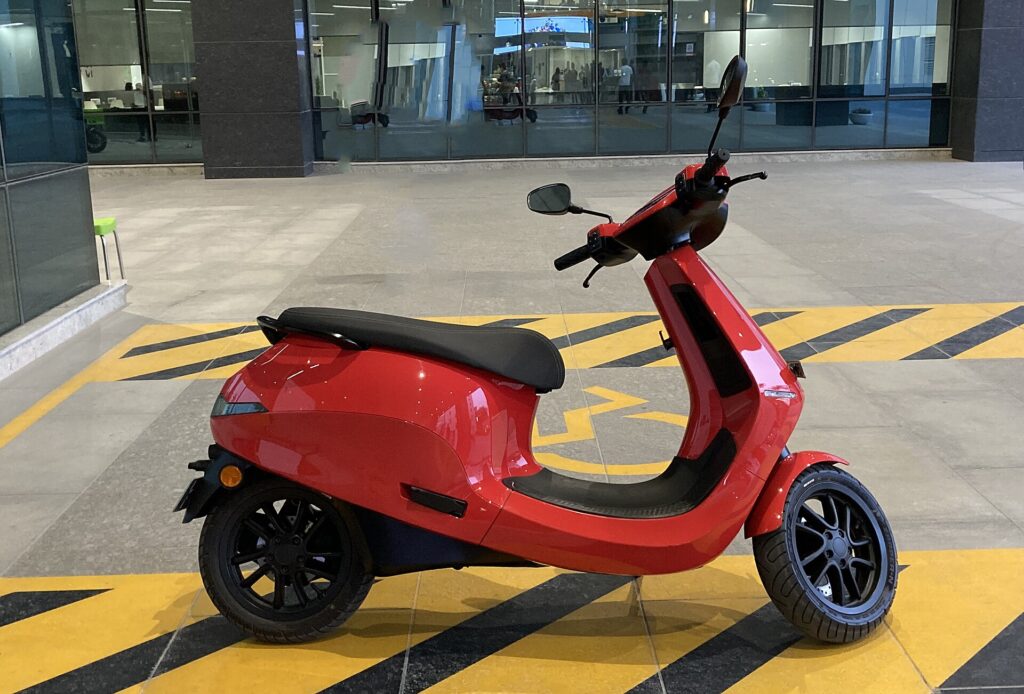
Featured image credit: Image: SnapMeUp via Wikimedia Commons (CC BY-SA 4.0). Source
By Piyush P. Yadav
No, Ola Electric is not shutting down. In the June 2026 quarter it narrowed its consolidated net loss to Rs 336 crore from Rs 430 crore a year earlier, cut quarterly operating expenses by 22 per cent, nearly doubled deliveries sequentially to 39,192 units and completed a Rs 780 crore qualified institutional placement that was 56 per cent oversubscribed. That is not the balance sheet of a company about to switch the lights off. But the question people are really asking – will the company still be around to honour my warranty and supply spares in five years – deserves a harder answer than the quarterly headline gives, because Ola was also the only manufacturer in India’s top eight electric two-wheeler makers to sell fewer scooters in August 2026 than in August 2025, and our volume calculation below shows it is selling well under half the units it needs to cover its own costs.
How we worked this out
The financial figures are Ola Electric’s reported Q1 FY27 results for the quarter ended 30 June 2026, as carried by ScanX and eMobility+ and checked on 13 September 2026. The monthly sales figures are Vahan registration data for August 2026 as compiled by Rushlane. The consumer-complaint history comes from Business Standard’s reporting on the Central Consumer Protection Authority’s action, and the dealer-network change from AckoDrive’s report on the transition. The break-even volume calculation is ours, built only from numbers Ola itself has reported – average realisation per vehicle, gross margin and quarterly operating expense – with the arithmetic shown so you can redo it. Nothing here is a view on the share price.
The quarter, in the company’s own numbers
| Metric, Q1 FY27 (quarter ended 30 June 2026) | Reported | Comparison |
|---|---|---|
| Revenue from operations | Rs 455 crore | Up 72% QoQ, down 45% YoY |
| Deliveries | 39,192 units | From 20,256 in Q4 FY26 |
| Consolidated net loss | Rs 336 crore | From Rs 430 crore in Q1 FY26 |
| EBITDA loss | Rs 165 crore | From Rs 170 crore in Q1 FY26 |
| Automotive gross margin | 30.5% | From 25.8% a year earlier |
| Consolidated operating expenses | About Rs 333 crore | Down 22% QoQ; steady-state target about Rs 300 crore |
| Cash flow from operations | Negative Rs 215 crore | – |
| Cell business | Rs 5 crore revenue, Rs 28 crore loss before tax | Loss from Rs 69 crore |
| Capital raised | Rs 780 crore QIP | 56% oversubscribed |
| Market share | 8.4% | From 5.1% in Q4 FY26 |
Read in isolation, that is a genuine operational turn: margins up, costs down, volumes recovering off a very low base. Read against the previous year, revenue is still 45 per cent lower than it was, and the company is still burning Rs 215 crore of operating cash a quarter.
The calculation that matters: how many scooters must Ola sell to break even?
Take Ola’s own reported figures and the arithmetic is simple. Revenue of Rs 455 crore across 39,192 deliveries gives an average realisation of about Rs 1.16 lakh per vehicle. At the reported 30.5 per cent automotive gross margin, that is roughly Rs 35,400 of gross profit per scooter.
Now set that against quarterly operating expenses of about Rs 333 crore. Dividing Rs 333 crore by Rs 35,400 gives roughly 94,000 vehicles per quarter – about 31,400 a month – simply to cover operating costs before interest, depreciation and any investment in the cell business. Even at the leaner steady-state opex of about Rs 300 crore that management has guided to, the requirement is around 85,000 units a quarter, or roughly 28,200 a month.
Ola registered 13,852 units in August 2026. Its best recent quarter, at 39,192 deliveries, was about 42 per cent of the volume the cost base needs. Two things could close that gap – higher gross margin as in-house cells go into more products, which we track in our Ola Bharat cell manufacturing scorecard, or a further cut in operating costs. Neither is impossible. But on today’s numbers the company needs to roughly double its volumes at current margins, in a market where its rivals are growing much faster than it is.
The August reality check
The Q1 market-share rebound from 5.1 to 8.4 per cent did not hold its momentum into the festive run-up. Vahan registrations for August 2026 look like this.
| Manufacturer | August 2026 | August 2025 | Change |
|---|---|---|---|
| TVS | 48,938 | 25,646 | +90.8% |
| Bajaj | 41,114 | 12,246 | +235.7% |
| Ather | 28,757 | 19,210 | +49.7% |
| Hero MotoCorp | 19,007 | 13,787 | +38.0% |
| Ola Electric | 13,852 | 19,464 | -28.8% |
| Greaves Ampere | 8,613 | 4,562 | +88.6% |
| Industry total | 183,204 | 109,673 | +67.1% |
In a market that grew 67 per cent, Ola shrank by 29 per cent, leaving it fifth with about 7.6 per cent share while TVS and Bajaj between them took close to half the month. Our scorecard on TVS, Bajaj, Ather and Vida crossing a million combined sales in 2026 sets out how quickly that consolidation has happened, and we covered the symbolic moment when TVS overtook Ola on cumulative electric two-wheeler sales.
The part that should actually worry a buyer: service
Solvency this quarter is not the real risk for someone spending a lakh on a scooter. Service is. Between September 2023 and August 2024 the National Consumer Helpline logged 10,644 complaints against Ola Electric, which led the Central Consumer Protection Authority to issue a show-cause notice in October 2024 over alleged unfair trade practices. The CCPA subsequently questioned the company’s claim that it had resolved 99 per cent of those complaints, and issued further notices as its investigation continued. Analysts at HSBC reported that service centres appeared overwhelmed and that the company had not invested enough in servicing capacity to match the volumes it had sold.
Ola’s answer has two parts: a HyperService programme launched in late 2025, and the bigger structural change of opening sales and service to dealer partners, targeting a full dealership footprint by Diwali 2026 after years of running company-owned stores. That is the right direction – a dealer has its own capital and its own local reputation at stake – but it is a transition, and transitions are exactly when a service network is at its thinnest.
Who this is for, and who should not follow it
This is written for someone deciding whether to buy an Ola scooter, not for someone deciding whether to buy the stock. It is not investment advice, it contains no view on valuation, and nothing here should be read as a prediction about the company’s future. The figures are as reported for the quarter ended 30 June 2026 and for August 2026 registrations; a company in this phase can change materially in two quarters, in either direction.
If you are considering an Ola, the practical checks are local rather than financial. Find out where your nearest service point is today and whether it is company-run or a new dealer, ask how long a typical spare takes to arrive, and read the warranty terms as what they are – a promise from the manufacturer, not an insured product; our comparison of electric scooter battery warranties in India shows what each brand commits to in writing. If you live somewhere with thin coverage, that matters more than any quarterly result.
Sources & Further Reading
- ScanX, Ola Electric Q1 FY27 results: consolidated loss narrows to Rs 336 crore
- eMobility+, Ola Electric reports Rs 455 crore revenue in Q1 FY27
- Rushlane, Electric two-wheeler sales August 2026 (Vahan data)
- Business Standard, CCPA questions Ola Electric’s 99 per cent resolution rate
- AckoDrive, Ola Electric turns to dealers after years of service complaints
People also ask
Is Ola Electric shutting down?
No. In Q1 FY27 the company narrowed its net loss to Rs 336 crore from Rs 430 crore, raised Rs 780 crore through an oversubscribed QIP, and cut quarterly operating costs 22 per cent to about Rs 333 crore. It remains loss-making with negative operating cash flow of Rs 215 crore in the quarter, but there is no reported sign of a wind-down.
Is Ola Electric profitable?
Not yet. Its automotive gross margin improved to 30.5 per cent in Q1 FY27 from 25.8 per cent a year earlier, but gross profit of roughly Rs 139 crore did not come close to covering about Rs 333 crore of quarterly operating expenses. The cell business lost a further Rs 28 crore before tax on Rs 5 crore of revenue.
Can Ola Electric survive?
It has the cash runway from a Rs 780 crore raise and a materially leaner cost base, so the near-term question is volume rather than survival. On its own reported numbers it needs roughly 85,000 to 94,000 vehicles a quarter to cover operating costs at current margins, against 39,192 delivered in Q1 FY27 and 13,852 registered in August 2026.
Why is Ola Electric in loss?
Because its fixed cost base was built for volumes it no longer achieves. Revenue fell 45 per cent year on year in Q1 FY27 while operating expenses, even after a 22 per cent sequential cut, stood at about Rs 333 crore. Add a cell manufacturing business that lost Rs 28 crore before tax in the quarter, and the losses follow arithmetically.
Is an Ola Electric scooter a good buy?
The product decision and the company decision are separate. Judge the scooter on range, warranty terms and price against the TVS, Bajaj and Ather alternatives that together took close to two-thirds of August 2026 registrations. Then check service coverage where you actually live, because Ola is mid-way through replacing company-owned stores with dealer partners, targeted for completion by Diwali 2026.
Has Ola Electric’s service improved?
The company launched a HyperService programme in late 2025 and is moving to a dealer-led network. Independent evidence of the earlier problem is substantial: 10,644 complaints on the National Consumer Helpline between September 2023 and August 2024, a CCPA show-cause notice in October 2024, and further notices as the regulator questioned the claimed 99 per cent resolution rate. Verify coverage locally rather than nationally.