

Featured image credit: Image: SerChevalerie via Wikimedia Commons (CC BY-SA 4.0). Source
Two years ago, Mahindra’s electric car business was a rounding error. The XUV400 sold in modest numbers, the company had no presence in the premium electric segment, and the conversation about Indian EVs was a conversation about Tata Motors with occasional mentions of MG.
In August 2026, Mahindra registered 6,464 electric vehicles, took 21.5% of India’s electric passenger vehicle market and grew 56.2% year on year in a month when the overall market fell 11.1% from July. It is now unambiguously the second force in Indian electric cars, and the gap to the leader is narrowing rather than widening.
This is an assessment of how Mahindra got here, what its August numbers actually show, and which parts of the strategy carry real risk. By Piyush P. Yadav.
Where Mahindra stands
India’s electric passenger vehicle registrations reached 30,051 units in August 2026, up 53.1% year on year but down 11.1% from the previous month.
| Manufacturer | August 2026 registrations | Market share | Year-on-year trend |
|---|---|---|---|
| Tata Motors | 13,158 | 43.8% | Growth, leadership retained |
| Mahindra | 6,464 | 21.5% | Up 56.2% |
| MG Motor | 4,622 | Roughly 15.4% | Down 17.8% YoY, down 22.2% MoM |
Together Tata and Mahindra accounted for about 65.3% of Indian electric passenger vehicle registrations in the month. Two domestic manufacturers now control roughly two-thirds of the segment, which is a notable outcome in a market where global brands were widely expected to dominate.
The more revealing comparison is Mahindra against MG. In the same month that Mahindra grew 56.2%, MG fell 17.8% year on year and 22.2% month on month. Mahindra is not simply riding a rising market; it is taking share from a competitor that was ahead of it not long ago. Our detailed look at Tata Motors’ August 2026 EV performance covers the leader’s side of the same month.
How Mahindra built the position
Three decisions explain most of the shift.
Entering at the top rather than the bottom
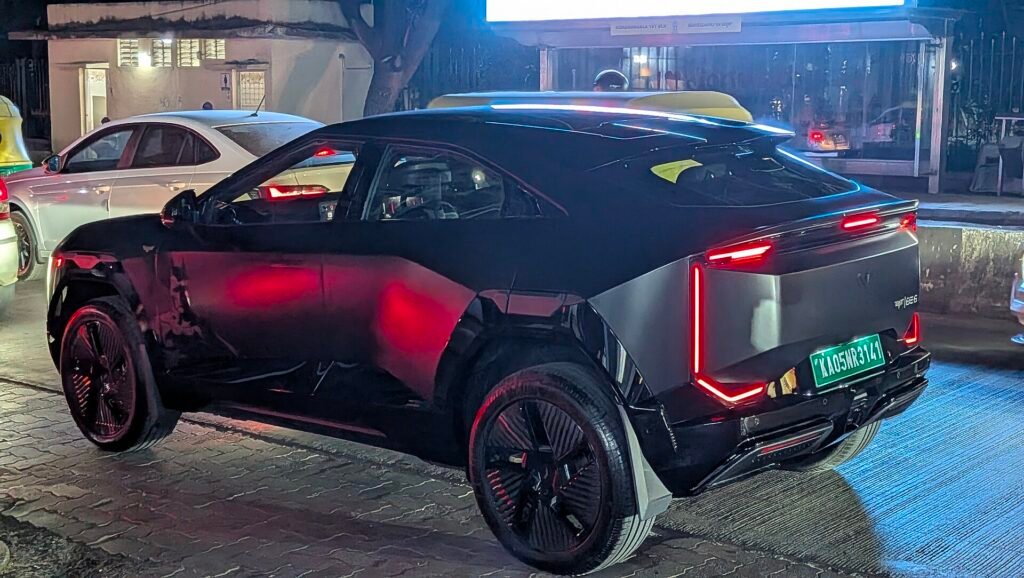
The conventional Indian playbook is to start cheap and work upward. Mahindra inverted it. The Electric Origin SUVs, the BE 6 and the XEV 9e, launched as premium, design-led, technology-heavy products rather than as affordable commuters.
That choice bought margin and it bought brand positioning. It also aligned with what Mahindra already does well, because the company’s ICE business had spent a decade establishing SUV credibility. An electric Mahindra SUV was a plausible product in a way that an electric Mahindra hatchback would not have been.
Adding a genuinely different body style
The XEV 9S, launched in August 2026 at Rs 20.65 lakh to Rs 30.90 lakh, is a seven-seat electric SUV. Seven-seat electric options in India remain scarce, and Indian family buying patterns place a high value on the third row.
Mahindra has since added an optional six-seat layout with second-row captain seats on the Pack Two Above, Pack Three and Pack Three Above variants, which is a direct response to how Indian buyers in this price band actually specify a large SUV.
Attacking the entry price without cutting it
The most aggressive move came on 29 August 2026, when Mahindra extended Battery-as-a-Service pricing across the full Electric Origin SUV portfolio. Under BaaS the XEV 9S starts at Rs 12.65 lakh instead of Rs 20.65 lakh, with a battery subscription of Rs 3.75 per kilometre.
An Rs 8 lakh reduction in the entry price transforms which buyers can consider the car, without Mahindra discounting the vehicle itself or damaging residual values for existing owners. Whether it is good value depends entirely on how far you drive, and we work through that arithmetic in detail in our analysis of what Mahindra’s BaaS pricing actually costs over an ownership period.
Production capacity is not the constraint
A common failure mode for Indian manufacturers has been demand arriving faster than the ability to build. Mahindra appears to have anticipated this.
The company currently produces up to 5,000 units a month of the XEV 9e and BE 6, and is adding a further 3,000 units of monthly capacity by the end of FY26 in anticipation of XEV 9S volumes. It states it can produce up to one lakh units per annum, with operational capacity expandable to two lakh units if required.
| Capacity measure | Figure |
|---|---|
| Current monthly output, XEV 9e and BE 6 | Up to 5,000 units |
| Additional monthly capacity by end FY26 | 3,000 units |
| Stated annual capacity | Up to 1,00,000 units |
| Expandable operational capacity | Up to 2,00,000 units |
Set the 8,000 monthly figure against August registrations of 6,464 and the picture is a company building ahead of its current run rate rather than behind it. That headroom is what makes an aggressive pricing move like BaaS sensible: there is little point stimulating demand you cannot fill.
The risks
Three deserve attention.
BaaS residual value exposure
Under BaaS, a financing partner owns the battery and carries its degradation and residual risk. That risk does not vanish; it is borne by whoever holds the asset, and it is priced on assumptions about battery life and used-EV values that India does not yet have good data for. If packs degrade faster than modelled, or used electric SUV values disappoint, the economics of the programme tighten. Our examination of Indian EV resale values and depreciation shows how wide the uncertainty band still is.
Cell supply
Mahindra does not make its own cells and depends on external suppliers in a market where several domestic cell projects have slipped. Any manufacturer scaling toward one lakh units a year needs contracted cell volumes well in advance. Our India cell manufacturing scorecard tracks which domestic projects are actually delivering, and it is not a uniformly encouraging picture.
Premium concentration
Mahindra’s electric volumes come almost entirely from SUVs priced well above the market’s centre of gravity. That is profitable while it lasts, but the largest volume growth in Indian EVs will eventually come from below Rs 15 lakh, where Tata is entrenched and where Maruti, Hyundai and others are arriving. Hyundai’s plans, which we covered in our piece on its 2030 roadmap of 26 launches backed by Rs 45,000 crore, point directly at that segment.
What this means for buyers
Market share contests matter to buyers mainly through their second-order effects, and three of those are worth noting.
Competition is improving the product. The six-seat captain-chair option on the XEV 9S appeared because rivals offer it and buyers ask for it. A manufacturer fighting for share responds to specification requests faster than one that is comfortable.
Financing innovation is spreading. BaaS lowers the entry price without a headline discount, and competitors under share pressure will feel obliged to answer it with something. Buyers should expect more creative ownership structures over the next year, and should evaluate each on total cost rather than entry price.
Scale is reaching service. A manufacturer building toward one lakh electric units a year has to invest in trained technicians, diagnostic tooling and parts availability. That investment is invisible at purchase and decisive three years later, and it is one of the more practical reasons to weigh volume when choosing an electric car.
The corresponding caution is that share leadership is not a proxy for product suitability. The right Mahindra for a given buyer may be no Mahindra at all if the use case points to a smaller, cheaper car. Share data tells you which companies are executing well; it does not tell you which vehicle fits your driving.
What to watch
- September and festive-season registrations, which will show whether BaaS converted interest into volume.
- Whether the 8,000 unit monthly capacity is actually reached by the end of FY26.
- Whether Mahindra announces a sub-Rs 15 lakh electric model, the clearest signal of a mass-market push.
- MG’s response, since its August decline suggests a portfolio under pressure.
- BaaS uptake rates, which determine how much battery residual risk accumulates.
The bottom line
Mahindra has executed one of the more coherent strategies in Indian electric vehicles. It entered where its brand was strongest, built a distinct product in the seven-seat segment, expanded capacity ahead of demand and then used a financing structure to cut the entry barrier without cutting price.
A 21.5% share and 56.2% year-on-year growth in a month when the overall market contracted is genuine evidence that the approach is working. The open question is not whether Mahindra can compete at the premium end, which it has settled. It is whether a company whose electric volumes are concentrated above Rs 20 lakh can follow the market down into the segment where the next several hundred thousand Indian EV buyers will actually be shopping.
Sources & Further Reading
- Autopunditz: Electric car registrations August 2026, Vahan data
- CarWale: Mahindra to ramp up EV production for the XEV 9S
- Mahindra: Battery-as-a-Service expanded across the Electric Origin SUV portfolio
- Rushlane: Electric car sales August 2026 by manufacturer
Frequently Asked Questions
What is Mahindra’s EV market share in India?
Mahindra held 21.5% of India’s electric passenger vehicle market in August 2026 with 6,464 registrations, placing it second behind Tata Motors at 43.8% and ahead of MG Motor. Mahindra grew 56.2% year on year in a month when the overall market fell 11.1% from July.
How many EVs can Mahindra produce?
Mahindra currently produces up to 5,000 units a month of the XEV 9e and BE 6, and is adding 3,000 units of monthly capacity by the end of FY26. The company states it can produce up to one lakh units annually, with operational capacity expandable to two lakh units if required.
What does Mahindra’s BaaS pricing do to the XEV 9S price?
Under Battery-as-a-Service, announced on 29 August 2026, the XEV 9S starts at Rs 12.65 lakh ex-showroom instead of Rs 20.65 lakh, a reduction of Rs 8 lakh. A battery subscription charge of Rs 3.75 per kilometre applies, so the total cost depends heavily on annual mileage.
What is the main risk to Mahindra’s EV strategy?
Its electric volumes are concentrated in SUVs priced well above Rs 20 lakh, while the largest future growth in Indian EVs is expected below Rs 15 lakh, where Tata is established and Maruti and Hyundai are arriving. Cell supply dependence and battery residual value assumptions under BaaS are further exposures.