

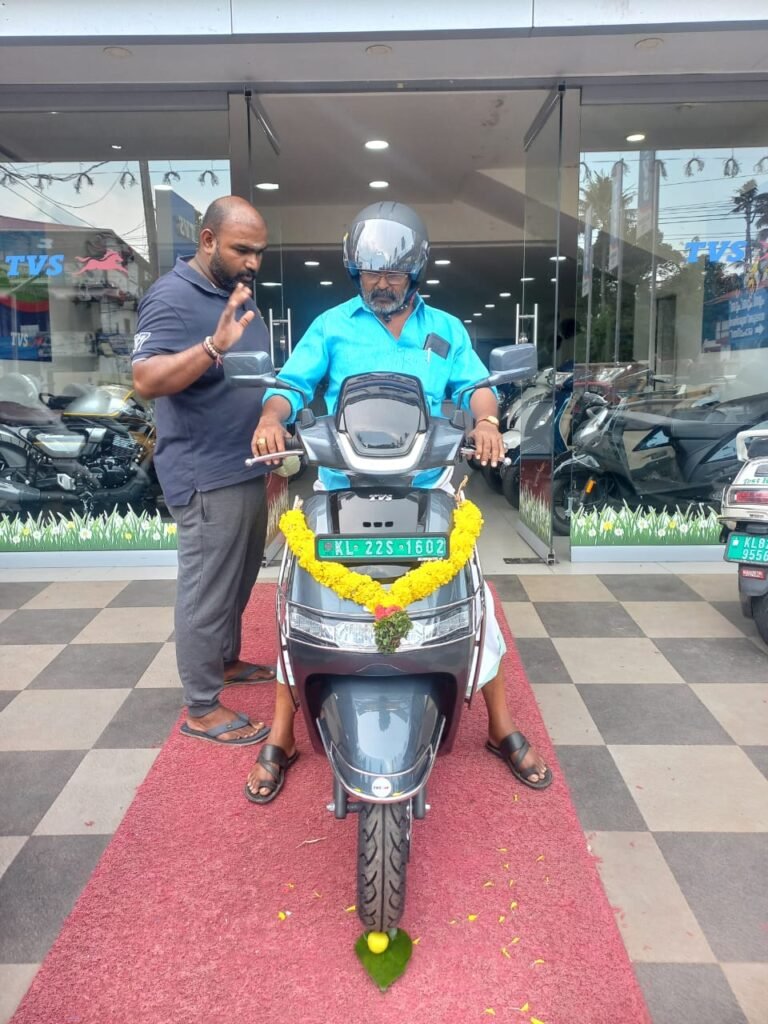
Featured image credit: Image: Maneesh Sreekariyam via Wikimedia Commons (CC BY-SA 4.0). Source
By Piyush P. Yadav | Updated September 14, 2026
India’s electric two-wheeler market crossed a new milestone in August 2026, with total retail sales touching 1,83,204 units — a jump of roughly 67 percent over the 1,09,673 units sold in August 2025. But the headline number hides a much sharper story underneath: TVS Motor Company and Bajaj Auto, between them, now account for more than half of every electric scooter sold in the country, and the gap between the traditional two-wheeler giants and the once-dominant EV-native brands like Ather Energy and Ola Electric keeps widening every month.
The August 2026 Scoreboard
TVS retained the top spot for electric two-wheelers with 48,938 units in August 2026, almost double its 25,646 units from a year earlier — a 90.82 percent year-on-year jump that gave it a 26.71 percent share of the market. Bajaj Auto held on to second place with 41,114 units, but its growth rate was the real headline: sales surged 235.73 percent from just 12,246 units in August 2025, pushing its market share to 22.44 percent.
Ather Energy came in third with 28,757 units, up 49.70 percent year-on-year, though its 15.70 percent share reflected a 5.27 percent dip from July’s numbers. Hero MotoCorp’s Vida brand registered 14,388 units in the August 1-26 provisional window, down from 23,030 units in July, with its market share slipping from 11.2 percent to 9.8 percent during the same period.
Put together, TVS and Bajaj alone made up close to 49.2 percent of the entire electric two-wheeler retail market in August — a level of concentration that would have seemed unlikely just two years ago, when Ola Electric and Ather were the names most associated with India’s EV scooter boom.
Model-Wise: Chetak and Rizta Keep Climbing
Zooming out to the full calendar year gives a clearer picture of momentum. Bajaj’s Chetak line sold 3,05,226 units in the first eight months of 2026, up 69 percent year-on-year, capturing a 22 percent share of the cumulative market. Its best single month so far was March 2026, when it moved 47,753 units. Ather, meanwhile, delivered 2,29,099 units over the same eight-month period, up 83 percent year-on-year for a 17 percent share — arguably the more impressive growth rate given it started from a smaller base and does not have the dealer network of a legacy two-wheeler maker behind it.
This growth run also means anyone weighing up the current market leaders should compare more than headline sales — check whether the specific scooter variant needs a licence and registration before assuming every model in a brand’s lineup is treated the same way under India’s low-speed EV rules.
Why Bajaj and TVS Are Pulling Ahead
The concentration of sales in two legacy manufacturers is not an accident. Both TVS and Bajaj entered the electric two-wheeler race later than Ather or Ola Electric, but they came in with decades-old dealer and service networks already spread across small towns, something pure-EV startups have had to build from scratch. That network advantage matters even more once a buyer starts asking about after-sales support, spare parts, and resale value — areas where legacy brands have historically had the edge over newer entrants.
Pricing aggression has also played a role. Both companies have used festive-season offers and finance schemes to push volumes at the lower end of their range, while continuing to invest in premium variants like the Chetak 3501 and the TVS iQube ST to compete on range and features rather than price alone.
Hero’s Two-Brand Bet
Hero MotoCorp’s slipping share in the provisional August numbers is a reminder that its strategy is still a work in progress. The company has been running a dual-brand approach with Vida and a growing stake in Ather, betting that owning positions across both the mass and premium ends of the market will pay off over a longer horizon. For a deeper look at how that strategy is meant to play out, see our breakdown of Hero MotoCorp’s Vida-Ather strategy and its target of becoming India’s largest EV seller.
Comparison Table: Top Electric Two-Wheeler Brands, August 2026
| Brand | August 2026 Units | YoY Growth | Market Share | Key Model |
|---|---|---|---|---|
| TVS Motor Company | 48,938 | +90.82% | 26.71% | iQube |
| Bajaj Auto | 41,114 | +235.73% | 22.44% | Chetak |
| Ather Energy | 28,757 | +49.70% | 15.70% | Rizta |
| Hero Vida (Aug 1-26, provisional) | 14,388 | Down from July’s 23,030 units | 9.8% | Vida V2 |
Figures compiled from industry sales data reported by Autopunditz and Autocar Professional; provisional numbers are subject to final Vahan revisions.
The Subsidy Backdrop: PM E-DRIVE Gets Extended
Part of what’s fuelling this growth is policy certainty. There was brief confusion in mid-2026 when the demand incentive under the PM E-DRIVE scheme for electric two-wheelers appeared to lapse on July 31, 2026, after already being extended once from its original March 31, 2026 deadline. The government subsequently confirmed an extension of the subsidy through FY28, meaning electric two-wheelers registered between April 1, 2025, and March 31, 2028, continue to receive Rs 2,500 per kWh of battery capacity, capped at Rs 5,000 per vehicle, as long as the ex-factory price stays under Rs 1.5 lakh.
That continuity matters because most of the volume leaders — Chetak, iQube, and Rizta variants — are priced to qualify for the incentive, and any lapse in the subsidy tends to show up almost immediately in monthly registration numbers, as it briefly did in the run-up to the July 31 deadline scare.
How the Two-Wheeler Race Compares to Four-Wheeler EVs
It’s worth noting that this brand concentration mirrors what’s happening in the electric car segment too, where an incumbent manufacturer with an established dealer and service network has similarly pulled ahead of newer rivals by combining an early product lineup with distribution reach — the same pattern now playing out for TVS and Bajaj on two wheels.
Where Does Ola Electric Fit In?
One name conspicuously absent from the top of the August 2026 charts is Ola Electric, once the country’s largest electric scooter seller by a wide margin. The company’s slide down the rankings over the past year has raised questions about its near-term strategy, its cash position, and whether it can hold on to a meaningful share as TVS, Bajaj, and Ather all post double-digit or triple-digit growth. We’ve covered what Ola Electric’s Q1 FY27 numbers and August sales actually show in more detail, but the short version is that its retreat has left a volume gap that Bajaj, in particular, appears to have absorbed fastest.
Festive Season Outlook: What Comes Next
India’s festive season, running from Navratri through Diwali, is traditionally the single biggest sales window for two-wheelers of any kind, and 2026 is unlikely to be an exception. With the PM E-DRIVE subsidy now confirmed through FY28, manufacturers have the pricing certainty they need to run aggressive festive campaigns without worrying about a sudden incentive cutoff mid-quarter — a risk that was very real just weeks before the government’s clarification.
Analysts tracking the segment expect TVS and Bajaj to keep widening their combined lead through the September-November period, largely because both brands can lean on rural and semi-urban dealer networks that EV-native players are still building out. Ather’s response has been to double down on its premium positioning with the Rizta family, betting that buyers upgrading from a first electric scooter will pay more for range, software features, and connected-app functionality rather than switch to a cheaper legacy-brand alternative. Whether that bet pays off through the festive quarter will be one of the more interesting sub-plots in India’s EV story heading into 2027.
For Hero MotoCorp, the festive season is also a test of its dual-brand approach: whether pushing Vida at the mass-market end while backing Ather at the premium end nets out to a bigger combined share than either brand could achieve alone, or whether the two efforts end up competing against each other for the same customer.
What This Means for Buyers
- More competition, better financing: With TVS and Bajaj chasing volume, expect continued aggressive EMI and exchange offers through the festive season.
- Wider service reach: Buyers in smaller towns are more likely to find a nearby Bajaj or TVS service centre than an Ather or Ola Electric outlet, which remains a practical consideration for day-to-day ownership.
- Resale value questions: As these brands scale, tracking battery health and resale value will matter more — our guide on checking an electric scooter’s battery health is a useful starting point before buying used.
- Subsidy-linked pricing: Because the PM E-DRIVE incentive is capped by ex-factory price, top-spec variants that cross the Rs 1.5 lakh threshold may lose eligibility, so it’s worth confirming subsidy status on the exact variant, not just the model name.
Sources & Further Reading
- Electric Two-Wheeler Sales August 2026: TVS Leads as Bajaj Surges 236% — Autopunditz
- India’s Top 4 E-2W Makers Cross 1 Million Sales in 2026 — Autocar Professional
- Electric two-wheeler sales fall 11 percent in August after record July — Autocar India
- PM E-Drive Subsidy For Electric Two-Wheelers Extended Till FY28 — DriveSpark
Frequently Asked Questions
Which brand sold the most electric two-wheelers in India in August 2026?
TVS Motor Company led with 48,938 units in August 2026, a 90.82 percent year-on-year increase, giving it a 26.71 percent share of the electric two-wheeler market.
Why did Bajaj Auto’s electric scooter sales grow so fast?
Bajaj’s Chetak sales rose 235.73 percent year-on-year in August 2026 to 41,114 units, driven by an expanding dealer network, aggressive festive-season pricing, and a wider lineup that spans mass-market and premium variants.
Is the PM E-DRIVE subsidy for electric scooters still active?
Yes. After brief confusion around a July 31, 2026 deadline, the government confirmed the PM E-DRIVE demand incentive for electric two-wheelers has been extended through FY28, offering Rs 2,500 per kWh capped at Rs 5,000 per vehicle for models priced under Rs 1.5 lakh ex-factory.
Is Ather Energy losing ground to TVS and Bajaj?
Ather’s market share dipped slightly month-on-month in August 2026, but its year-on-year growth of 49.70 percent and cumulative 2026 growth of 83 percent show it is still expanding — just at a slower pace than the two legacy manufacturers with larger dealer networks.