

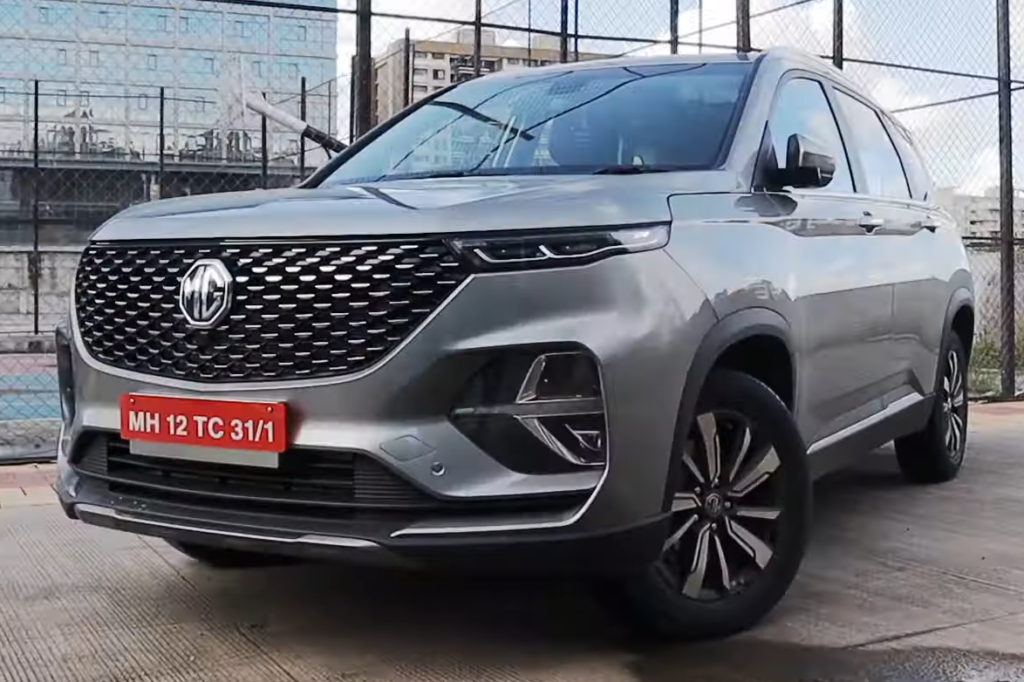
Featured image credit: Image: The Drivers Hub via Wikimedia Commons (CC BY 3.0). Source
By Piyush P. Yadav
JSW MG Motor India spent August building up to its most important launch of the year, and on August 26 it delivered: the Hector Tomahawk EV, a three-row electric SUV priced from Rs 19.49 lakh to Rs 23.49 lakh ex-showroom, built on the company’s new ADAPT architecture that can carry hybrid, plug-in hybrid, electric and range-extender powertrains on a single platform. It is also, MG claims, India’s first electric car to support vehicle-to-home charging, letting the car’s battery power a house during an outage. This is a full look at what the Hector Tomahawk EV actually offers and where it sits against the electric SUVs already on the road.
Hector Tomahawk EV: full specifications
| Specification | Detail |
|---|---|
| Price (ex-showroom) | Rs 19.49 lakh to Rs 23.49 lakh |
| Battery | 69.2 kWh |
| Motor | Front-mounted, 204 hp (about 150 kW), 310 Nm |
| Claimed range | Up to 517 km on the Modified Indian Driving Cycle (MIDC) |
| 0 to 100 kmph | 8.2 seconds |
| Seating | 5-seat and 7-seat configurations offered |
| Wheels | 18-inch |
| Touchscreen | 15.6-inch |
| Roof | Panoramic sunroof |
| Safety | 6 airbags, Level 2 ADAS, 360-degree camera |
| Notable feature | Vehicle-to-home (V2H) charging support — claimed as an India first for an electric car |
| Platform | ADAPT architecture, based on the Wuling Starlight 560, shared with hybrid, PHEV and range-extender variants |
The MIDC range figure is worth reading carefully. MIDC is a newer, somewhat more realistic Indian test cycle than the older ARAI figures many rivals still quote, but it is still a lab test; expect real-world range in the 380 to 420 km band for typical mixed driving, which is still competitive for the price.
What vehicle-to-home charging actually means
V2H lets the car’s battery discharge power back into a home’s electrical system, effectively turning a 69.2 kWh pack into a large backup battery during a grid outage. In practice this requires a compatible home inverter or transfer switch installed alongside the charger, which is an additional cost MG has not detailed publicly. The capability itself, however, is significant: a full Hector Tomahawk EV battery holds roughly ten to fifteen times the capacity of a typical home inverter battery, enough to run essential household loads — lights, fans, a refrigerator, Wi-Fi — for well over a day. No other electric car on sale in India currently advertises this feature, though several premium imports elsewhere in the world offer it.
How it compares with rival three-row and premium electric SUVs
| Model | Starting price | Battery | Claimed range | Seating |
|---|---|---|---|---|
| MG Hector Tomahawk EV | Rs 19.49 lakh | 69.2 kWh | 517 km (MIDC) | 5 or 7 |
| MG Windsor EV | Rs 12.36 lakh (listing) | Up to 52.9 kWh | Up to 449 km | 5 (crossover MPV) |
| Mahindra XEV 9e | Rs 21.90 lakh | Multiple options | Not directly comparable — coupé-SUV, 5-seat | 5 |
| Hyundai Creta Electric | Rs 18.20 lakh (post-hike) | Not disclosed in this comparison | Lower than Hector Tomahawk’s claim | 5 |
The Hector Tomahawk EV’s genuine point of difference is the seven-seat option combined with a large battery and long claimed range — nothing else in this price band offers three rows on a dedicated or near-dedicated EV platform. Most rivals at this price, including the Creta Electric covered in our report on September’s Tata and Hyundai EV price hikes, are five-seat SUVs. Buyers who specifically need a third row and want to go electric currently have very few other options below Rs 25 lakh.
The ADAPT architecture bet
What makes the Hector Tomahawk notable beyond its own specification sheet is the platform underneath it. ADAPT is designed to accept hybrid, plug-in hybrid, battery-electric and range-extender powertrains on the same basic architecture, which lets MG build multiple versions of the same vehicle without separate tooling for each powertrain. A PHEV variant of the Hector Tomahawk is already confirmed to exist alongside the EV. This flexible-platform approach is the same logic other manufacturers are applying at their own Indian plants, and it typically shows up in pricing: shared tooling costs less to run than dedicated EV-only production, which likely helped MG price the EV variant as aggressively as it has relative to its size and range.
Should you consider it?
- Consider it if you specifically need three rows in an electric SUV. There is very little direct competition in this configuration below Rs 25 lakh.
- Consider it if you want backup-power capability for your home and are willing to invest in the compatible inverter setup separately.
- Cross-shop the MG Windsor EV if you don’t need the third row — it undercuts the Tomahawk EV by roughly Rs 7 lakh at entry while sharing MG’s lifetime battery warranty philosophy on select trims, detailed in our EV battery warranty comparison guide.
- Wait for real-world range tests before treating the 517 km MIDC figure as a daily-use number; budget for something closer to 400 km in typical conditions.
Sources & Further Reading
- Autopunditz: MG Hector Tomahawk EV launched at Rs 19.49 lakh — 517 km range, 7 seats, 69.2 kWh battery
- NewsX: MG Hector Tomahawk launched in India — price, range, battery, features
- Autocar India: MG Hector Tomahawk EV — price, range and expert reviews
FAQ
What is the price of the MG Hector Tomahawk EV?
Rs 19.49 lakh to Rs 23.49 lakh ex-showroom, launched August 26, 2026.
What is the range of the MG Hector Tomahawk EV?
Up to 517 km on the Modified Indian Driving Cycle (MIDC) from its 69.2 kWh battery; real-world range is likely to be lower, in the 380-420 km range for mixed driving.
Does the MG Hector Tomahawk EV support vehicle-to-home charging?
Yes. MG claims it is India’s first electric car with vehicle-to-home (V2H) support, letting the battery power a home during an outage, subject to a compatible home inverter/transfer-switch installation.
Is the Hector Tomahawk EV a 7-seater?
Both 5-seat and 7-seat configurations are offered, making it one of the few electric SUVs in India with a genuine three-row option below Rs 25 lakh.