

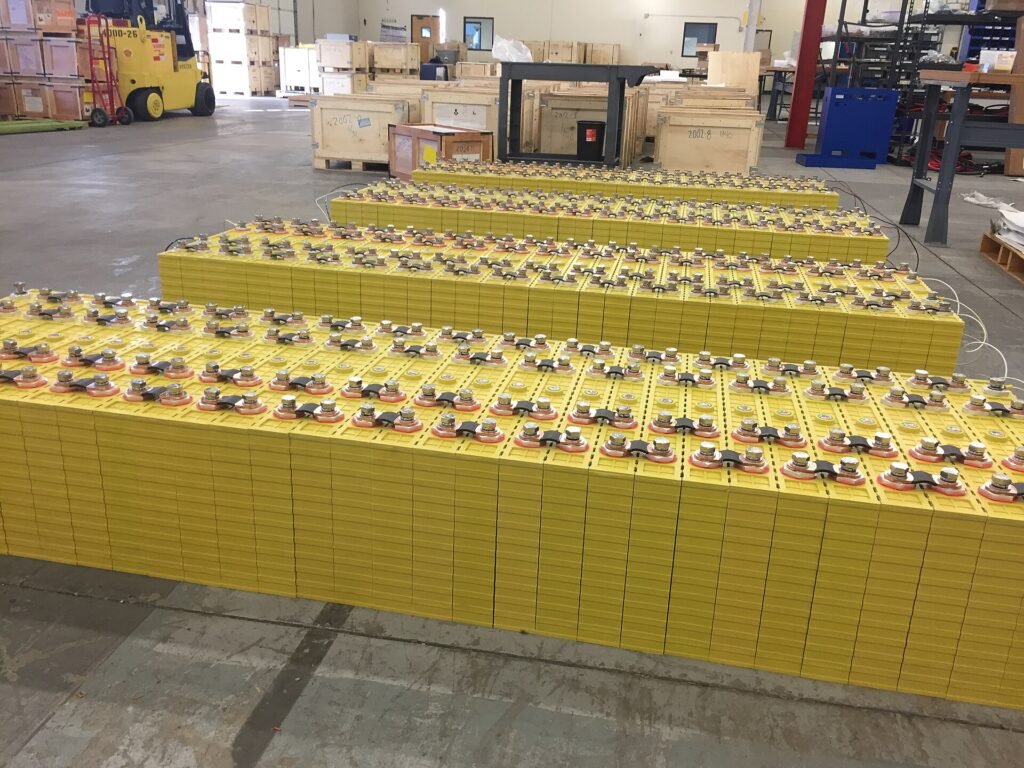
Featured image credit: Image: Yo-Co-Man via Wikimedia Commons (CC BY-SA 4.0). Source
By Piyush P. Yadav
On 28 August 2026 a lithium-ion cell designed and manufactured in India went into a production vehicle for the first time. Ola Electric’s “Bharat Cell”, a lithium iron phosphate cylindrical cell in the 46-series format made at its Krishnagiri gigafactory in Tamil Nadu, powers the new Rs 79,999 S1Z scooter. That is a milestone worth marking, because for a decade India’s cell-making ambitions have been announced far more often than they have been delivered. It is also a useful moment to take stock. Who in India is actually producing cells today? At what cost against Chinese imports? And why have Reliance, JSW and Amara Raja slipped while Ola and Exide have moved ahead? This report sets out the September 2026 scorecard.
What the Bharat Cell is
Ola’s cell is a lithium iron phosphate (LFP) chemistry in a large-format 46 mm diameter cylindrical can, the same family of formats Tesla popularised with its 4680 cell. Ola has previously described its cell programme as NMC-first, so the LFP variant going into the S1Z represents a pivot towards the cheaper, longer-lived, more thermally tolerant chemistry that now dominates Chinese two-wheeler and entry-car packs. The company says the cell was developed at its Battery Innovation Centre in Bengaluru, is protected by 426 patents, is rated to operate between minus 30°C and plus 70°C, and is engineered for a usable life beyond 15 years.
The S1Z uses a 3.1 kWh pack of these cells, and the S1Z Plus a 5.1 kWh pack, with claimed IDC ranges of 179 km and 301 km. Deliveries begin in December 2026 and March 2027 respectively, which is also a reasonable proxy for when Bharat Cell volume production is expected to be stable. Ola’s stated rationale is that the battery accounts for 35 to 45 per cent of an electric scooter’s cost, so owning the cell is the only route to sustained price cuts.
One caution: an LFP cell’s lower energy density means a 5.1 kWh pack is heavier and bulkier than an equivalent NMC pack, which is one reason the S1Z tops out at 70 km/h with a 4 kW motor. LFP’s advantages are cycle life and safety, both of which matter more to a commuter than outright performance. Our explainer on real-world EV battery degradation data in India covers why LFP packs typically retain capacity better than NMC in Indian heat.
India’s cell manufacturing scorecard, September 2026
| Company | Location | Announced capacity | Chemistry | Status (Sep 2026) | Indicative cell cost |
|---|---|---|---|---|---|
| Ola Electric | Krishnagiri, Tamil Nadu | 5 GWh phase 1; 20 GWh planned; 100 GWh long-term | NMC and LFP (46-series) | Producing; first production vehicle (S1Z) launched Aug 2026 | Rs 8 to 9 per Wh |
| Exide Energy Solutions | Bengaluru, Karnataka | 6 GWh phase 1 (12 GWh planned) | LFP and NMC (with SVOLT licence) | Commercial production from FY26 end; shipping cells | Rs 9 to 11 per Wh |
| Amara Raja Energy & Mobility | Divitipally, Telangana | 4 GWh phase 1 (16 GWh cell, 5 GWh pack planned) | Cylindrical NMC/LFP (Gotion licence) | Deferred; commercial production now expected FY27 | Rs 10 to 12 per Wh (projected) |
| Agratas (Tata) | Sanand, Gujarat | 20 GWh | NMC and LFP | Under construction; targeting 2027 supply to Tata EVs | Not disclosed |
| Reliance New Energy | Jamnagar, Gujarat | Up to 40 GWh planned | LFP (Hithium licence sought) | Cell plans paused Jan 2026 after Chinese tech-transfer talks stalled; focus shifted to BESS assembly | No cell output |
| JSW Energy | Odisha (planned) | Up to 50 GWh announced | Not finalised | No technology partner secured; no domestic output | No cell output |
| Log9 Materials | Bengaluru | 50 MWh per year | LTO and LFP | Small-scale production for commercial vehicles | Not disclosed |
| Chinese benchmark (CATL, BYD, CALB) | China | 300 GWh plus each | LFP dominant | Mature | Rs 6 to 7 per Wh |
Two patterns jump out. First, the companies that are producing cells today, Ola and Exide, are the ones that secured technology early: Exide through its licence with China’s SVOLT, Ola through its own R&D programme that began in 2022. Second, the companies that are stuck are the ones that tried to license Chinese cell technology after Beijing tightened export controls on clean-energy know-how in 2025. Reliance’s talks with Xiamen Hithium collapsed in late 2025 and the company confirmed in January 2026 that it was concentrating on assembling battery energy storage systems for its own solar projects rather than making cells. JSW has not named a partner.
The cost gap with China
The most important number in the table is the last column. Indian cells today cost between Rs 8 and Rs 12 per watt-hour to produce, against Rs 6 to 7 per watt-hour for CATL, BYD and CALB. That is a 30 to 50 per cent premium, and it explains why most Indian EV makers still import packs or cells even when a domestic option exists. Ola, Exide and Amara Raja all say they expect to reach Rs 7 to 8 per watt-hour by 2027-28 as volumes rise and imported inputs such as cathode active material are localised.
The premium is not only about scale. India imports almost all of its cathode and anode material, electrolyte and separator, and the rupee cost of those inputs rises with every tariff and freight change. The rare-earth dependence we documented in our report on India’s 100 per cent import reliance for EV motor magnets has a direct parallel in cell materials: the mine-to-cell chain is Chinese at almost every step, and Indian chemical groups scaling cathode and electrolyte plants are, for now, running ahead of the cell makers who would buy from them.
Why the PLI ACC scheme has under-delivered
The Production Linked Incentive scheme for Advanced Chemistry Cells, approved in 2021 with an outlay of Rs 18,100 crore for 50 GWh of capacity, awarded its first allocations to Ola (20 GWh), Reliance (5 GWh) and Rajesh Exports (5 GWh) in 2022. Of those three, only Ola has cells in a product four years later. Reliance has paused. Rajesh Exports’ ACC Energy Storage project has not reported commercial output. A further 10 GWh tranche went to Reliance in 2024. The scheme’s incentive is paid on actual cell sales, so undelivered capacity has not cost the exchequer, but it has also not built the ecosystem the scheme was designed to create.
The Union Budget for 2026-27 extended customs duty exemptions on key inputs used in lithium-ion cell manufacturing, a signal that policy support continues. The binding constraint, however, is technology access rather than incentives, and that constraint tightened rather than loosened in the past year.
What this means for EV prices
In the short term, very little. Ola’s Bharat Cell will supply Ola’s own scooters and the volumes are small relative to India’s demand, which the industry estimates at roughly 102 GWh a year by 2030. Exide’s 6 GWh will go partly to two-wheeler OEMs it is in talks with and partly to stationary storage. Tata’s Agratas plant in Sanand, which we examined in detail in our piece on the 20 GWh Sanand gigafactory that could cut Tata EV costs by 2027, is the single project most likely to move car prices, because Tata sells more than 40 per cent of India’s electric cars and will consume the output itself.
In the medium term, the sodium-ion programme that the Ministry of New and Renewable Energy says has reached technology readiness level 7 may matter as much as lithium. We covered that development when MNRE said sodium-ion cells were two to three years from commercial scale. Sodium-ion sidesteps the lithium and cobalt supply chain entirely and is a chemistry where India has no structural disadvantage against China.
What to watch through 2027
- Bharat Cell delivery discipline: if S1Z deliveries begin in December 2026 as promised, Ola’s cell line is real. If they slip, the cell is the likeliest cause.
- Exide’s first OEM supply contract: the company has said it is in talks with two leading two-wheeler makers. A signed contract would be the first arm’s-length sale of Indian-made cells to a mass-market OEM.
- Amara Raja’s FY27 start: the Divitipally plant is the test of whether a Gotion-licensed line can be commissioned under current Chinese export rules.
- Agratas commissioning: Tata’s Sanand plant is the one that changes car prices.
- Reliance and JSW: any announcement of a non-Chinese technology partner, from Korea, Japan or Europe, would signal a workaround to Beijing’s controls.
Sources & Further Reading
- DriveSpark: Ola Electric S1Z launched with in-house LFP Bharat Cell
- PluginCaroo: India’s push for lithium cell manufacturing, cost comparison by company
- Autocar Professional: Exide to commercialise 6 GWh lithium-ion cell plant by FY26 end
- S&P Global AutoTechInsight: Amara Raja delays lithium-ion cell production to FY2027
- BW Businessworld: Reliance pauses India battery cell plans after talks for Chinese tech stall
Frequently asked questions
Which Indian companies are manufacturing lithium-ion cells today?
Ola Electric (Krishnagiri, Tamil Nadu) and Exide Energy Solutions (Bengaluru) are producing cells at commercial scale as of September 2026. Log9 Materials produces at small scale. Amara Raja, Agratas and others are still building or commissioning plants.
What is Ola’s Bharat Cell?
An in-house lithium iron phosphate cell in a 46-series cylindrical format, made at Ola’s Tamil Nadu gigafactory. The Ola S1Z, launched on 28 August 2026, is the first production vehicle to use it.
How much more expensive are Indian-made cells than Chinese ones?
Roughly 30 to 50 per cent. Indian producers report Rs 8 to 12 per watt-hour against Rs 6 to 7 per watt-hour for CATL, BYD and CALB. Indian makers target Rs 7 to 8 per watt-hour by 2027-28.
Why did Reliance pause its cell manufacturing plans?
Its talks to license LFP cell technology from China’s Xiamen Hithium stalled after Beijing tightened controls on overseas transfer of clean-energy technology. Reliance has since focused on assembling battery energy storage systems for its own renewable projects.