

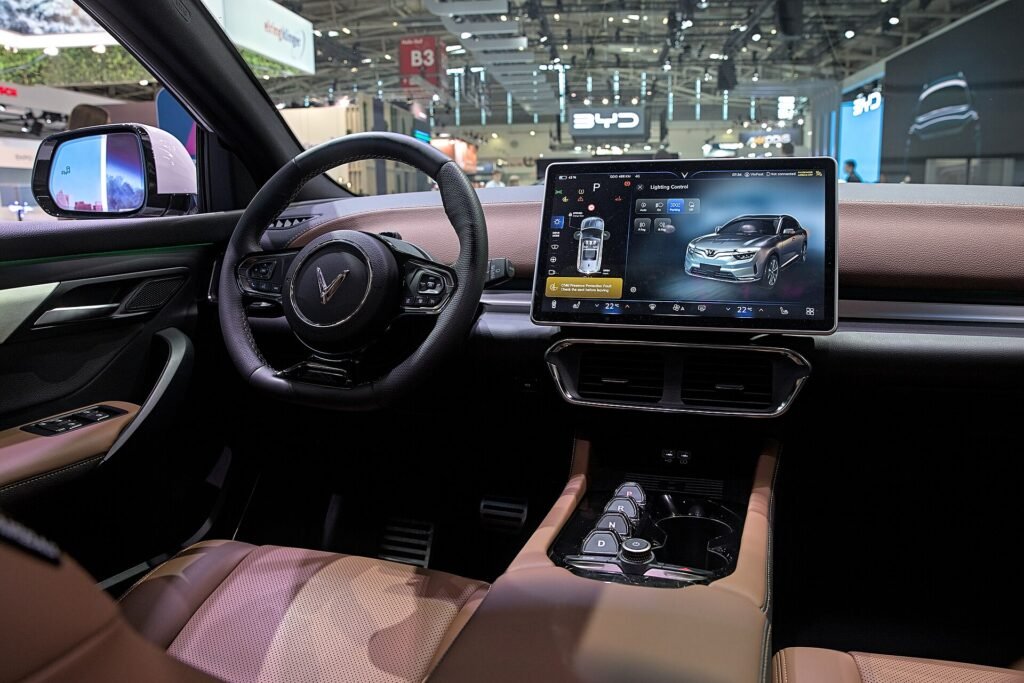
Featured image credit: Image: Alexander-93 via Wikimedia Commons (CC BY-SA 4.0). Source
Less than a year after entering India in September 2025, VinFast has overtaken BYD in monthly electric passenger vehicle sales — over 850 units against BYD’s 550-plus in early 2026 — a reversal that would have seemed unlikely given BYD’s global scale and years-longer India presence. Backing that early sales lead is a Rs 7,000 crore (USD 840 million) expansion of VinFast’s Thoothukudi, Tamil Nadu facility, aimed at turning the plant into a multi-segment hub building cars, scooters, and buses under one roof. By Piyush P. Yadav.
How VinFast Got Here So Fast
VinFast entered the Indian market in September 2025 and moved quickly to establish local relevance: aggressive pricing relative to BYD’s premium positioning, a rapidly expanding model lineup, and — critically — a clear commitment to local manufacturing rather than relying purely on imports. That combination let VinFast compete on price in a market where BYD has largely stayed in the premium sedan and SUV segments with the Seal and Atto lineup, priced well above what most Indian EV buyers are shopping for.
The Product Lineup Expanding Through 2026
- VF3 micro EV — expected in 2026, positioned as a direct rival to the MG Comet, with an estimated price range of Rs 8-10 lakh, aimed squarely at India’s most price-sensitive EV buyers.
- Limo Green — an electric MPV that, until its India launch, was sold only in Vietnam, making India the model’s first international market. This is a notable vote of confidence in India as more than just a secondary market for VinFast.
- Battery localisation plans — VinFast has stated it is working to localise battery production in India, alongside three new EV models due in 2026, a move that would further reduce costs and insulate the company from import duties and currency fluctuation.
The Thoothukudi Expansion
VinFast’s proposed Rs 7,000 crore (USD 840 million) expansion of its Thoothukudi facility in Tamil Nadu, which made headlines in June 2026, is designed to transform the plant into a multi-segment manufacturing hub — producing electric cars, electric scooters, and electric buses from a single integrated site. This phase adds dedicated production lines for e-scooters and e-buses, both targeted for launch by the end of 2026, expanding VinFast’s ambitions well beyond passenger cars into segments currently dominated by entirely different sets of competitors (Ather, Bajaj, and TVS in scooters; Tata and PMI Electro in buses).
VinFast vs BYD: Early 2026 Snapshot
| Metric | VinFast | BYD |
|---|---|---|
| India market entry | September 2025 | Earlier (established presence) |
| Early 2026 monthly e-PV sales | 850+ units | 550+ units |
| Positioning | Value-to-mid pricing, expanding fast | Premium sedans/SUVs (Seal, Atto) |
| Manufacturing investment (2026) | Rs 7,000 crore Thoothukudi multi-segment expansion | Primarily import/assembly-focused in India |
| Segment ambitions | Cars + scooters + buses (single hub) | Passenger cars only |
Why This Matters Beyond the Sales Numbers
Monthly sales volumes in India’s still-nascent EV passenger vehicle market are small enough — tens of thousands of units, not lakhs — that a single quarter’s numbers can be noisy and shouldn’t be read as a permanent trend reversal. What’s more structurally significant is the manufacturing commitment: VinFast building a multi-segment hub in Tamil Nadu signals a long-term India bet rather than an opportunistic import strategy, while BYD’s approach in India has so far remained comparatively cautious on local manufacturing depth. If VinFast’s battery localisation plans and Thoothukudi expansion execute on schedule, its cost structure could pull further ahead of import-dependent rivals over 2026-27.
What BYD’s Response Might Look Like
BYD is not without options if it wants to defend its position against VinFast’s early gains. Globally, BYD is one of the largest EV manufacturers by volume, with far greater manufacturing scale, battery vertical integration, and R&D resources than VinFast currently commands. A localised manufacturing response from BYD in India, should the company choose to accelerate one, could quickly neutralise VinFast’s cost advantage — the open question is whether BYD views the Indian market as strategically important enough, relative to its other global priorities, to make that investment at the pace and scale needed to respond. BYD’s historical approach in India has leaned more cautious and premium-focused than aggressive volume expansion, which may reflect a deliberate strategic choice rather than an inability to compete on VinFast’s terms if it chose to.
The Risk Side
VinFast’s rapid multi-segment expansion is ambitious on a timeline — cars, scooters, and buses all targeted from one facility by the end of 2026 is an aggressive execution bar, and Indian manufacturing ramp-ups have frequently slipped versus announced timelines across the industry (including established players like Tata and Mahindra). Buyers and industry watchers should treat the “by end of 2026” target for scooters and buses as directional rather than guaranteed, and watch subsequent VinFast announcements for confirmation of on-schedule progress.
How VinFast’s Strategy Differs From Other Foreign Entrants
India’s EV market has seen a steady stream of foreign entrants over the past few years, but most have followed a similar playbook: launch a handful of import-heavy models at premium pricing, build brand awareness slowly, and expand local manufacturing only once sales volumes justify the investment. VinFast has largely inverted that sequence — committing to a Rs 7,000 crore multi-segment manufacturing hub relatively early in its India journey, betting that local production capability itself becomes a competitive advantage rather than a reward for already having won market share. This is a higher-risk, higher-reward approach: if VinFast’s sales growth doesn’t keep pace with its manufacturing build-out, it risks significant underutilised capacity; if it does, VinFast could end up with a durable cost advantage over rivals still importing components or fully-built units.
Tata and Mahindra, by contrast, built their EV manufacturing depth over a decade or more of prior ICE vehicle manufacturing in India, giving them an inherent local-production advantage that VinFast is trying to compress into a much shorter timeframe. Whether VinFast can execute a decade’s worth of manufacturing maturity in two to three years, without the quality or reliability issues that often accompany rapid scaling, will be the real test of whether its early sales lead over BYD translates into sustained market share.
What This Means for Indian EV Buyers
For price-sensitive buyers, VinFast’s expanding lineup — especially the upcoming sub-Rs-10-lakh VF3 — adds a new credible option beyond the established Tata/MG/Mahindra budget EV field. For buyers in the premium segment, BYD’s positioning remains largely unchallenged by VinFast today, since VinFast’s growth has come primarily from value and mid-segment models rather than direct premium competition. The more interesting long-term story for buyers, however, may be VinFast’s scooter push — if the Thoothukudi hub delivers electric scooters by end of 2026, VinFast would become the first major four-wheeler EV brand in India to also compete directly in the two-wheeler space from day one — putting it in direct contention with established players like Ather, Bajaj, and TVS in a segment that currently has nothing to do with VinFast’s existing car-buyer audience, and that will test the company’s ability to build brand credibility in a completely different competitive set.
Related Reading
- Mahindra Overtakes MG for #2 Spot as VinFast Leapfrogs BYD in India’s EV Brand Race (H1 2026)
- Bajaj Overtakes Ola Electric as Ather, Hero, VinFast Prep New Scooters for August 2026
- India Electric Car Sales August 2026: Tata Hits Record 44% Share, MG Hector Tomahawk EV Arrives
- Complete EV Buying Guide India 2026: Best Electric Car for Every Budget
Frequently Asked Questions
Has VinFast really overtaken BYD in India EV sales?
In early 2026, VinFast recorded over 850 units in electric passenger vehicle sales against BYD’s 550-plus units in the same period, marking the first time VinFast outsold BYD in India since entering the market in September 2025.
What is VinFast’s Thoothukudi expansion?
VinFast proposed a Rs 7,000 crore (USD 840 million) expansion of its Thoothukudi, Tamil Nadu facility in June 2026, aiming to turn it into a multi-segment hub producing electric cars, scooters, and buses.
When will the VinFast VF3 launch in India?
The VinFast VF3 micro EV is expected in 2026, estimated to be priced between Rs 8-10 lakh, positioned as a rival to the MG Comet.
Is VinFast planning to sell electric scooters in India?
Yes, VinFast’s Thoothukudi facility expansion includes dedicated electric scooter and electric bus production lines, both targeted for launch by the end of 2026, though this timeline has not been independently confirmed as on-track.
Is VinFast localising battery production in India?
VinFast has stated it is working to localise battery production in India alongside three new EV models due in 2026, though a confirmed timeline for battery localisation specifically has not been published.