

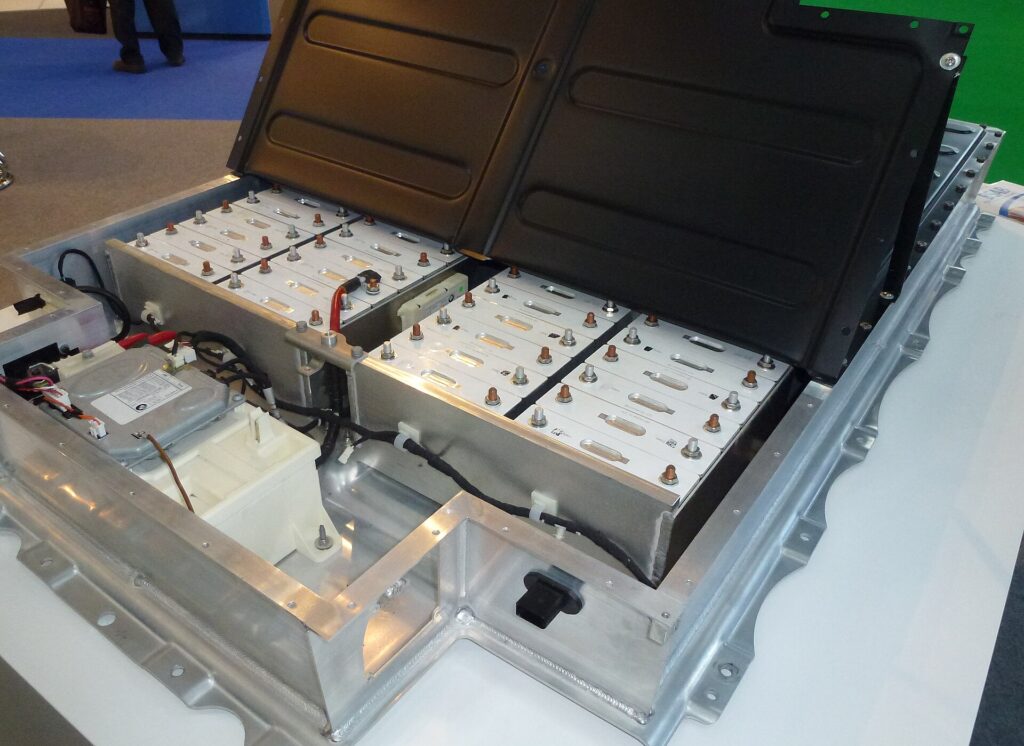
Featured image credit: Image: RudolfSimon via Wikimedia Commons (CC BY-SA 3.0). Source
By Piyush P. Yadav
Every electric scooter, three-wheeler and car sold in India since 2023 has had to pass a set of battery tests that did not exist before the spring of 2022, when a run of e-scooter fires in Pune, Vellore, Chennai and Trichy pushed the Ministry of Road Transport and Highways to rewrite the rulebook in months rather than years. The result was Amendment 2 to two Automotive Industry Standards: AIS-156 for two- and three-wheelers, and AIS-038 Revision 2 for cars, vans and trucks. They are the reason your scooter’s battery now has a serial number the government can trace, why the pack must survive one cell catching fire without the neighbours joining in, and why the vehicle must warn you, out loud, before a thermal event gets serious. This explainer sets out what the two standards require, how they were phased in, what the August 2024 fourth revision added for cars, what the 2026 cybersecurity and battery-identity rules layer on top, and, most usefully, what a buyer can actually check.
Why the standards were rewritten in 2022
Until 2022, Indian EV batteries were certified under AIS-048, a standard that tested cells and modules for vibration, shock, penetration and short circuit, largely in isolation from the vehicle. It did not require the pack to be tested as a system, did not address what happens when one cell fails inside a sealed pack, and said nothing about the battery management system that decides how the pack is charged. When the 2022 fires were investigated, the recurring findings were cells of inconsistent quality packed too tightly, management systems that could not detect a failing cell and no mechanism to stop a single-cell failure from propagating through the pack.
The Ministry’s response, published through ARAI in August and September 2022, was to replace the component view with a system view. In the government’s own words, the amendments added “additional safety requirements related to battery cells, on-board charger, design of battery pack, thermal propagation due to internal cell short circuit leading to fire”. Implementation was split into two phases so manufacturers could re-engineer packs already in production: Phase 1 from 1 December 2022 and Phase 2 from 31 March 2023.
AIS-156 and AIS-038 Rev 2: who they cover
| Standard | Vehicle categories | What it governs | Mandatory since |
|---|---|---|---|
| AIS-156 (Amendment 2 and later) | L category: two-wheelers, three-wheelers, quadricycles | Electric powertrain and traction battery safety for scooters, motorcycles, e-rickshaws, L5 autos | Phase 1: 1 Dec 2022; Phase 2: 31 Mar 2023 |
| AIS-038 Rev 2 (Amendment 2; fourth revision Aug 2024) | M category (passenger cars, buses) and N category (goods vehicles) | Electric powertrain and traction battery safety for cars, vans, trucks and buses | Phase 1: 1 Dec 2022; Phase 2: 31 Mar 2023 |
| AIS-048 (replaced) | All EVs before 2022 | Cell and module mechanical tests only | Superseded |
Both standards derive from UN Global Technical Regulation 20 and UNECE Regulation 136, which is why the tests will look familiar to anyone who has read European type-approval documents. The Indian amendments went further than the UN text in several places, particularly on traceability, cell spacing and audible warnings, because the failure modes seen in 2022 were specific to the low-cost packs then being sold.
What Phase 1 required from December 2022
- Battery pack traceability. Each pack must carry a unique identifier, and the manufacturer must be able to trace the cells inside it. This is the foundation on which the 2026 Battery Pack Aadhaar identity scheme, which we explained in our guide to India’s 21-character battery ID, is now being built.
- An additional safety fuse in the pack, separate from the main contactor, so that a short circuit can be isolated even if the primary protection fails.
- Protection against regenerative braking overcharge. Regen can push current into a full or cold pack faster than it can safely accept it; the management system must now limit or refuse it.
- Cell-to-cell spacing. The standard specifies minimum separation between cells so that a single hot cell does not immediately heat its neighbours. This directly targeted the tightly packed low-cost packs implicated in 2022.
- A microprocessor-based battery management system with over-voltage, under-voltage, over-current, over-temperature and short-circuit protection at cell level. A simple analogue protection board no longer qualifies.
What Phase 2 added from March 2023
- Thermal propagation test. The defining test of the new regime. One cell inside the pack is deliberately driven into thermal runaway, by heating or by nail penetration, and the pack must not catch fire or explode within a defined period. The intent is that a single-cell failure gives occupants time to get clear.
- Audio-visual warning. The vehicle must warn the rider or driver, both visibly and audibly, when the management system detects a thermal event. Cars typically show a red battery warning and sound a chime; scooters use the instrument cluster and a buzzer.
- Four temperature sensors as a minimum inside the pack, reporting to the management system, so that a hot spot is detected rather than averaged away.
- Earth-leakage detection in the charger. The on-board or supplied charger must detect current leaking to earth and cut off.
- Electromagnetic compatibility testing of the management system under AIS-004, so that electrical noise cannot cause a false reading or a missed fault.
- Active parallel circuits. Packs built from parallel cell strings must manage current sharing actively, so that one weak string does not carry a disproportionate load. The August 2024 fourth revision of AIS-038 Rev 2 updated this requirement for cars.
- IPX7 water ingress protection for the pack, meaning it must survive immersion to one metre for 30 minutes. This is the reason waterlogged roads no longer produce the pack failures they did in early e-scooters.
How the tests are actually run
Certification is done at government-notified test agencies, principally ARAI in Pune and ICAT in Manesar, on production-representative packs. The mechanical tests carried over from AIS-048, vibration, mechanical shock, drop, crush and penetration, are still performed, but now at pack level and in some cases with the pack installed in the vehicle. The thermal tests are the ones that changed the industry: the thermal propagation test is destructive, expensive and cannot be passed by a pack that was designed before the rule existed, which is why several small e-scooter brands quietly left the market in 2023 rather than re-engineer.
| Test | What is done | Pass condition |
|---|---|---|
| Thermal propagation | One cell forced into runaway inside the sealed pack | No fire or explosion outside the pack within the specified time; warning issued |
| Thermal shock and cycling | Pack cycled between hot and cold extremes | No leak, rupture, fire or loss of isolation |
| Overcharge and over-discharge | Charger or load driven past limits | Management system cuts off; no fire |
| External short circuit | Terminals shorted | Fuse or contactor opens; no fire |
| Water immersion (IPX7) | Pack submerged 1 m for 30 minutes | No ingress affecting safety; isolation maintained |
| Vibration and shock | Profiles representing Indian road use | No damage, leak or loss of function |
| Fire resistance | Pack exposed to external flame | No explosion; no propagation into the cabin |
What the standards do not do
AIS-156 and AIS-038 Rev 2 are safety standards, not performance or durability standards. They do not specify how long a pack must last, how much capacity it must retain or what warranty a manufacturer must offer; those are commercial terms, and our comparison of electric scooter battery warranties shows how widely they vary. Nor do they dictate chemistry. An LFP pack and an NMC pack must both pass the same thermal propagation test, although, as we set out in our guide to LFP and NMC chemistry in Indian EVs, LFP’s higher thermal-runaway threshold makes the test easier to pass and is one reason most Indian mass-market packs have moved to it.
The standards also apply at type approval. A model certified in 2023 is not re-tested unless the pack design changes materially, and enforcement against non-compliant packs already on the road, particularly in the e-rickshaw and retrofit markets, depends on state transport departments rather than on the test agencies.
What has been layered on since: 2024 to 2026
The 2022 amendments were the start of a regulatory build-out that is still under way. The items below are the ones an EV buyer or fleet operator will encounter in 2026.
| Rule | What it does | Status |
|---|---|---|
| AIS-038 Rev 2, fourth revision | Updated active-parallel-circuit requirements for car and commercial packs | Issued August 2024 |
| AIS-189 (cybersecurity management, per UNECE R155) | Manufacturers must have a certified cybersecurity system covering the vehicle’s life, including the management system and charging interface | New vehicle types from 1 October 2025; all types from 1 October 2028 |
| AIS-190 (software update management, per UNECE R156) | Secure over-the-air update process with version traceability for up to 10 years; relevant because management-system firmware is now updated remotely | Alongside AIS-189 |
| Battery Pack Aadhaar identity | A 21-character national ID for every pack, building on the AIS traceability rule | Being rolled out in 2026 |
| AVAS (AIS-173) | Mandatory pedestrian warning sound for new EV models; not a battery rule but the next EV compliance date | From 1 October 2026, as we explained in our AVAS explainer |
| BIS battery-swapping standards | Form factor, connector and management-system communication for swappable packs | In development |
| IS 17017 and AIS-138 | Charger and on-vehicle charging-interface standards; BIS certification required for subsidy-eligible chargers | In force |
What a buyer can actually check
- Ask for the type-approval certificate. Every mainstream manufacturer holds an ARAI or ICAT certificate referencing AIS-156 or AIS-038 Rev 2 with Amendment 2 or later. A dealer who cannot produce it, or a brand that does not appear on the test agency’s public list, is a warning sign. This matters most for e-rickshaws, low-speed scooters and imported kits.
- Look for the pack identifier. The traceability rule means the pack label carries a unique serial; it should match the vehicle’s documents. This is what any future recall will be run against.
- Check the warning on the display. Switch on the vehicle and look for a battery temperature or fault indicator in the cluster; the standard requires one. Ask the salesperson to explain what the audible warning sounds like.
- Look at the charger. A compliant portable charger carries a BIS mark and an earth-leakage cut-off; a bare two-pin adaptor does not.
- Retrofits and replacement packs. A replacement pack fitted outside the manufacturer’s network is not covered by the vehicle’s type approval. Insurers have begun declining fire claims on vehicles with non-original packs.
Sources & Further Reading
- Press Information Bureau: Amendments to EV battery testing standards AIS-156 and AIS-038 (Rev 2) to be implemented in two phases
- EVreporter: Guide to battery safety standards in India, compiled by ARAI
- Mercom India: Electric vehicle battery standards amended for enhanced safety
- Electray Tech: Indian EV regulatory standards 2026, what every OEM must know
FAQ
What is AIS-156?
AIS-156 is the Automotive Industry Standard governing the safety of electric powertrains and traction batteries in L-category vehicles: two-wheelers, three-wheelers and quadricycles. Amendment 2, mandatory from December 2022 and March 2023, added thermal propagation testing, a microprocessor-based battery management system, cell-to-cell spacing, traceability, IPX7 water protection and an audio-visual warning.
What is the difference between AIS-156 and AIS-038 Rev 2?
They contain broadly the same battery safety requirements but apply to different vehicles. AIS-156 covers two- and three-wheelers; AIS-038 Rev 2 covers M-category passenger vehicles including cars and buses, and N-category goods vehicles. AIS-038 Rev 2 received a fourth revision in August 2024 updating the active parallel circuit rules.
What is the thermal propagation test?
One cell inside the sealed pack is deliberately forced into thermal runaway, and the pack must not catch fire or explode outside its casing within the specified period, while the vehicle issues a warning. It is the test that most directly addresses the 2022 scooter fires.
Are all electric vehicles on Indian roads compliant?
All models type-approved since March 2023 must be. Vehicles approved earlier, retrofitted packs and some unregistered low-speed vehicles may not be, which is why buyers should ask for the type-approval certificate and avoid non-original replacement packs.
How can I check that the scooter I am buying has an AIS-156 compliant battery?
Ask the dealer for the CMVR type-approval certificate for that exact variant, issued by ARAI or ICAT. AIS-156 compliance is a precondition for that approval, so the certificate is the real proof rather than a sticker on the pack. On the battery itself, look for the AIS-156 reference and the ingress-protection marking the standard requires, and confirm the pack uses the manufacturer original BMS. A dealer who cannot produce the type-approval paperwork is selling you a vehicle you may struggle to register or insure.
Can I fit a cheaper local replacement battery pack when the original one dies?
You should not. The traction pack in a registered L-category vehicle is part of what was type-approved, so an uncertified local pack puts the whole vehicle outside its approval, and insurers routinely reject fire or damage claims traced to a non-original battery. It also ends the manufacturer warranty on the rest of the drivetrain in most cases. If cost is the problem, ask the maker about an officially refurbished or remanufactured pack rather than a grey-market one.
Does AIS-156 require a particular cell chemistry, such as LFP?
No. The standard is performance-based and chemistry-neutral: a pack either passes the thermal propagation, vibration, shock, immersion and overcharge tests or it does not, whatever the cells inside are. In practice LFP has a higher thermal-runaway threshold, which makes the propagation test easier to clear and is one reason several Indian makers moved to LFP after the 2022 fires, but an NMC pack that passes the same tests is equally compliant.