

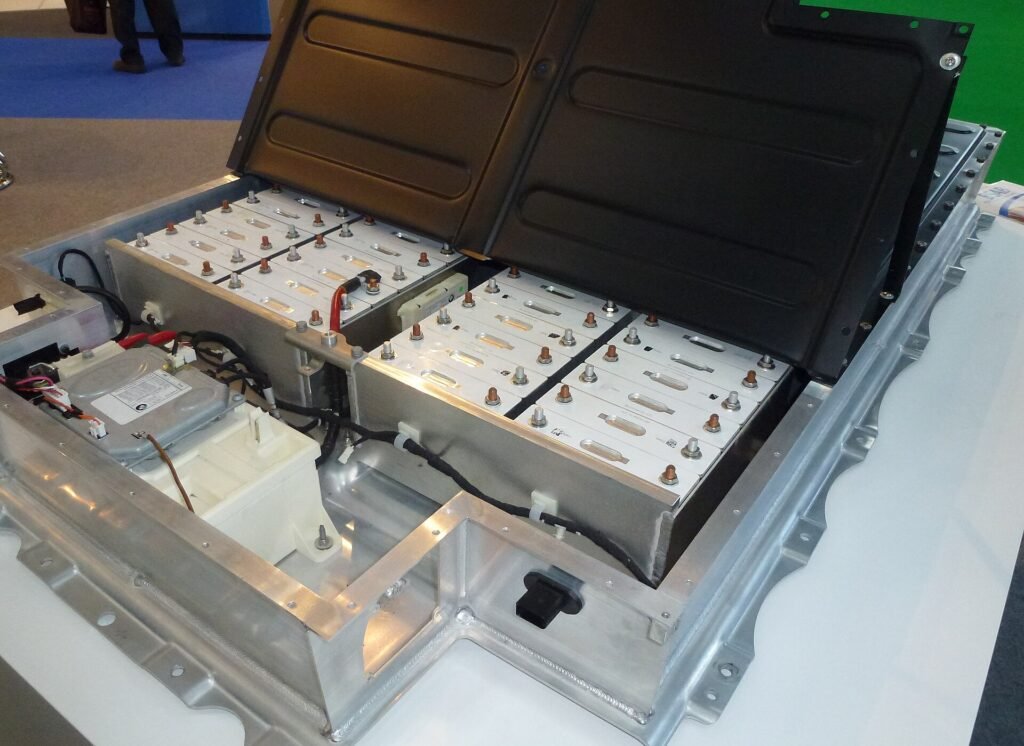
Featured image credit: Image: RudolfSimon via Wikimedia Commons (CC BY-SA 3.0). Source
By Piyush P. Yadav
Every EV battery pack sold in India is about to get an identity card. The Ministry of Road Transport and Highways has drafted a framework called the Battery Pack Aadhaar, under which each pack placed on the Indian market must carry a unique 21-character alphanumeric code, physically marked on the casing and duplicated as a QR code, with its data uploaded to a government-run portal for the entire life of the battery. The system is being routed through the Automotive Industry Standards process, and EV batteries are first in line. This explainer sets out what the Battery Pack Aadhaar Number, or BPAN, actually is, what data it carries, who has to comply, why the government wants it, and what it changes for anyone who buys, sells or scraps an electric vehicle.
What the Battery Pack Aadhaar is
The draft guidelines, released by MoRTH in early January 2026, describe an indigenous digital identification and data storage system for battery packs. The core of it is the BPAN: a 21-character unique number assigned by the battery producer or importer to every pack introduced in the market, including packs a company builds for its own use. The BPAN must be:
- Permanently affixed to the battery pack in a clearly visible and accessible location, positioned so it cannot be destroyed or damaged during the pack’s life.
- Printed in both plain alphanumeric form and as a QR code.
- Designed so that basic identifying details can be decoded from the number itself without an internet connection.
- Registered on an official BPAN portal, where the producer must upload both static information and ongoing Battery Dynamic Data.
The analogy to Aadhaar is deliberate. Just as the citizen ID links a person to a record that can be verified anywhere, the BPAN links a physical pack to a lifecycle record that follows it from the cell plant through the vehicle, into second-life use and finally to a recycler.
What data travels with the pack
| Category | Examples of fields | When it is recorded |
|---|---|---|
| Static data | Manufacturer or importer identity, chemistry, rated capacity, material composition, carbon footprint of production, date of manufacture | At registration, before the pack enters the market |
| Battery Dynamic Data (BDD) | State of health, cycle count, operational performance, ownership or vehicle changes, repurposing status | Updated through the pack’s life |
| End-of-life data | Collection, refurbishment, recycling or disposal record | At end of first and second life |
Two things about this list are significant. The first is carbon footprint: recording the emissions of production creates the raw material for a future “battery passport” of the kind the European Union is phasing in, which Indian exporters of cells and packs will eventually need to satisfy anyway. The second is dynamic state-of-health data, which is exactly what a used-EV buyer cannot get today from most brands, and what we identified as the central information gap in our guide to why used electric cars depreciate faster than petrol cars.
Which batteries are covered, and in what order
The draft sets out a phased scope that starts with the segment that accounts for 80 to 90 per cent of India’s lithium-ion demand: electric vehicles.
| Battery type | Covered? | Notes |
|---|---|---|
| EV traction batteries, L category (two- and three-wheelers) | Yes, first phase | Largest share of packs by volume |
| EV traction batteries, M and N category (cars, buses, trucks) | Yes, first phase | Largest share by kWh |
| Industrial and stationary batteries above 2 kWh | Recommended for inclusion | Covers grid storage and telecom packs |
| Starting, lighting and ignition (SLI) batteries | Excluded | Conventional 12 V lead-acid car batteries |
| Portable consumer batteries | Excluded | Phones, laptops, power banks |
Compliance falls on producers and importers. That includes vehicle makers that assemble their own packs, cell manufacturers selling packs, and importers bringing in finished packs from China or elsewhere. The framework is to be institutionalised through an Automotive Industry Standard under the Automotive Industry Standards Committee, which means it will eventually sit alongside the AIS-156 safety standard that already governs EV battery design and testing.
Why the government wants this
1. Recycling and Extended Producer Responsibility
India’s Battery Waste Management Rules already require producers to collect and recycle a rising share of the batteries they place on the market. The problem has been proof: without a unique identifier there is no reliable way to show that a specific pack was collected and processed rather than dumped or informally dismantled. A BPAN that is scanned at each hand-off closes that loop and makes EPR compliance auditable.
2. Verifying “made in India” cells
The government is spending heavily on domestic cell manufacturing through the Production Linked Incentive scheme for Advanced Chemistry Cells, and the localisation requirements under PM E-DRIVE now extend to traction motors and, progressively, to cells. As our lithium cell manufacturing scorecard showed, only a handful of Indian-made cells are in production vehicles so far. A pack-level ID that records the origin of cells gives the ministries a verification tool for subsidy and PLI claims.
3. Safety recalls
Fires in electric two-wheelers in 2022 led to recalls of tens of thousands of scooters, and the recall process depended on manufacturers’ own records of which battery batch went into which vehicle. A national registry would let a defective cell lot be traced to every pack and vehicle it entered.
4. Second-life and financing
Battery-as-a-Service schemes, which now underpin pricing for the Mahindra BE 6 and XEV 9S as well as Tata and Maruti models, rest on lenders owning a battery they cannot easily identify or value once it leaves the vehicle. A verified state-of-health record attached to a unique ID makes the pack a financeable asset and makes second-life use in stationary storage far easier to underwrite.
What it changes for EV owners
- Buying used: in time, scanning the QR code on a pack should return its registered capacity and health history, which would do more for used-EV confidence than any brand warranty. Until portal access rules are finalised, it is not clear how much of the dynamic data will be visible to a private buyer.
- Replacement and repair: a replacement pack will carry its own BPAN, and the vehicle’s record will show the swap. Unofficial pack repairs that void warranties, which we covered in our battery degradation explainer, will be harder to hide.
- Scrapping: when a vehicle is scrapped, the pack’s record must be closed out by a registered recycler, which should reduce the leakage of lithium packs into the informal sector.
- Cost: the marking and data obligations fall on producers. Any cost pass-through to buyers should be marginal relative to pack prices.
Where the framework stands
As of September 2026 the Battery Pack Aadhaar remains a draft. MoRTH has recommended rolling it out through the AIS process and is awaiting a committee report on detailed implementation, including the exact encoding of the 21 characters, portal architecture and enforcement timelines. No date has been notified for mandatory compliance. Battery makers scaling up domestic capacity, including the plants we profiled in our coverage of Tata’s Agratas gigafactory at Sanand, will be among the first to design BPAN marking into their production lines once the standard is fixed.
| Milestone | Status |
|---|---|
| Draft guidelines released by MoRTH | Done, January 2026 |
| Routing through AIS under AISC | Recommended |
| Committee report on implementation detail | Awaited |
| Final AIS notification and compliance date | Not yet announced |
| BPAN portal live | Not yet announced |
How it compares with the EU battery passport
The European Union’s Batteries Regulation requires a digital battery passport for EV and industrial batteries above 2 kWh placed on its market from February 2027, carrying much the same categories of information: manufacturer, chemistry, capacity, carbon footprint, state of health and end-of-life status, accessible through a QR code. India’s BPAN draft mirrors that structure, and the 2 kWh threshold for industrial batteries is the same number. The important difference is governance. The EU passport is a decentralised record held by the producer and made interoperable through common standards, while the Indian draft centralises registration on a government portal, which gives regulators direct visibility for EPR audits and PLI verification. For Indian cell and pack makers hoping to export to Europe, building BPAN compliance into the production line now is a low-cost way to be passport-ready when the EU deadline arrives.
Sources & Further Reading
- Office of the Principal Scientific Adviser: Draft Guidelines for Implementation of Battery Pack Aadhaar System
- Business Today: Govt proposes Aadhaar-like ID for EV batteries
- pv magazine India: India introduces Battery Aadhaar system to track EV batteries
- pv magazine India: EV battery innovation and affordability (September 2026)
Frequently Asked Questions
What is the Battery Pack Aadhaar Number?
A 21-character unique alphanumeric identifier that battery producers and importers must assign to every battery pack sold or used in India under a draft MoRTH framework. It is marked on the pack as text and a QR code and linked to a lifecycle record on a government portal.
Is the Battery Pack Aadhaar mandatory now?
Not yet. The guidelines are in draft form as of September 2026 and are to be finalised through the Automotive Industry Standards process. No compliance date has been notified.
Which batteries does the BPAN apply to?
EV traction batteries for two-, three- and four-wheelers and commercial vehicles come first, with industrial batteries above 2 kWh recommended for inclusion. Conventional 12 V starter batteries and portable consumer batteries are excluded.
Will EV owners be able to see their battery’s data?
The draft requires producers to upload static and dynamic battery data to a portal, and basic details are to be readable from the number offline. How much of the health data will be accessible to owners and used-car buyers will be defined in the final standard.