

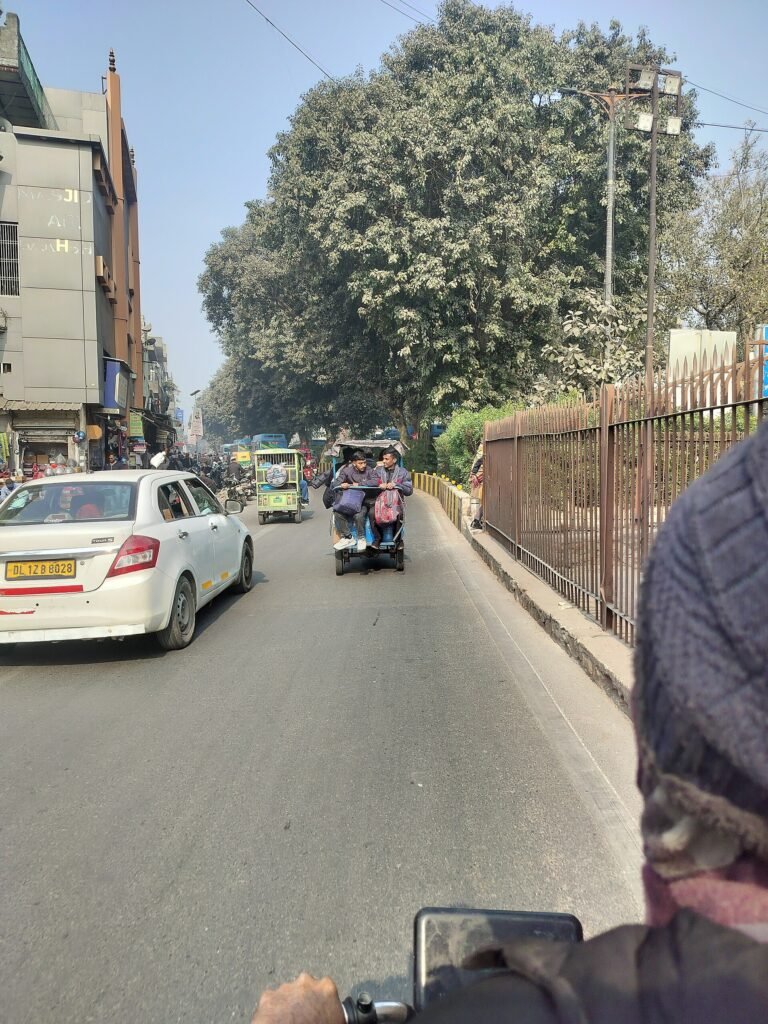
Featured image credit: Image: Nitin Maletha via Wikimedia Commons (CC BY-SA 4.0). Source
By Piyush P. Yadav
India registered 28,811 e-rickshaws and 6,029 e-carts in August 2026, according to Vahan data compiled by EVreporter. That is nearly 35,000 three-wheeled electric vehicles in a month, more than all the electric cars sold in the country in the same period, and it came from manufacturers most car buyers have never heard of: YC Electric, Hooghly Motors, Terra Motors, Zeniak Innovation, Saarthi, Lohia. The e-rickshaw is India’s largest electric vehicle fleet by number, with an estimated 1.5 million or more on the road, and it is also the least understood: built in small workshops as often as in factories, priced from Rs 95,000, run on lead-acid batteries that are replaced every year, and governed by rules that Delhi, Bihar and Maharashtra have all tightened in 2026. This explainer sets out what an e-rickshaw legally is, what it costs, how the battery choice decides the economics, who makes them, and what the new rules mean for the drivers and fleet owners who buy them.
August 2026: the three-wheeler picture
| Segment | August 2026 registrations | July 2026 | Top OEMs in August |
|---|---|---|---|
| E-rickshaw (L3 passenger) | 28,811 | 34,718 | YC Electric, Hooghly Motors, Terra Motors, Zeniak Innovation |
| E-cart (L3 goods) | 6,029 | 7,282 | Same cluster of makers |
| L5 electric auto (passenger) | 40,419 | 41,375 | Bajaj Auto, Mahindra Last Mile Mobility, TVS Motor |
| L5 electric cargo | 4,583 | 4,944 | Mahindra Last Mile Mobility, Bajaj Auto, YC Electric |
| All three-wheeler EVs | 79,842 | 88,319 | Three-wheeler EV penetration about 55 per cent in L5 passenger |
The month-on-month dip mirrors the wider market, which fell 10.3 per cent from July’s record. The more important number is structural: e-rickshaws and e-carts together were 44 per cent of all electric three-wheelers registered in August, and the segment is dominated by regional manufacturers rather than the Bajaj, Mahindra and TVS names that lead the L5 auto market we covered in our electric three-wheeler and small commercial vehicle buying guide.
What an e-rickshaw is, legally
E-rickshaws were given legal status by the Motor Vehicles (Amendment) Act of 2015, which inserted Section 2A defining an e-rickshaw as a special-purpose battery-powered vehicle with three wheels, carrying not more than four passengers plus the driver and not more than 40 kg of luggage, with net motor power not exceeding 2,000 W and a maximum speed not exceeding 25 km/h. An e-cart is the goods equivalent, with a payload cap of roughly 310 kg. Both are category L3 under Indian vehicle classification, distinct from the L5 category that covers conventional autos like the Bajaj RE and Mahindra Treo with higher speeds and power.
The 25 km/h cap is what makes the e-rickshaw cheap. Below that speed, the vehicle is exempt from most of the crash, braking and lighting standards that apply to L5 vehicles, needs only a simplified type approval, and the driver needs only a light motor vehicle licence with a relaxed test. It is also why e-rickshaws are banned from highways in several states and from many arterial roads in cities.
What they cost, and why the battery is the whole story
| Model and maker | Battery | Ex-showroom price | Claimed range | Motor |
|---|---|---|---|---|
| Saarthi (lead-acid) | 48V 100Ah lead-acid | Rs 95,000 to 1.2 lakh | 80 to 100 km | 1,000 W |
| Saarthi (lithium) | Lithium-ion | Rs 1.4 to 1.7 lakh | 100 to 120 km | 1,000 W |
| YC Electric Yatri | 48V 120Ah lithium-ion | Rs 1.3 to 1.6 lakh | 100 to 130 km | 1,200 W |
| Lohia Comfort | 48V 120Ah LFP | Rs 1.6 to 1.9 lakh | 100 to 120 km | 1,000 W BLDC |
| Mahindra Treo Yaari (L3) | Lithium-ion | Rs 2.0 to 2.5 lakh | 100 to 120 km | Under 2 kW |
| Bajaj RE EV (L5, for comparison) | Lithium-ion | Rs 2.9 to 3.5 lakh | 150 to 170 km | Higher; 45 km/h class |
The Rs 40,000 to 60,000 gap between a lead-acid and a lithium e-rickshaw looks large against a Rs 1 lakh vehicle, and it is the reason lead-acid still sells. But the operating arithmetic runs the other way.
| Cost item over 5 years | Lead-acid | Lithium (LFP) |
|---|---|---|
| Purchase price | Rs 1.10 lakh | Rs 1.60 lakh |
| Battery replacements | Rs 15,000 to 25,000 every 12 to 18 months; 3 to 4 sets, Rs 60,000 to 90,000 | None expected; rated 1,500 to 2,000 cycles, 4 to 6 years |
| Charging time | 8 to 10 hours | 3 to 5 hours; some models support faster charging |
| Usable range per charge | Falls steadily as the battery ages; often under 60 km by month 10 | Holds close to rated range for most of its life |
| Weight of battery | Around 120 kg for four units | Around 35 to 45 kg |
| Approximate 5-year total | Rs 1.7 to 2.0 lakh | Rs 1.6 to 1.7 lakh, plus one replacement if the pack fails early |
The lithium e-rickshaw is cheaper to own within 18 to 36 months, which is why organised financiers now prefer to lend on it: the asset holds value and the driver’s cash flow is not hit by a Rs 20,000 battery bill in month 14. The reason lead-acid persists is that most e-rickshaw buyers are financing Rs 1 lakh at informal rates of 2 to 3 per cent a month, and the lower upfront figure is what they can get approved for. The battery chemistry trade-offs are the same ones we set out for cars and scooters in our LFP versus NMC explainer, with LFP dominant in e-rickshaws for cost and heat tolerance.
The subsidy: Rs 2,500 per kWh, capped at Rs 12,500
PM E-DRIVE, the central incentive scheme that runs to March 2028 after its extension earlier this year, covers L3 e-rickshaws and e-carts at Rs 2,500 per kWh of battery capacity, capped at Rs 12,500 per vehicle in the current year, with an ex-factory price ceiling of Rs 2.5 lakh. The first-year rate was double that. The incentive is paid to the manufacturer and shown as a discount on the invoice, and only vehicles from makers registered under the scheme with lithium batteries meeting AIS-156 qualify. Lead-acid e-rickshaws get nothing. We covered the scheme’s extension and structure in our report on PM E-DRIVE’s extension to March 2028. Several states add their own incentives; Delhi’s 2026 policy retains a purchase subsidy for e-rickshaws bought by owner-drivers.
Who makes them
The e-rickshaw industry is fragmented in a way no other vehicle segment is. Vahan lists hundreds of registered manufacturers, many assembling fewer than 100 vehicles a month from imported motors, controllers and chassis kits. A handful have scaled:
- YC Electric (Delhi-NCR) is consistently the largest by registrations, with the Yatri passenger and cargo lines.
- Hooghly Motors (West Bengal) dominates the eastern market with the Diamond series.
- Terra Motors, a Japanese-owned company with Indian manufacturing, is one of the few organised-sector players with a dealer network across northern states.
- Zeniak Innovation, Saarthi and Lohia Auto round out the top tier.
- Mahindra, Bajaj and Piaggio sell L3 variants (the Treo Yaari, for instance) but focus on the higher-value L5 market.
The fragmentation has consequences. Quality varies widely, spare parts are often generic, and the Battery Waste Management Rules that now impose collection targets on producers, which we explained in our battery recycling rules explainer, are hardest to enforce in exactly this segment, where lead-acid batteries are already handled by an informal recycling trade.
The rules are tightening in 2026
Three state actions this year change the operating environment.
Delhi: registrations resumed with conditions
Delhi paused new e-rickshaw registrations from November 2025 to May 2026 while it rewrote the rules. Registrations resumed on 15 May 2026 with three new conditions: a mandatory ten-day training programme for drivers before certification, an annual fitness certificate for every vehicle, and a limit of one e-rickshaw per licence holder. The last condition is aimed at fleet operators who buy dozens of vehicles and rent them to drivers by the day, a model the government blames for overcrowding and unsafe vehicles. Existing multi-vehicle owners were not required to divest, but they cannot add.
Bihar: banned from highways
Bihar’s transport department has prohibited e-rickshaws, along with improvised “jugaad” vehicles, from all national and state highways in the state, citing collision data. Enforcement is by police checkpoints at highway entry points. The ban does not affect town and village roads, where most e-rickshaws operate, but it cuts off the inter-village routes that were a significant income source in districts like Patna, Gaya and Muzaffarpur.
Maharashtra: permits now compulsory
Maharashtra has decided to make permits mandatory for passenger-carrying e-rickshaws and e-bikes, bringing them under the same regime as autos. Until now e-rickshaws in the state operated on registration alone. The permit requirement gives regional transport offices control over numbers by route and will raise the cost of entry for new drivers.
What the changes mean for buyers
- Owner-drivers are favoured. Delhi’s one-per-licence rule and Maharashtra’s permit regime both push the market toward individual ownership and away from rental fleets.
- Lithium is increasingly required in practice. Subsidies, fitness certification and financier preference all point the same way. A lead-acid e-rickshaw bought in 2026 may be hard to certify or resell by 2028.
- Route matters. Check whether your intended route touches a highway or a restricted arterial before buying. In Bihar and several cities the answer now decides whether the vehicle is usable.
- Buy from a manufacturer that will exist in three years. The organised makers cost more but have parts, warranty and, increasingly, financing tie-ups. The fragmented end of the market is where most unfit-vehicle complaints originate.
The e-rickshaw is the reason India’s three-wheeler market is more than half electric, ahead of every other vehicle category, and it got there with almost no policy help and no large manufacturers. The 2026 rule changes are the first real attempt to organise it. Whether they raise the quality of the fleet without cutting off the drivers who depend on it will be visible in the registration numbers over the next year.
Sources & Further Reading
- EVreporter: India’s electric vehicle sales trend, August 2026
- Drivio Trucks: Best e-rickshaw models in India 2026, prices and buying guide
- Local Samosa: Inside Delhi’s e-rickshaw reset, new registration rules
- Patna Press: E-rickshaws banned on national and state highways in Bihar
- GEV World: PM E-DRIVE 2026 subsidy for e-rickshaws and loaders explained
Frequently Asked Questions
How many e-rickshaws were sold in India in August 2026?
Vahan registration data compiled by EVreporter show 28,811 e-rickshaws and 6,029 e-carts registered in August 2026, down from 34,718 and 7,282 in July. The leading manufacturers were YC Electric, Hooghly Motors, Terra Motors and Zeniak Innovation.
What is the difference between an e-rickshaw and an electric auto?
An e-rickshaw is a category L3 vehicle limited by law to 25 km/h, 2,000 W of motor power, four passengers and 40 kg of luggage, and is exempt from many of the safety standards that apply to full autos. An electric auto such as the Bajaj RE EV or Mahindra Treo is a category L5 vehicle with higher speed and power, full type approval and a higher price, typically Rs 2.9 lakh and above.
Is a lithium e-rickshaw worth the extra cost over lead-acid?
For a full-time driver, yes. A lead-acid battery set costs Rs 15,000 to 25,000 and lasts 12 to 18 months, so a five-year owner replaces it three or four times. A lithium pack is rated for four to six years. The lithium vehicle costs Rs 40,000 to 60,000 more upfront but is cheaper to own within 18 to 36 months, and it is the only type eligible for the PM E-DRIVE subsidy.
What subsidy does an e-rickshaw get under PM E-DRIVE?
Rs 2,500 per kWh of battery capacity, capped at Rs 12,500 per vehicle, on lithium-battery L3 e-rickshaws and e-carts with an ex-factory price below Rs 2.5 lakh, from manufacturers registered under the scheme. The incentive is shown as a discount on the invoice. Lead-acid vehicles do not qualify. The scheme runs to March 2028.