

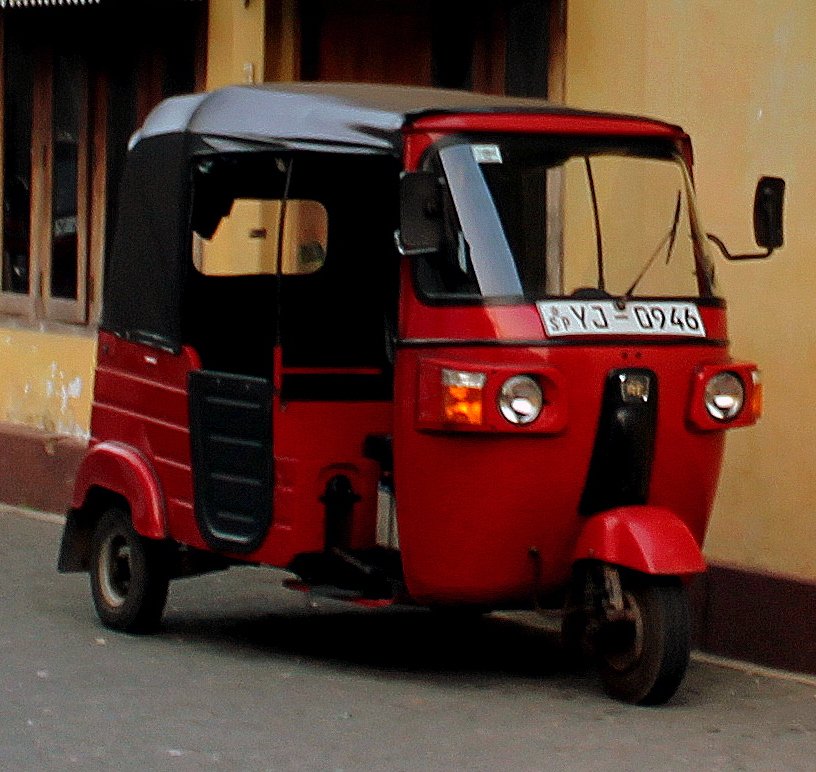
Featured image credit: Image: calflier001, cropped by uploader Mr.choppers via Wikimedia Commons (CC BY-SA 2.0). Source
By Piyush P. Yadav
More than half of every L5 passenger auto-rickshaw registered in India in August 2026 was electric. The Vahan data compiled by EVreporter puts electric penetration in the segment at 55.5 per cent, up from 51.6 per cent in July, on 40,419 electric L5 passenger registrations. In the L5 cargo segment, the small three-wheeled pickups that carry most of India’s last-mile freight, penetration reached 31.4 per cent on 4,583 units. Across all three-wheeler categories, including the lead-acid e-rickshaws we covered separately, electric three-wheelers took 65.3 per cent of the market, against 56.6 per cent a year earlier. No other vehicle category in India is anywhere close: electric two-wheelers were at 10.7 per cent in August and electric cars at 7.6 per cent. This report sets out the August numbers segment by segment, the manufacturer race in which Bajaj Auto has overtaken Mahindra in total electric three-wheelers while Mahindra remains almost fully electric, why the cargo segment lags the passenger segment by 24 points, and what the month says about the commercial EV business heading into the festive quarter.
August 2026 by segment
August was a softer month than July across every EV category, which EVreporter’s data attributes to the monsoon and the pre-festive lull rather than to anything structural; total EV registrations fell 10.3 per cent month on month to 2,98,048 from July’s record 3,32,274. Three-wheelers followed the pattern.
| Segment | August 2026 registrations | July 2026 | Change | EV penetration, August |
|---|---|---|---|---|
| E-3W L5 passenger (autos) | 40,419 | 41,375 | -2.3 per cent | 55.5 per cent (51.6 per cent in July) |
| E-3W L5 cargo | 4,583 | 4,944 | -7.3 per cent | 31.4 per cent (30.8 per cent in July) |
| E-rickshaw (L3 passenger) | 28,811 | 34,718 | -16.9 per cent | Effectively 100 per cent |
| E-cart (L3 cargo) | 6,029 | 7,282 | -17.2 per cent | Effectively 100 per cent |
| All electric three-wheelers | 79,842 | 88,319 | -9.6 per cent | 65.3 per cent (65.1 per cent in July; 56.6 per cent in August 2025) |
| For comparison: e-goods carriers (four-wheel LCV and above) | 3,773 | 3,057 | +23.4 per cent | Tata Motors 37 per cent share |
| For comparison: e-buses | 908 | 575 | +57.7 per cent | Olectra, JBM, Pinnacle lead |
The striking number is the L5 passenger penetration, which rose four points in a month even as absolute volumes dipped. That happened because petrol and CNG auto registrations fell faster than electric ones: the total L5 passenger market shrank in August while the electric share of it grew. The e-rickshaw and e-cart declines are larger and seasonal; we explained the structure of that market, its lead-acid economics and the tightening state rules in our report on India’s e-rickshaw economy.
The manufacturer race: Bajaj ahead on volume, Mahindra on commitment
Two companies dominate the L5 electric market and they have taken opposite routes to it. Mahindra Last Mile Mobility, the Treo and Zor maker, went almost entirely electric years ago and sells very few petrol or CNG three-wheelers. Bajaj Auto, the country’s largest three-wheeler maker by far, added the electric RE and Maxima to a huge CNG business and is now converting that customer base. In August the second strategy produced more electric units.
| Manufacturer | L5 passenger total, August | Electric share of own L5 passenger sales | Electric share of own L5 cargo sales | All electric 3W, August (retail) |
|---|---|---|---|---|
| Bajaj Auto | 36,860 | 35.3 per cent (about 13,020 electric) | 8.2 per cent of 5,355 (about 440 electric) | 13,833 |
| Mahindra Last Mile Mobility | Not published separately | 98.1 per cent | 63.8 per cent | 12,819 (Mahindra group) |
| TVS Motor | Not published separately | 65.2 per cent | 27.4 per cent | Third in passenger |
| Piaggio Vehicles | Not published separately | 24.5 per cent | 3.6 per cent | Predominantly CNG and diesel |
| Atul Auto | Not published separately | 19.6 per cent | 5.3 per cent | Predominantly CNG and diesel |
| Saera Electric | 936 (all electric) | 100 per cent | – | 936 |
| Mini Metro | 906 (all electric) | 100 per cent | – | 906 |
| YC Electric | 782 passenger; 412 cargo (all electric) | 100 per cent | 100 per cent | Third in cargo |
| Omega Seiki, Dilli Electric | Cargo: 393 and 347 (all electric) | – | 100 per cent | Cargo specialists |
Bajaj Auto sold 36,860 L5 passenger autos in August across all fuels, of which about 13,020 were electric. That single-fuel share of 35.3 per cent is low next to Mahindra’s 98.1 per cent, but the base is so large that it still yields the biggest electric volume in the segment. Across all electric three-wheelers, retail intelligence data puts Bajaj at 13,833 against 12,819 for the Mahindra group in August, a lead of about a thousand units in a race that Autocar Professional has tracked as a near tie for most of 2026. Mahindra’s own release shows its three-wheeler business, electric and otherwise, up 42 per cent year on year to 14,922 units.
The two companies are also selling into different places. Mahindra’s Treo is the default electric auto in Delhi, where only electric auto-rickshaws will be registered from 1 January 2027 under the Delhi EV Policy, and in the southern metros. Bajaj’s electric RE is converting CNG-auto customers in Maharashtra, Gujarat and the north, where its dealer and finance network is unmatched. TVS, a distant third, is the one to watch: its King EV has reached a 65 per cent electric share of its own passenger three-wheeler sales inside two years, and TVS’s balance sheet allows it to price aggressively.
Why cargo lags passenger by 24 points
The 55.5 per cent passenger penetration and 31.4 per cent cargo penetration describe two different buyers. A passenger auto runs a predictable urban loop of 100 to 150 km a day, returns to the same place every night, and earns its owner fares that scale with hours worked rather than with load; electricity at a fifth of the cost of CNG per kilometre is decisive. A cargo three-wheeler carries variable loads over variable distances, often between cities, and its owner is more sensitive to payload, range under load and the resale value of the vehicle. The electric cargo models on sale, which we compared in our electric three-wheeler and small commercial vehicle buying guide, carry 500 to 600 kg and claim 130 to 150 km unladen, which is enough for intra-city delivery and not enough for a fleet owner who cannot predict tomorrow’s route.
The manufacturer split reinforces this. Bajaj, with 8.2 per cent electric in cargo against 35.3 per cent in passenger, is selling its diesel and CNG Maxima to the same customers it always did. Mahindra, at 63.8 per cent electric in cargo, has committed to the Zor Grand and is taking the intra-city delivery business, while the pure-electric specialists YC Electric, Omega Seiki and Dilli Electric sell almost entirely to e-commerce and grocery fleets. The cargo segment’s electric share has risen about a point a quarter through 2026; the passenger segment’s has risen a point a month.
What the August numbers mean for the commercial EV business
- The three-wheeler is India’s proven electric commercial vehicle. At 65 per cent penetration and roughly 80,000 units a month, electric three-wheelers outsold electric cars by 2.6 to one in August and are the only segment where the electric option is now the default purchase. The financing, resale and service ecosystems that the e-bus and e-truck markets still lack, as we set out in our analysis of India’s fleet-scale EV shift, already exist for three-wheelers.
- Policy is pulling the passenger segment. Delhi’s electric-only auto registration from January 2027, and similar signals in other states, mean the passenger conversion will accelerate regardless of subsidy. The PM E-DRIVE incentive for L5 three-wheelers, whose extension and terms we covered in our PM E-DRIVE explainer, is now a secondary factor.
- Bajaj’s conversion strategy is working, and it has more room. At 35 per cent electric on a base of nearly 37,000 passenger autos a month, every ten points of conversion adds about 3,700 electric units. Mahindra, already at 98 per cent, can only grow by growing its total.
- The festive quarter will set the year. September to November is when auto and cargo buyers, many of them financed through non-bank lenders whose disbursements peak before Diwali, replace vehicles. July’s record and August’s dip both fit the normal seasonal shape; a return above 85,000 electric three-wheelers in October would confirm the trend.
- Mahindra’s portfolio bet matters beyond three-wheelers. Last Mile Mobility is the profitable, high-volume electric business inside the group that also builds the BE 6 and XEV 9e; we mapped how the pieces fit in our guide to Mahindra’s electric vehicle portfolio.
Sources & Further Reading
- EVreporter: India’s electric vehicle sales trend, August 2026
- EVreporter: India ICE vs EV sales for top 2W, 3W and 4W OEMs in August 2026
- Retail Intel: August 2026 data, India electric three-wheeler retail sales rose 25 per cent
- Autocar Professional: Mahindra and Bajaj Auto in close battle in electric 3W honours
FAQ
What share of three-wheelers sold in India are electric?
In August 2026, 65.3 per cent of all three-wheeler registrations were electric, including e-rickshaws. Within the L5 category, 55.5 per cent of passenger autos and 31.4 per cent of cargo three-wheelers were electric.
Who sells the most electric three-wheelers in India?
In August 2026 Bajaj Auto led with about 13,800 electric three-wheelers at retail, narrowly ahead of the Mahindra group at about 12,800. Mahindra Last Mile Mobility remains the most committed, with 98 per cent of its passenger autos electric against Bajaj’s 35 per cent.
Why are fewer cargo three-wheelers electric than passenger autos?
Cargo owners carry variable loads over less predictable distances, often between cities, and care more about payload and resale value. Passenger autos run fixed urban loops and return home nightly, which suits overnight charging and rewards the lower cost per kilometre.
Did electric three-wheeler sales fall in August 2026?
They fell about 9.6 per cent from July’s record, to roughly 79,800 units, in line with a 10.3 per cent dip across all EV categories attributed to the monsoon and pre-festive lull. Year on year, electric three-wheeler retail sales were up about 25 per cent.