

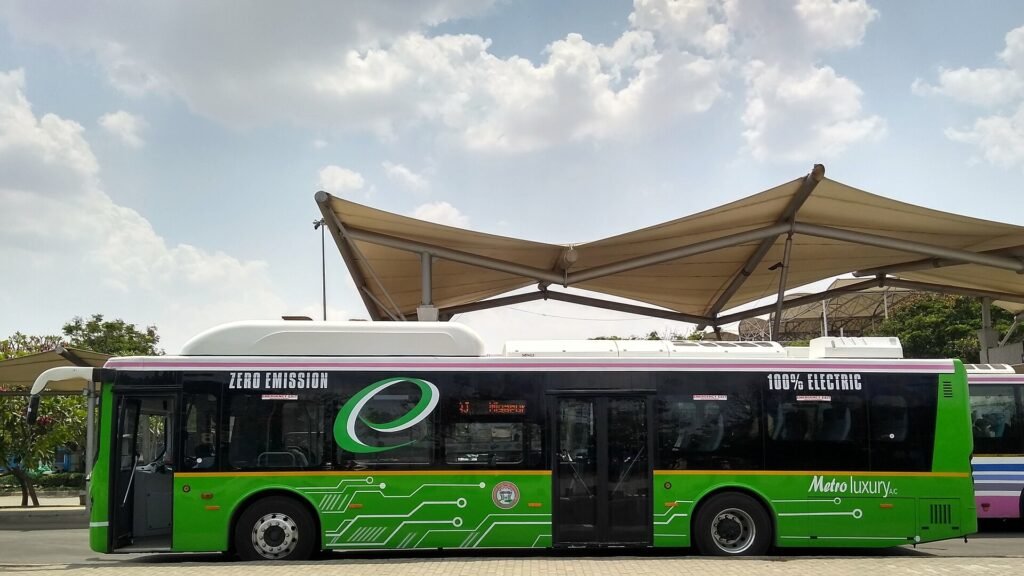
Featured image credit: Image: LoveofZ via Wikimedia Commons (CC BY-SA 4.0). Source
By Piyush P. Yadav
Two developments in August 2026 show India’s electric bus rollout accelerating on two different fronts at once: city fleets and manufacturer order books. Delhi put 400 new electric buses into service under its DEVi initiative, with 2,080 more due by the end of the year, while Tata Motors disclosed it has crossed 3,400 orders for electric commercial vehicles across its entire range, from small delivery vans to heavy trucks and buses. Neither story is about a policy announcement or a tender; both are about metal actually hitting the road, which is the harder milestone.
Delhi’s DEVi buses: what’s actually running
| Metric | Figure |
|---|---|
| New electric buses inducted (August 2026) | 400, under the Delhi Electric Vehicle Interconnector (DEVi) initiative |
| Additional buses planned by year-end | 2,080 more |
| Implied total by end of 2026 | 2,480 new electric buses added to Delhi’s fleet in a single year |
DEVi is Delhi’s push toward what the state has described as a goal of 100 per cent electric public transport, and the 2026 induction numbers are large enough to matter at a city scale — Delhi’s total bus fleet across DTC and cluster operators runs to several thousand vehicles, so adding close to 2,500 electric buses in one year represents a genuine share shift, not a pilot programme. This sits alongside the broader central procurement pipeline we covered in our analysis of CESL’s 6,230-bus tender and the financing questions we detailed in our report on the proposed Rs 9,852 crore heavy-duty EV scheme. Delhi’s DEVi fleet is a state-level procurement running in parallel with those central efforts, illustrating that electric bus adoption in India is now happening on multiple tracks simultaneously — state transport undertakings buying directly, central agencies like CESL aggregating demand across states, and manufacturers building order books independent of either.
Tata’s 3,400-unit electric commercial vehicle order book
| Category | Approximate orders |
|---|---|
| Small commercial vehicles and pick-ups (Ace EV and similar) | About 2,000 |
| Medium- and heavy-duty trucks | About 900 |
| Buses | About 500 |
| Total electric commercial vehicle orders | Over 3,400 |
The composition of this order book is the most telling part. Small commercial vehicles and pick-ups — the Ace EV segment we detailed in our electric three-wheeler and small commercial vehicle buying guide — account for well over half the volume, which tracks with the running-cost economics that favour electrification most strongly on vehicles doing many short, repeatable urban trips. Heavy trucks, at roughly 900 units, look small next to that, but stack it against the 573 electric trucks that sold across the ENTIRE Indian market in all of 2025, a figure we cited in our report on why India’s electric truck market hasn’t started, and Tata’s order book alone looks set to substantially exceed last year’s entire national truck sales figure once these orders convert to deliveries.
Reading the two stories together
The pattern across both is that visible, funded demand is now showing up at exactly the segments the data predicted would move first: small commercial vehicles with high daily utilisation, and buses bought by public agencies with dedicated budgets and no financing-approval bottleneck of the kind that has held back private truck fleets. Heavy trucks remain the laggard, which is consistent with the financing-gap diagnosis the Ministry of Heavy Industries gave when it floated the proposed credit-guarantee scheme on September 1 — buses bought by government-backed transport undertakings and small commercial vehicles bought by high-utilisation urban operators don’t face the same bank-risk-aversion problem that a private long-haul trucking company does.
For fleet operators and city planners, the practical takeaway is that 2026 is the year electric buses and small commercial vehicles crossed from pilot-scale to genuine fleet-scale procurement in India, while heavy trucks remain one policy intervention away from doing the same.
Sources & Further Reading
- TractorJunction Trucks: Delhi targets 100% electric public transport by 2026
- Sustainable Bus: Tata Motors secures 500 e-bus orders as electric commercial vehicle bookings exceed 3,400 units
FAQ
How many electric buses has Delhi added in 2026?
Delhi inducted 400 new electric buses under its DEVi initiative, with 2,080 more planned by the end of 2026 — close to 2,500 in total for the year.
How many electric commercial vehicle orders does Tata Motors have?
Over 3,400, made up of roughly 2,000 small commercial vehicles and pick-ups, about 900 trucks, and about 500 buses.
How does Tata’s truck order book compare with India’s total electric truck sales?
Tata’s roughly 900 electric truck orders alone approach or exceed the 573 electric trucks that sold across the entire Indian market in all of 2025.
What is the DEVi initiative?
The Delhi Electric Vehicle Interconnector initiative, the state’s programme to convert its public bus fleet to electric as part of a goal of 100 per cent electric public transport.