

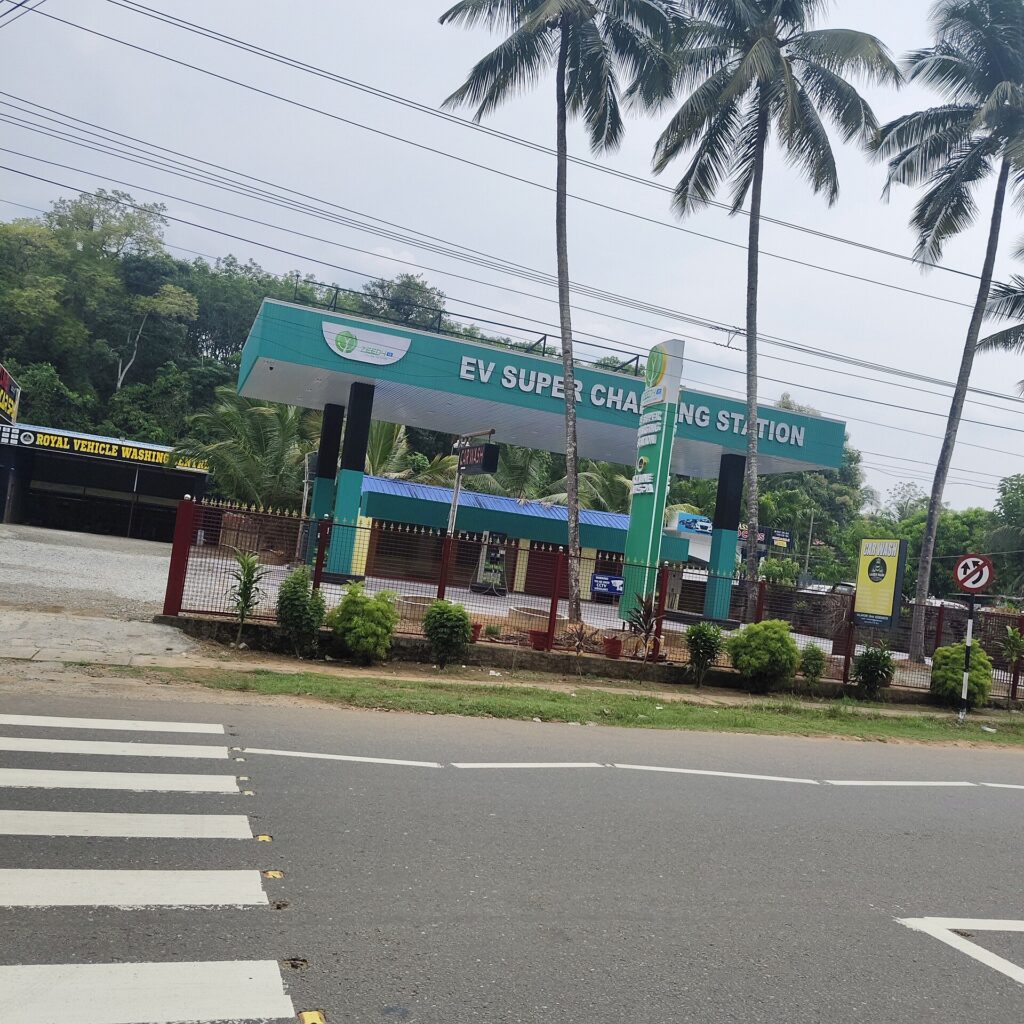
Featured image credit: Image: Sujithshivam511 via Wikimedia Commons (CC BY-SA 4.0). Source
By Piyush P. Yadav
An electric car owner in India who wants to be sure of a charger on a 600 km drive currently needs five or six apps, three or four wallets and a working knowledge of which operator is strong on which highway. There is no national roaming, no single tariff and, until recently, no reliable way to know whether the charger on the map was actually switched on. This guide compares the six charge-point operator networks that matter to a private car owner in 2026, Tata Power EZ Charge, Statiq, ChargeZone, Jio-bp pulse, Zeon and Bolt.Earth, on what each one claims for size, where it is actually strong, what it charges per unit, how the app behaves and which car brands’ own apps aggregate it. It also explains why every operator’s “charging point” count means something different, and why the number that matters is not the total but the count of working DC units on the corridor you drive.
Why the network counts do not add up
Rubix Data Sciences put India’s total at 67,657 chargers in August 2026, and we set out in our analysis of that report that 73 per cent of them are rated under 30 kW. Add up the operators’ own claims below and you get well over 1.2 lakh, because they count differently. Bolt.Earth counts every 3.3 kW socket it has sold to a housing society. Tata Power counts stations, some with several guns. Statiq counts chargers on its app, including partner units it does not own. Jio-bp counts charging points including those at fleet depots. None of them is lying; they are answering different questions. For a car owner the question is how many DC units above 30 kW the operator runs on the routes you use, and that number is a fraction of any headline.
The six networks compared
| Operator | Claimed size (own figures, 2026) | Where it is strong | Typical DC tariff | Payment model |
|---|---|---|---|---|
| Tata Power EZ Charge | 5,600-plus public stations across every state; about 92 per cent uptime claimed | Widest geographic spread; metro cities, malls, hotels, Tata dealers; strong on Mumbai-Pune and Delhi NCR | About Rs 14 to 24 a unit, most sites Rs 15 to 20 | Prepaid wallet in EZ Charge app; RFID card |
| Statiq | 10,000-plus chargers across 1,000-plus cities (includes partner units listed on its app) | North India, Delhi NCR, Rajasthan and Uttarakhand highways; large aggregator listing | About Rs 16 to 20 a unit for cars on its own DC units; partner sites vary | Wallet in Statiq app; UPI top-up |
| ChargeZone | 2,200-plus fast-charging points in 58-plus cities | Highway corridors: Mumbai-Ahmedabad, Delhi-Jaipur, Bengaluru-Chennai; 60 to 240 kW hubs; bus depots | About Rs 18 to 22 a unit at highway hubs | Wallet in ChargeZone app |
| Jio-bp pulse | 7,000-plus charging points for cars, fleets and buses | Mumbai and Maharashtra, Delhi NCR, fuel-station forecourts, Jio-bp mobility hubs on expressways | Rs 24 a unit standard; Rs 18.25 to 20.25 on subscription plans | Wallet plus monthly Pulse subscription tiers |
| Zeon Charging | 500-plus charging points at 300-plus locations | South India highways: Bengaluru-Chennai, Kerala, Tamil Nadu, Hyderabad; hotel and restaurant sites | About Rs 18 to 22 a unit | Wallet; also listed on Statiq and Tata.ev apps |
| Bolt.Earth | 1 lakh-plus charging points in 2,000-plus cities, overwhelmingly 3.3 kW AC sockets | Apartment complexes and two-wheeler charging; not a highway network | Set by the host; often Rs 8 to 12 a unit | App or UPI QR at the socket |
The tariffs are indicative ranges observed on the operators’ apps and published rate cards in 2026 and vary by state, site owner and charger power. All of them sit above the regulated ceilings we explained in our guide to how public EV charging prices are set, because the ceilings apply to the service charge and not to the electricity, the GST or the site owner’s share.
Operator by operator
Tata Power EZ Charge: the default network
Tata Power is the operator most Indian EV owners already have an account with, because it was first to scale and because Tata Motors bundles it into the IRA.ev app that every Tata EV buyer installs. Its strength is breadth: it is the only operator with public sites in every state, and its metro coverage in Mumbai, Delhi NCR, Bengaluru, Pune and Hyderabad is dense enough that an owner without home charging can live on it. Its weakness is power. A large share of its sites are 25 to 30 kW units installed in 2021 and 2022, and its highway presence outside Maharashtra is thinner than ChargeZone’s. The 92 per cent uptime claim is the highest published by any operator and matches user experience better than most; the app’s live-status flag is reliable.
Statiq: the aggregator that became a network
Statiq began as an app that listed other people’s chargers and has grown into a large operator in its own right, particularly across North India, with a strong presence on the Delhi-Jaipur, Delhi-Chandigarh and Delhi-Dehradun routes and in Rajasthan and Uttarakhand tourist destinations. Because its app still lists partner units, including Zeon and several smaller operators, it is the closest thing India has to a single map, and the 10,000-charger claim should be read that way. Its own DC units are mostly 30 to 60 kW; tariffs are competitive; uptime is patchier than Tata Power’s, particularly at partner sites.
ChargeZone: the highway specialist
ChargeZone has built its business on corridors rather than cities, with 60 kW to 240 kW hubs at regular intervals on the Mumbai-Ahmedabad, Mumbai-Pune, Delhi-Jaipur, Bengaluru-Chennai and Hyderabad-Vijayawada routes and a large bus-depot business that pays the bills. For a road trip in an EV that can accept 100 kW or more, it is the operator to plan around; its 2,200 fast-charging points is a smaller number than its rivals’ but nearly all of it is DC. Tariffs at highway hubs are at the upper end. It is one of the four partners in Tata.ev’s Mega Charger programme, which is putting 120 kW sites at 500 locations.
Jio-bp pulse: forecourts and subscriptions
Jio-bp’s network follows its fuel stations and its purpose-built mobility hubs, which gives it a strong position on the Mumbai-Pune Expressway and around Mumbai, Delhi NCR and Gujarat. Its standard Rs 24 per unit tariff is the highest of the six, but its subscription plans bring the rate to Rs 18.25 to 20.25 for regular users, and the hubs are well lit, staffed and have food and toilets, which matters at midnight. A large share of the 7,000-point claim is fleet and bus infrastructure not open to the public.
Zeon: the southern corridor operator
Zeon is small but concentrated where its customers drive: the Bengaluru-Chennai, Bengaluru-Mysuru, Chennai-Coimbatore and Kerala corridors, at hotels and restaurants that give a driver somewhere to sit for 40 minutes. Most of its 500-plus points are 24 to 60 kW DC. It is listed on both Statiq and the Tata.ev apps, so a driver rarely needs the Zeon app itself, and it is a Mega Charger partner.
Bolt.Earth: the apartment network
Bolt.Earth’s 1 lakh-plus figure is real but describes something different: low-power AC sockets in parking lots, sold to housing societies and shops, used mostly by two-wheelers and by car owners who can leave a car for eight hours. It is not a road-trip network and should not be compared with the others on that basis. For an apartment resident without a dedicated parking slot it is often the only option, and at host-set tariffs of Rs 8 to 12 a unit it is the cheapest public charging in the country.
The manufacturer apps that stitch it together
Because no operator covers the country, the car makers have become the aggregators. Tata Motors’ IRA.ev app shows and pays for Tata Power, ChargeZone, Statiq and Zeon units from one wallet, and gives Tata EV owners priority and a preferential tariff at the 500 Mega Charger sites being built with those four partners, each delivering 120 kW through one four-gun unit or two 60 kW units. Mahindra’s app aggregates a similar set. Hyundai and MG run their own aggregator layers. For a new owner the practical advice is: install your manufacturer’s app first, then Tata Power and Statiq as backups, then the corridor specialist for the highways you drive.
What to check before relying on any of them
- Charger power, not station count. A 30 kW unit takes a 55 kWh car from 10 to 80 per cent in about 85 minutes; a 60 kW unit in about 50 and a 120 kW unit in about 40 if the car can accept it. Our guide to real 10-to-80 per cent charging times has model-by-model figures.
- Live status. Every app has one; only Tata Power’s and ChargeZone’s are consistently accurate. Call the site if the app is your only plan.
- Number of guns. A single-gun station with one car ahead of you is a 90-minute wait. ChargeZone and Jio-bp hubs usually have four or more.
- Utilisation. As we reported in our analysis of charger utilisation and operator economics, most public chargers are used 1 to 5 per cent of the time, which is good news for availability and bad news for the operators’ finances; expect tariffs to rise and weak sites to close.
- Wallet minimums. Most apps require a Rs 200 to 500 top-up that is not refundable. Keep balances small across five apps rather than large in one.
- Idle fees. Jio-bp and ChargeZone now charge for occupying a bay after charging ends. Move the car.
Sources & Further Reading
- Bolt.Earth: Top EV charging apps in India 2026, features and coverage
- EVSelect: Top EV charging companies in India (2026), the complete list
- Jio-bp: EV Saver subscription plans and charging rates
- Tata Motors: TATA.ev Mega Charger programme with Tata Power, ChargeZone, Statiq and Zeon
- GreenTax: Public EV charging stations in India 2026, networks, apps and cost guide
FAQ
Which EV charging network is the largest in India?
By public stations open to all cars, Tata Power EZ Charge, with more than 5,600 stations in every state. Statiq lists more than 10,000 chargers but includes partner units; Bolt.Earth’s 1 lakh-plus figure is mostly 3.3 kW sockets in apartment complexes.
Which network is best for highway road trips?
ChargeZone for the Mumbai-Ahmedabad, Delhi-Jaipur and Bengaluru-Chennai corridors, with 60 to 240 kW hubs; Jio-bp pulse on the Mumbai-Pune Expressway; Zeon in South India; Statiq on North Indian hill and tourist routes. Install two of them and your car maker’s aggregator app.
How much does public DC fast charging cost in India?
Between about Rs 14 and Rs 24 per unit in 2026 depending on operator, state and charger power, against Rs 6 to 9 per unit at home. Jio-bp’s standard rate is the highest at Rs 24; subscriptions bring it under Rs 21. Bolt.Earth AC sockets are often Rs 8 to 12.
Do I need a separate app for every operator?
Not always. Tata’s IRA.ev app pays for Tata Power, ChargeZone, Statiq and Zeon from one wallet, and Statiq’s app lists many partner networks. But no single app covers everything, so most owners carry three or four.
Can I charge any electric car at any public charging station in India?
Almost. Every electric car sold in India today uses a CCS2 inlet, which takes Type 2 AC at 3.3 to 22 kW and CCS2 DC above that, and CCS2 is the mandated standard on new public four-wheeler DC sites. The exceptions are the older GB/T guns on legacy Bharat DC-001 chargers, which will not fit a Nexon EV, Windsor or BE 6, and the light-EV AC sockets that Bolt.Earth and others install for two- and three-wheelers. Check the connector type in the app before you drive to a station.
Can I pay for EV charging with UPI instead of an operator wallet?
Increasingly, yes. Unified Bharat eCharge, built by the Ministry of Heavy Industries with BHEL and NPCI and announced in May 2026, lets you find a participating charger in the BHIM app, scan its QR code and pay straight from your bank account with no operator app or prepaid wallet. Pulse Energy connected more than 10,000 chargers to it in August 2026. Coverage is still partial, so keep the two or three operator apps you actually use.
How often are public chargers in India out of order?
Often enough to plan around. Surveys through 2026 put the share of installed public chargers that are not working at close to a fifth, against an industry target of 95 per cent uptime; the best-run networks report around 92 per cent. Treat any single charger as a maybe — check live status in the app before setting off, and on a long drive keep a second station inside your remaining range.