

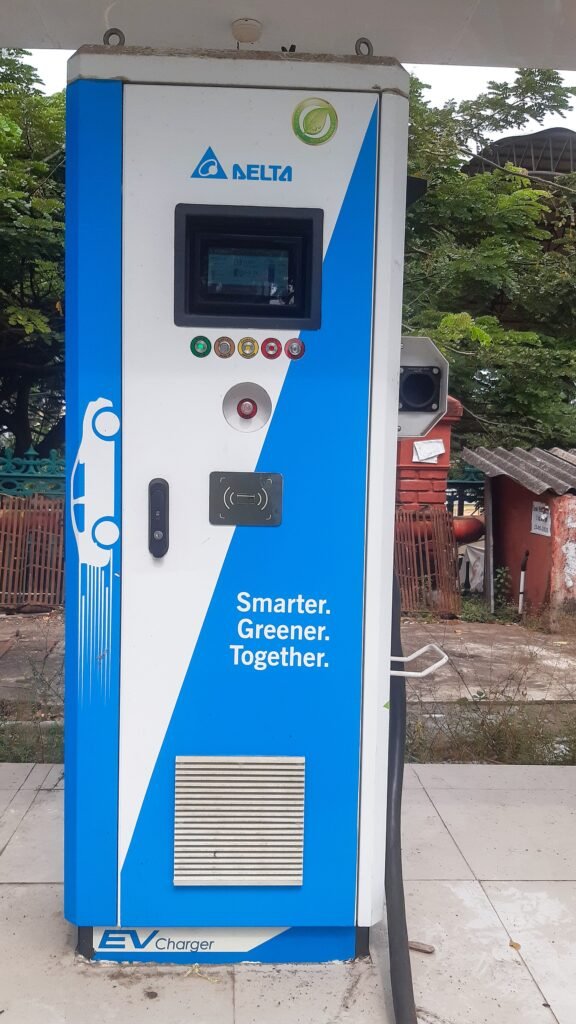
Featured image credit: Image: Shagil Kannur via Wikimedia Commons (CC BY-SA 4.0). Source
India’s EV charging network has undergone a dramatic transformation. From roughly 5,000 public charging stations in 2022 to over 29,000 by early 2026 — a near six-fold expansion in three years — the infrastructure that once held back EV adoption is finally catching up with consumer demand.
Yet challenges remain. India’s 2.3 million registered EVs share approximately one charger per 235 vehicles — far below the global benchmark of 1 per 6-20. To reach 30% EV penetration by 2030, India needs an estimated 1.32 million public charging stations. Here’s where things stand and what’s coming.
India’s EV Charging Networks: Who’s Who
Tata Power EV
India’s largest network — 2,000+ stations across 1,100+ cities. Integrated with 13 Charge Point Operators (CPOs). App-based payment. Dominant in metro areas.
HPCL & V-GREEN
5,300 stations + 24,400 fuel retail outlets being converted. 150 battery swapping stations. Highway coverage expanding rapidly across national highways.
Ather Grid
500+ fast-charging points across 80+ cities. Proprietary network for Ather scooters. Free charging for Ather owners. Expanding to third-party EVs.
BPCL Pulse
Highway fast chargers on key corridors. Delhi-Mumbai, Chennai-Bengaluru routes well covered. 50 kW and 150 kW DC chargers.
Magenta ChargeGrid
Commercial and residential complexes focus. 7.2 kW AC and 50 kW DC chargers. B2B partnerships with housing societies and offices.
Maruti EV Charging
2,000+ charging stations across 1,100 cities. Integrated with 13 CPOs for Suzuki e Vitara owners. Pre-launch network build-out.
Types of EV Chargers: Speed and Cost Compared
| Charger Type | Power | Charge Time (40 kWh) | Range Added/Hour | Typical Cost | Where Found |
|---|---|---|---|---|---|
| Level 1 (15A Socket) | 2.2 kW | 16-18 hours | 12-15 km/hr | ₹7-9/unit (home rate) | Home, emergency |
| Level 2 AC (Home Charger) | 7.2 kW | 5-6 hours | 40-50 km/hr | ₹7-9/unit (home rate) | Home, offices, malls |
| DC Fast Charger (50 kW) | 50 kW | ~1 hour (10-80%) | 250 km/hr | ₹15-20/unit | Public stations, highways |
| DC Ultra-Fast (150 kW+) | 150-350 kW | 15-25 min (10-80%) | 700+ km/hr | ₹18-25/unit | Highways, premium stations |
| Battery Swap | N/A | Under 5 minutes | Full range instantly | Subscription-based | Honda, Ola swap stations |
Highway Charging: Key Corridors in 2026
India’s highway charging network has matured significantly. Key corridors now covered:
- Delhi–Mumbai (NH-48) — DC fast chargers every 50-80 km. Multiple CPOs present.
- Delhi–Jaipur (NH-48) — Well covered; 4-5 charging stops for full Delhi-Jaipur journey
- Bengaluru–Chennai (NH-44) — BPCL Pulse chargers at key points; 2-3 stops needed
- Mumbai–Pune (NH-48) — Express highway well served; Tata Power EV dominant
- Hyderabad–Bengaluru (NH-44) — Improving rapidly; plan 2-3 charging stops
Setting Up Home EV Charging: Step-by-Step Guide
Step 1: Check Your Electrical Capacity
Most urban homes have a 5 kW sanctioned load — sufficient for Level 2 charging. Call your electricity board to confirm, and if needed, apply to upgrade to 10-15 kW sanctioned load. Cost: ₹2,000-5,000 for load enhancement.
Step 2: Choose Your Home Charger
Most EVs come with a 3.3 kW portable charger (plugs into 15A socket). For faster charging, purchase a 7.2 kW wall-box charger. Options: Tata Power EZ Charge, Exicom Home Charger, Ampere Nexus. Cost: ₹8,000-15,000 for the charger unit.
Step 3: Installation
Hire a certified electrician to install a dedicated circuit with proper earthing and MCB protection. Avoid running the EV charger on an extension cord. Typical installation cost: ₹5,000-15,000 depending on wiring distance from meter board.
Step 4: Estimate Monthly Electricity Cost
| EV | Battery Size | Home Charging Cost (Full) | Monthly Cost (1,500 km) |
|---|---|---|---|
| Tata Tiago EV | 24 kWh | ₹192 | ₹700-900 |
| Tata Punch EV | 40 kWh | ₹320 | ₹900-1,100 |
| Tata Nexon EV | 40.5 kWh | ₹324 | ₹900-1,100 |
| Mahindra BE 6 | 59 kWh | ₹472 | ₹1,000-1,300 |
| Tata Harrier EV | 71.8 kWh | ₹574 | ₹1,000-1,300 |
What’s Coming: India’s EV Charging Roadmap to 2030
- 2026: 22,100 DC fast chargers deployed under PM E-DRIVE; HPCL network at 30,000+ stations
- 2027: Every major highway to have DC chargers every 25 km; Tier-2 cities coverage improves
- 2028: PM E-DRIVE charging infra target achieved; private sector adds 50,000+ stations
- 2030: Government target: 1,32,000+ public stations; EV adoption at 30% penetration
Related Reading
- HPCL’s 24,400-Outlet EV Charging Rollout With V-GREEN
- India’s EV Charging Network Mid-2026: Rs 503 Crore for 4,874 New Chargers
- Home Charging vs Public Fast Charging: The Real Cost of Running an EV in India (2026)
- 73% of India’s 67,657 EV Chargers Are Under 30 kW: The September 2026 Rubix Report
Frequently Asked Questions
How many EV charging stations are in India in 2026?
India had over 29,000 public EV charging stations as of early 2026, up from ~5,000 in 2022. Of the 27,737 installed by March 2026, 22,753 were operational. India targets 1,32,000 public stations by 2030 — over 40x the current base.
How much does it cost to charge an electric car at a public station in India?
₹12-20 per kWh at public stations, vs ₹7-9 per kWh at home. A full charge of a 40 kWh battery costs ₹480-800 at public stations versus ₹280-360 at home. Always prefer home charging when possible for maximum savings.
Can I charge an electric car at home in India?
Yes. Every EV comes with a portable charger for standard 15A sockets (slow, 10-16 hours). For faster home charging, install a Level 2 wall-box charger (7.2 kW) that charges most EVs overnight in 6-8 hours. Total home charger setup cost: ₹15,000-30,000 including installation.
Which is the best EV charging app in India?
Tata Power EV app for the widest network (2,000+ stations in 1,100 cities). PlugShare for real-time multi-network visibility. Ather app for Ather scooter owners. HPCL app for highway corridor charging.
Can my housing society refuse to let me install an EV charger?
Generally, no. Under the Ministry of Power’s EV charging guidelines, an RWA cannot refuse a charger installed in your own allotted parking bay provided it meets safety norms, and your DISCOM is obliged to provide the connection – either through your existing meter or as a separate EV connection, at your choice. What the society can legitimately require is an NOC and sign-off on how armoured cable is routed through common areas, plus compliance with CEA and BIS safety standards. Its role is to manage how you charge safely, not to decide whether you may.
Is there a separate EV electricity tariff in India, and is it cheaper?
Yes in several states, and it is usually worth the paperwork. Delhi offers roughly ₹4.50 per unit on a dedicated EV meter, and Maharashtra’s MSEDCL has an EV category at around ₹5.50-6 per unit – both below the ₹7-9 slab rates most households pay. Many DISCOMs stack a time-of-day discount of 30-40% on top for charging overnight, roughly 10 pm to 6 am. A separate EV meter costs about ₹4,000-6,000 one-time, which most regular drivers recover within a year.
How long does charging at a public station actually take in India?
That depends far less on your car than on the charger you find. A September 2026 Rubix report found 73% of India’s 67,657 public charge points are rated under 30 kW – at those speeds a 40-50 kWh car needs well over an hour, not the 30-40 minutes most buyers expect. On a genuine 60 kW or higher CCS2 unit, most mainstream EVs complete 10-80% in roughly 35-60 minutes. It is worth filtering by charger power, not just location, in your app before setting off on a long drive.
Find EV charging stations near you with our Charging Map → evautoindia.co.in/tools