

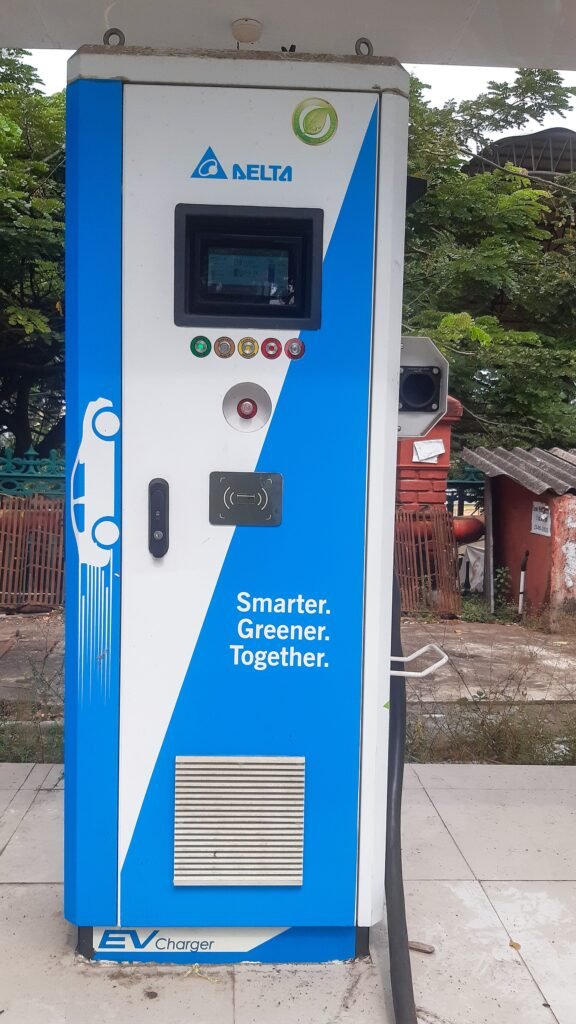
Featured image credit: Image: Shagil Kannur via Wikimedia Commons (CC BY-SA 4.0). Source
By Piyush P. Yadav
India now has 67,657 public EV chargers, a figure that has grown more than sixfold since 2022. Almost none of them are busy. A State Bank of India sector report puts average capacity utilisation at 1 to 3 per cent; S&P Global estimates about 5 per cent. Put differently, a typical public charger in India is dispensing electricity for somewhere between 15 minutes and 72 minutes in a 24-hour day. Two reports published this week, from Rubix Data Sciences and an IANS analysis of the 2030 requirement, set out both sides of the paradox: the country needs roughly 13 lakh public charging points by 2030, twenty times today’s count, while the operators who would build them are struggling to make the existing ones pay. This article explains why utilisation is so low, what it costs a charge point operator to run a station, and what the numbers mean for anyone planning to rely on public charging.
The network by the numbers
| Metric | Figure | Source and date |
|---|---|---|
| Public charging stations, Dec 2025 | 29,151 (8,805 fast, 20,346 slow) | Rubix Data Sciences, Sep 2026 |
| Total chargers incl. swap stations, 7 Aug 2026 | 67,657 | Rubix Data Sciences, Sep 2026 |
| Chargers rated below 30 kW | About 73% | Rubix Data Sciences |
| Charge point operators active | 200 plus | Rubix Data Sciences |
| Karnataka share of stations | About 21% | Rubix Data Sciences |
| Maharashtra share of stations | 14% | Rubix Data Sciences |
| Top 10 states’ share | About 78% | Rubix Data Sciences |
| Average utilisation (SBI estimate) | 1 to 3% | SBI sector report |
| Average utilisation (S&P Global estimate) | About 5% | S&P Global |
| EV owners charging at home or work | 93% (Tata Motors); 90 to 95% (Ather) | Company data cited by Autocar India |
| Public charging points needed by 2030 | About 13.2 lakh | CII estimate via IBEF, IANS, Sep 2026 |
We covered the composition of the network, and the fact that three in four chargers are below 30 kW, when the Rubix report first appeared on 2 September. The new information this week is the utilisation and cost data, which explains why the network looks the way it does.
Why utilisation is so low
Almost everyone charges at home
Tata Motors, which sells more than 40 per cent of India’s electric cars, reported in 2023 that 93 per cent of its EV owners charge at home or in the office. Ather Energy puts the figure for its scooter owners at 90 to 95 per cent. Public chargers are used for emergencies and highway trips. This is rational behaviour: home electricity at Rs 6 to 9 per unit is exempt from GST, while public charging at Rs 18 to 25 per unit carries 18 per cent GST on top. We compared the two in detail in our analysis of home versus public fast-charging costs; the per-kilometre gap is roughly threefold.
The fleet mismatch
India’s EV fleet is dominated by two- and three-wheelers, which account for well over 90 per cent of electric vehicles registered. Penetration in mid-August 2026 stood at 60.77 per cent for three-wheelers, 8.88 per cent for two-wheelers and 5.70 per cent for four-wheelers. Most electric two-wheelers charge from a household socket and most commercial three-wheelers either charge at a depot or swap batteries. Neither uses the CCS2 public chargers that make up the bulk of installed capacity. The 67,657 figure includes 1,139 chargers at battery swapping stations, but swapping for scooters and autos is a separate, largely proprietary ecosystem.
Location, not just count
Karnataka alone has 21 per cent of India’s charging stations and the top ten states have 78 per cent. Within cities, chargers cluster at malls, hotels and fuel stations where site hosts are willing, not necessarily where demand is. A charger in a mall basement that is only accessible during mall hours will never see high utilisation.
What it costs to run a charger
The Rubix and Autocar reporting sets out the cost side with unusual candour. A charge point operator faces four recurring pressures:
- Electricity tariffs of Rs 6 to 15 per kWh, varying by state and by whether the station has a dedicated commercial connection. At 3 per cent utilisation, fixed demand charges are spread over very few units sold.
- Site acquisition and host arrangements. Many CPOs operate chargers on third-party premises, relying on the host for the electricity connection. That creates blind spots around bill payment, GST input credit compliance and energy-cost efficiency.
- A mandated 98 per cent monthly uptime under the Ministry of Power guidelines and PM E-DRIVE funding conditions, which requires monitoring, maintenance contracts and spare hardware regardless of how often the charger is used.
- Capital cost. A 60 kW DC charger with installation typically costs Rs 15 lakh to Rs 25 lakh. At 3 per cent utilisation, that is roughly 43 kWh dispensed a day, or under Rs 1,000 of daily gross margin at a Rs 20 per unit tariff before electricity costs.
Rubix president Tushar Bhaskar put the challenge plainly: the gap between infrastructure growth and utilisation is “where CPOs will either make money or burn through it.” Operators are responding with fleet contracts, subscriptions, roaming agreements between networks and revenue sharing with site hosts, but none of these fixes the underlying problem, which is that private car owners do not need public chargers often.
The 13 lakh target
The IANS analysis published on 2 September draws on Confederation of Indian Industry estimates to argue that India needs about 1.32 million public charging points by 2030 to support 30 per cent EV penetration. The calculation assumes one public charger for every 40 EVs. Today, with 2.3 million EVs registered in 2025 alone and 67,657 chargers, the ratio is roughly one charger per 235 EVs, against a global benchmark of one per 6 to 20.
The two sets of numbers are in tension. If utilisation is 1 to 5 per cent, the existing network could absorb ten to twenty times today’s public charging demand before it is stretched. Building twenty times more chargers into that environment would push utilisation towards zero. The resolution is that the ratio target and the utilisation problem describe different vehicles: highway and intercity chargers for cars are genuinely under-supplied and often queue-bound on holiday weekends, while urban slow chargers are heavily over-supplied relative to use. The policy question is not whether India needs 13 lakh chargers but which 13 lakh.
Where the money is going
PM E-DRIVE allocates Rs 2,000 crore of its Rs 10,900 crore outlay (now extended to March 2028 with a larger envelope) to public charging, with subsidies of up to 80 per cent of infrastructure cost for chargers meeting the uptime and location criteria. The largest private commitments are from fuel retailers, who already have highway sites and grid connections: HPCL’s agreement with V-GREEN to deploy chargers across 24,400 fuel outlets, which we examined in our report on HPCL’s 24,400-outlet EV charging rollout, is the clearest example of building where utilisation is likely to be highest.
The other structural shift is towards higher-power hardware. The 73 per cent of chargers below 30 kW are a legacy of early FAME-era procurement that favoured cheap AC units. New PM E-DRIVE-funded installations are weighted towards 60 kW and above, and Tata.ev’s plan for 500 “Mega Chargers” of 120 kW plus with partner CPOs is aimed squarely at the highway use case.
What this means for an EV owner
| Use case | Public charging outlook | Practical advice |
|---|---|---|
| Daily city commuting | Rarely needed; urban slow chargers widely available and empty | Install a 7.4 kW home wallbox; treat public chargers as backup |
| Highway trips on major corridors | 91% of highways have a fast charger within 50 km; queues on peak days | Plan stops around 60 kW plus sites; carry two network apps |
| Highway trips off main corridors | Thin fast-charging coverage | Check charger uptime reviews before departure; keep a 30% buffer |
| Apartment without parking access | Dependent on public slow charging | Look for society-installed chargers under PM E-DRIVE; push RWA for shared points |
| Fleet or taxi operation | Depot charging dominant; CPOs actively seeking fleet contracts | Negotiate a fixed per-kWh fleet tariff; utilisation-hungry CPOs will discount |
For most private car owners the practical conclusion is the one we set out in our guide to home charger installation and connector types: the single most important charging decision is the wallbox at home, and public infrastructure matters only for the handful of long trips a year. The low utilisation figures are, from the driver’s side, good news. A charger you need on the highway is unlikely to be occupied. The bad news is for the operators who have to keep it working at 98 per cent uptime while it waits for you.
Sources & Further Reading
- Autocar India: India’s EV charging network grows, but usage remains low (2 September 2026)
- EMobility+: India’s EV charging network expands as CPOs navigate low utilisation and high operating costs (1 September 2026)
- IANS: India needs 1.32 million EV charging points by 2030 (2 September 2026)
- Business Standard: India’s EV charging stations cross 29,000, rise nearly six-fold since 2022
Frequently asked questions
How many EV chargers does India have in 2026?
67,657 chargers as of 7 August 2026, including 1,139 at battery swapping stations, according to Rubix Data Sciences. About 73 per cent are rated below 30 kW.
What is the utilisation rate of public EV chargers in India?
Very low. An SBI sector report estimates 1 to 3 per cent capacity utilisation; S&P Global estimates about 5 per cent. The main reason is that 90 to 95 per cent of EV owners charge at home or work.
How many chargers does India need by 2030?
About 1.32 million public charging points, according to CII estimates cited by IBEF and IANS, based on one charger for every 40 EVs at 30 per cent penetration. That is roughly twenty times today’s count.
Why is public charging so much more expensive than home charging?
Public operators pay commercial tariffs of Rs 6 to 15 per kWh, must recover the cost of hardware that sits idle 95 per cent of the time, maintain 98 per cent uptime, and charge 18 per cent GST on the service. Home electricity is GST-exempt and billed at domestic rates.
Which Indian state has the most EV charging stations?
It depends on which dataset you use. The Rubix Data Sciences report behind these figures puts Karnataka first with about 21 per cent of India’s charging stations, ahead of Maharashtra at 14 per cent, with the top ten states holding roughly 78 per cent between them. Ministry of Heavy Industries figures placed before the Rajya Sabha on 7 August 2026 rank Maharashtra marginally ahead at 6,985 stations against Karnataka’s 6,805, then Uttar Pradesh (4,493), Tamil Nadu (3,839) and Telangana (3,739). Either way, the concentration is the real story: two states account for about a third of the national network.
Do you need a licence to set up an EV charging station in India?
No electricity licence is required. The Ministry of Power has held since 2018 that EV charging is a service rather than a resale of electricity, which makes charging a de-licensed activity under the Electricity Act, 2003. You still need a DISCOM connection sanction, an electrical inspector’s clearance before energising, fire safety clearance, local building permissions and BIS-certified hardware, and any charger claiming PM E-DRIVE support must also meet the ministry’s technical standards and uptime conditions.
How long does an EV charging station take to break even in India?
Franchise programmes commonly quote two to three years for a well-sited station, but that assumes utilisation far above the 1 to 5 per cent national average described here. A 60 kW DC charger costing Rs 15 lakh to Rs 25 lakh installed and running at 3 per cent utilisation dispenses roughly 43 kWh a day, which is under Rs 1,000 of daily gross revenue at Rs 20 per unit before electricity and fixed demand charges. In practice, break-even is decided by site quality, fleet or depot contracts, and whether the station qualifies for the PM E-DRIVE subsidy of up to 80 per cent of infrastructure cost.