

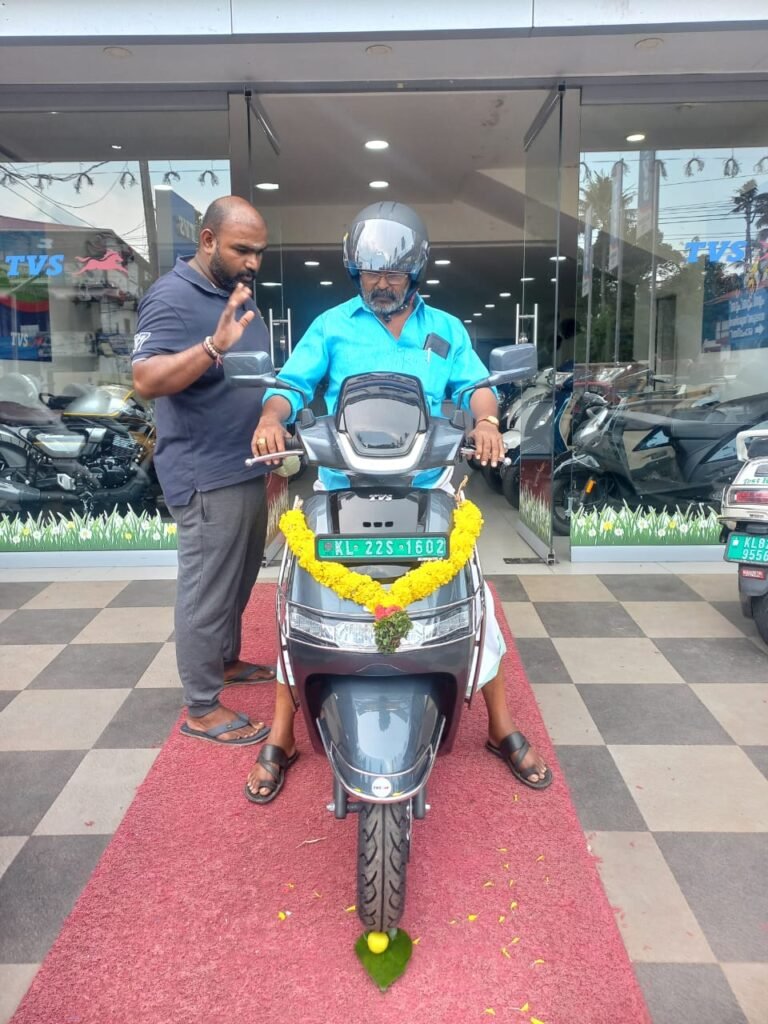
Featured image credit: Image: Maneesh Sreekariyam via Wikimedia Commons (CC BY-SA 4.0). Source
By Piyush P. Yadav
The cheapest electric scooters in India are no longer the ones with the smallest batteries. They are the ones sold without a battery at all. Hero MotoCorp’s Vida VX2 Go lists at Rs 59,490 ex-showroom on its Battery-as-a-Service plan against Rs 99,490 with the battery included. TVS launched the Orbiter V1 in March 2026 at Rs 49,999 on a battery subscription, against Rs 84,500 outright. That is a Rs 35,000 to 40,000 gap on the sticker, and it is the reason the sub-Rs 60,000 electric scooter now exists in showroom price lists.
The catch, of course, is that the battery is not free. You rent it, either per kilometre or per month, for as long as you own the scooter. Whether that is a good deal depends almost entirely on how far you ride. This guide explains how the two main subscription models work, what each brand actually promises in return, and where the break-even sits for a typical commuter. It also covers the second-hand and warranty implications that rarely make it into the launch coverage.
What Battery-as-a-Service means on a scooter
Battery-as-a-Service, or BaaS, separates the vehicle from its most expensive component. You buy the scooter (motor, frame, electronics, charger) and the manufacturer retains ownership of the battery pack, which it leases to you. On a scooter the battery is typically 35 to 45 per cent of the total cost, so removing it takes a Rs 1 lakh scooter down to Rs 55,000 to 65,000.
The lease is priced in one of two ways. Hero’s Vida uses a per-kilometre charge, billed on the distance the scooter’s telematics report. TVS uses a flat monthly subscription with unlimited kilometres. Both include the battery warranty for the subscription term, and both allow you to buy the battery outright later if you decide the rental no longer suits you.
This is the same concept Mahindra and MG apply to cars, where we have worked through the Rs 3.75 per km BaaS maths on the BE 6 and XEV 9S. The scooter version has smaller numbers but the same structure: a low entry price traded for a running cost that never goes away.
Vida VX2: Rs 59,490 with BaaS, Rs 99,490 without
Hero launched the VX2 on 1 July 2025 as its first mass-market Vida. There are two core variants. The VX2 Go has a 2.2 kWh battery, a 92 km certified range and a 70 km/h top speed. The VX2 Plus has a 3.4 kWh battery, a 142 km range and an 80 km/h top speed. Hero has since added larger-battery Go variants (3.1 kWh and 3.4 kWh) and a 4.4 kWh VX2 Plus.
| Variant | Battery | Certified range | Price with BaaS | Price without BaaS | Difference |
|---|---|---|---|---|---|
| Vida VX2 Go | 2.2 kWh | 92 km | Rs 59,490 | Rs 99,490 | Rs 40,000 |
| Vida VX2 Plus | 3.4 kWh | 142 km | Rs 64,990 | Rs 1,10,000 | Rs 45,010 |
Prices are ex-showroom Delhi at launch and have since risen slightly in some cities after the September 2026 PM E-DRIVE subsidy reduction. Hero quotes a running cost of Rs 0.96 per km for the VX2 on BaaS, which covers both electricity and the battery rental. The subscription also carries three benefits worth money: the battery is replaced free if it falls below 70 per cent health during the subscription term, fast charging at Vida’s own network is free for the subscription period, and there is a buyback option if you want to sell the scooter back to Hero while still subscribed.
Charging on the standard 580 W charger takes 3 hours 53 minutes for the Go and 5 hours 39 minutes for the Plus. The batteries are removable, so they can be charged indoors.
TVS Orbiter V1: Rs 49,999 on subscription, Rs 84,500 outright
TVS introduced the Orbiter V1 on 12 March 2026 in Lucknow, alongside a battery subscription model it had not previously offered. The V1 has a 1.8 kWh battery and an 86 km certified IDC range, with charging from zero to 80 per cent in about 2 hours 20 minutes. It sits below the Orbiter V2, launched the previous year, which carries a 3.1 kWh battery.
| Item | TVS Orbiter V1 |
|---|---|
| Price with battery subscription (ex-showroom Delhi, incl. PM E-DRIVE subsidy) | Rs 49,999 |
| Price without subscription | Rs 84,500 |
| Difference | Rs 34,501 |
| Subscription | From Rs 862 per month, unlimited kilometres |
| Battery | 1.8 kWh |
| Certified range | 86 km |
| Charging (0-80%) | About 2 hours 20 minutes |
| Extended warranty on subscription | Up to 5 years or 70,000 km |
The important difference from Hero’s model is that TVS charges a flat monthly fee starting at Rs 862 with no distance cap. For a heavy user that is far cheaper per kilometre than a per-km rental. For a light user it can be more expensive, since you pay the same whether you ride 200 km or 2,000 km a month. TVS’s Gaurav Gupta framed the model as giving buyers “a clearer picture of the total cost of owning an EV” by separating the vehicle price from battery usage.
The maths: when does the subscription cost more than buying the battery?
The question is simple: over the years you keep the scooter, does the total rental exceed the Rs 35,000 to 45,000 you saved upfront? Below are the two models worked through at three usage levels. For the Vida we assume the Rs 0.96 per km figure includes roughly Rs 0.25 per km of electricity (2.2 kWh over 92 km at Rs 8 per unit is about Rs 0.19 per km, so the battery rental component is about Rs 0.70 per km). Hero has not published the rental component separately, so treat this as an estimate. For TVS we use the Rs 862 monthly floor.
| Usage | Vida VX2 Go rental (approx. Rs 0.70/km) | TVS Orbiter V1 subscription (Rs 862/month) | Upfront saving (Vida / TVS) |
|---|---|---|---|
| 500 km/month, 3 years | Rs 12,600 | Rs 31,032 | Rs 40,000 / Rs 34,501 |
| 1,000 km/month, 3 years | Rs 25,200 | Rs 31,032 | Rs 40,000 / Rs 34,501 |
| 1,500 km/month, 3 years | Rs 37,800 | Rs 31,032 | Rs 40,000 / Rs 34,501 |
| 1,000 km/month, 5 years | Rs 42,000 | Rs 51,720 | Rs 40,000 / Rs 34,501 |
| 1,500 km/month, 5 years | Rs 63,000 | Rs 51,720 | Rs 40,000 / Rs 34,501 |
Three conclusions follow. First, over a three-year ownership at typical commuter distances (500 to 1,000 km a month), both subscriptions cost less than the upfront saving, so BaaS wins on cash. Second, over five years the picture flips for most riders: the Vida rental overtakes the saving at around 1,000 km a month, and the TVS subscription overtakes it at any usage level after roughly 40 months. Third, the flat TVS fee favours high-mileage riders; the Vida per-km model favours low-mileage riders.
What the table does not capture is that the subscription also buys you out of battery replacement risk. Our guide to electric scooter running costs and the battery replacement bill puts a replacement pack at Rs 40,000 to 80,000 depending on the brand. If the battery would have needed replacing in year five or six, the subscription rider never pays that bill; the outright buyer does, unless the warranty covers it.
Warranty and the 70 per cent rule
Under Hero’s BaaS the battery is replaced free if it drops below 70 per cent state of health during the subscription. TVS bundles an extended warranty of up to five years or 70,000 km with the subscription. These are broadly better terms than the standard warranties on outright purchases, which we compared brand by brand in our electric scooter battery warranty comparison. The 70 per cent threshold is the industry norm for what counts as a failed battery, and a subscription removes the argument about whether degradation is a defect or normal wear.
Resale, financing and the fine print
Three things to check before signing a BaaS contract. First, resale: a subscribed scooter is sold without the battery unless the buyer takes over the subscription or you buy the battery out. Hero offers a buyback within the subscription period, which is the cleanest exit. Ask TVS dealers what the buyout price for the pack is at year two or three; it is not published. Second, financing: banks lend against the ex-showroom price, so a Rs 59,490 BaaS scooter gets a smaller loan and a lower EMI, but the rental is a separate monthly outgoing that does not appear in your loan schedule. Third, subsidy: the Rs 49,999 Orbiter V1 price includes the PM E-DRIVE incentive, which was cut to Rs 5,000 per scooter from September 2026; we explained the change in our piece on PM E-DRIVE’s extension to March 2028. Dealers may have re-priced since.
Who should take the subscription
Take BaaS if you ride under 1,000 km a month, plan to keep the scooter three to four years, and value the free battery replacement and lower entry price over long-term cost. Buy outright if you ride more than 1,200 km a month, plan to keep the scooter five years or longer, or intend to sell it privately, because a scooter with its own battery is far easier to resell. If you are choosing between the two subscription models on cost alone, Hero’s per-km structure is cheaper for light riders and TVS’s flat fee is cheaper for anyone above about 1,200 km a month.
Either way, the arrival of Rs 49,999 and Rs 59,490 electric scooters with a real brand behind them changes the entry point of the market. The Ola S1Z at Rs 79,999 and the Simple Wave at Rs 1.10 lakh are now competing not just with each other but with a battery-free sticker price that no fixed-battery scooter can match.
Sources & Further Reading
- Autocar Professional: TVS Motor launches Orbiter V1 at Rs 49,999, introduces battery subscription model
- Autocar India: Hero Vida VX2 electric scooter launched at Rs 59,490
- 91Wheels: Hero Vida VX2 launched with BaaS model
- EVFY: Battery replacement costs of EV two-wheelers in India
Frequently Asked Questions
What is Battery-as-a-Service on an electric scooter?
You buy the scooter without the battery pack, which the manufacturer retains and leases to you, either per kilometre (Hero Vida) or as a flat monthly fee (TVS Orbiter V1). The upfront price drops by Rs 35,000 to 45,000 and the battery warranty is bundled into the subscription.
How much does the Vida VX2 cost with and without BaaS?
At launch the VX2 Go was Rs 59,490 with BaaS and Rs 99,490 without; the VX2 Plus was Rs 64,990 with BaaS and Rs 1,10,000 without (ex-showroom Delhi). Hero quotes a running cost of Rs 0.96 per km on BaaS.
How much is the TVS Orbiter V1 battery subscription?
The Orbiter V1 costs Rs 49,999 with subscription or Rs 84,500 without. Monthly plans start at Rs 862 with unlimited kilometres, and an extended warranty of up to 5 years or 70,000 km is included.
Is a battery subscription cheaper than buying the battery?
Over three years at up to 1,000 km a month, yes, on both Hero and TVS models. Over five years or at high mileage the cumulative rental usually exceeds the upfront saving, though the subscription also removes battery replacement risk.