

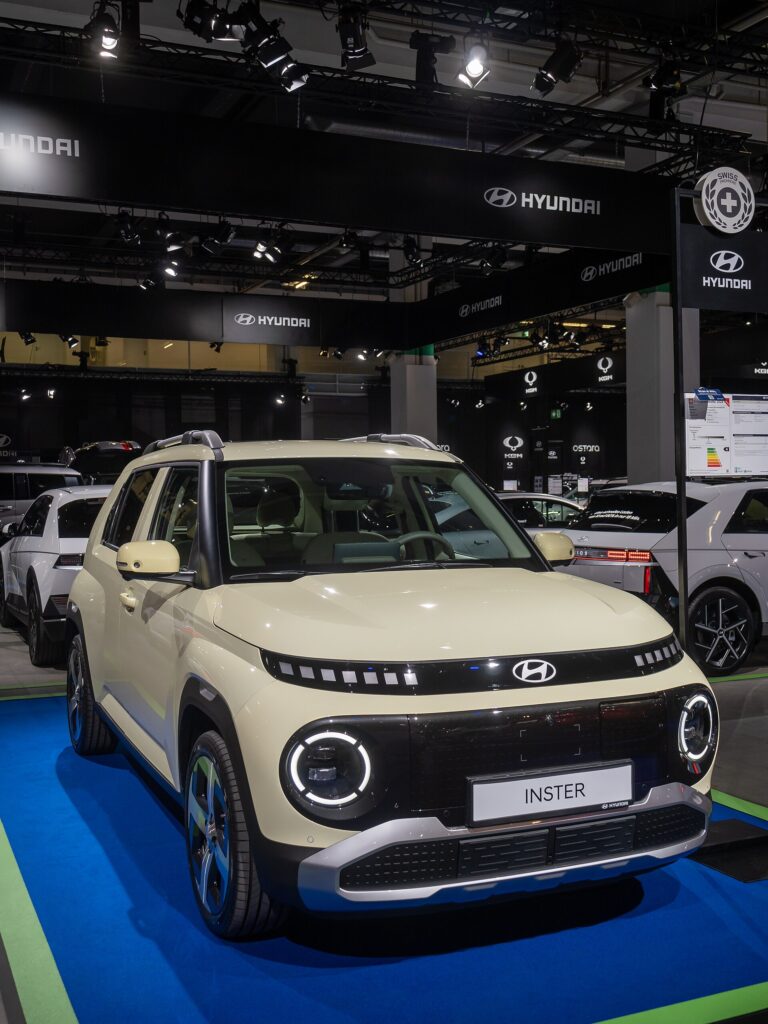
Featured image credit: Image: Matti Blume via Wikimedia Commons (CC BY-SA 4.0). Source
By Piyush P. Yadav | 11 September 2026
Hyundai’s first electric car built for the Indian mass market is arriving three months early. Hyundai Motor India managing director and CEO Tarun Garg has confirmed that the compact electric SUV codenamed HE1i, originally scheduled for March 2027, will now debut by December 2026. The catch is in the battery: because Exide Energy Solutions’ Bengaluru cell plant will not be ready in time, the first cars will roll out of Sriperumbudur with lithium-iron-phosphate cells imported from China’s Svolt. This article explains what the car is, what the platform tells us about its range and price, why the cell switch happened, and how it lines up against the Tata Nexon EV, Mahindra XUV 3XO EV and Kia Syros EV it will fight.
What Hyundai has actually confirmed
The hard facts, stripped of speculation, are these. The HE1i is a compact electric SUV built on Hyundai-Kia’s E-GMP (K) platform, the same architecture that underpins the Hyundai Inster sold in Europe and Korea. It will be built at Hyundai’s Sriperumbudur plant in Tamil Nadu, not imported. It will come in a standard-range and a long-range version. It gets Hyundai’s next-generation infotainment and Level 2 driver assistance. And the launch has been pulled forward from March 2027 to the end of 2026.
Garg’s own words to reporters were blunt about why the timeline held despite the cell problem: “We are already ready with the new EV using Svolt cells. Otherwise, the programme could have been delayed.” Hyundai’s plan is to run on Svolt cells initially and move to Exide’s locally made cells once that plant is producing.
Pricing has not been announced. Autocar India’s reporting puts the expected bracket at Rs 9.79 lakh to Rs 12.99 lakh ex-showroom, which would put the base car underneath the current Nexon EV and squarely against the Punch EV’s upper variants. Treat that as an estimate until Hyundai says otherwise.
Why the platform matters: what the Inster tells us
Because the HE1i shares its bones with the Inster, the global car is the best available guide to what India will get. The Inster is sold with 42 kWh and 49 kWh battery packs and a WLTP range of up to 355 km on the larger pack. India-spec cars usually carry MIDC or ARAI figures that read 20 to 30 per cent higher than WLTP, so a long-range HE1i quoting somewhere north of 400 km on the Indian test cycle is plausible. The cells, however, are the important difference. The Inster uses nickel-manganese-cobalt (NMC) chemistry; the Indian car is planned around LFP, which is cheaper, longer-lived and more tolerant of Indian summer heat, but slightly heavier per kWh. That is why the Exide project was designed around LFP prismatic cells from the start.
| Item | Hyundai Inster (global reference) | Hyundai HE1i (India, confirmed or expected) |
|---|---|---|
| Platform | E-GMP (K) | E-GMP (K), confirmed |
| Battery packs | 42 kWh and 49 kWh | Standard and long range, sizes not disclosed |
| Cell chemistry | NMC | LFP (Svolt at launch, Exide later) |
| Range | Up to 355 km WLTP | Not disclosed |
| Production | Ulsan, Korea | Sriperumbudur, Tamil Nadu |
| Launch | On sale since 2024 | By December 2026 (was March 2027) |
| Expected price | Not applicable | Rs 9.79 to 12.99 lakh (Autocar India estimate) |
The Exide delay and the Svolt workaround
The cell story is the real news here. Exide Energy Solutions is building a 6 GWh lithium-ion cell plant in Bengaluru, expandable to 12 GWh, making both NMC cylindrical and LFP prismatic cells. In 2024 it signed a co-investment agreement with Hyundai and Kia to build a dedicated LFP line for their Indian EVs; Exide’s managing director Avik Roy has described it as “not going to be a complete line. It could be half a line, for customisation.” On 3 August 2026, Exide told analysts that the Hyundai-Kia project would not be completed in the current financial year, which ends March 2027. It did not give a reason.
For Hyundai that created a straight choice: wait for Exide and slip the launch into FY28, or source cells elsewhere and keep the December date. It chose Svolt Energy Technology, the Chinese cell maker spun out of Great Wall Motor, which already supplies LFP cells to several global carmakers. The trade-off is that imported cells attract customs duty and do not count toward the domestic value addition that the PLI scheme and CAFE-III super-credits reward, so Hyundai’s margins on the early cars will be thinner than planned. We looked at how few Indian cell projects have actually delivered in our piece on India’s battery supply chain in 2026, and the Exide slip fits that pattern exactly.
Why Hyundai needs this car so badly
Hyundai is India’s second-largest carmaker overall, but in electric cars it is nowhere. In August 2026 it sold 802 EVs, all of them the Creta Electric, against Tata’s 13,070 and Mahindra’s 6,408, according to Autocar India’s August EV sales tally. EVs are about 1 per cent of Hyundai’s domestic volume. The company’s stated target is for the HE1i to lift EVs to more than 7 per cent of its Indian sales within a year of launch, which at Hyundai’s roughly 50,000-unit monthly run rate implies something like 3,500 electric cars a month. That would immediately make it India’s third-largest EV brand.
This car is also the first tangible product of the 26-launch, Rs 45,000 crore roadmap Hyundai laid out for 2030, which we analysed in Hyundai’s 2030 EV plan. The Creta Electric is a converted petrol platform; the HE1i is the first dedicated-EV architecture Hyundai will build here, and the localisation lessons from it will feed every electric Hyundai and Kia that follows.
How it stacks up against the Nexon EV, XUV 3XO EV and Syros EV
The compact electric SUV segment is now the most contested in India, and the HE1i will land in the middle of it. The table uses current ex-showroom prices from CarDekho as of September 2026 for the rivals and the reported estimate for the Hyundai.
| Model | Battery options | Claimed range | Ex-showroom price (Delhi) |
|---|---|---|---|
| Hyundai HE1i (expected) | Standard and long range | Not disclosed | Rs 9.79 to 12.99 lakh (estimate) |
| Tata Nexon EV | 30 kWh and 45 kWh | 275 km / 489 km | Rs 12.49 to 17.89 lakh |
| Tata Punch EV | 30 kWh and 40 kWh | Up to 468 km (40 kWh) | Rs 9.79 to 12.99 lakh |
| Mahindra XUV 3XO EV | 39.4 kWh | 456 km (ARAI) | Rs 13.89 to 15.46 lakh |
| Kia Syros EV | 42 kWh and 51.4 kWh | 443 km / 526 km | Rs 13.50 to 20.00 lakh |
Two things stand out. First, the estimated price band for the HE1i is identical to the Punch EV’s Rs 9.79 to 12.99 lakh, not the Nexon EV’s. If that holds, Hyundai is pricing a dedicated-platform car with Level 2 ADAS against Tata’s smallest EV, which would be aggressive. Second, the Kia Syros EV, launched on 23 July 2026 on the converted K1 platform, already offers 42 kWh and 51.4 kWh packs and claims up to 526 km, and the Nexon EV’s 45 kWh long-range pack is bigger than anything the Inster offers. On paper Kia and Tata would keep the range crown unless Hyundai fits a larger India-specific pack than the Inster’s 49 kWh. If you are weighing the Nexon today, our worked example of how ex-showroom becomes on-road for the Nexon EV and Creta Electric shows how much state road tax shifts the comparison.
What the early cell switch means for buyers
Should a buyer care whether the cells are Svolt or Exide? Practically, no. Both are LFP prismatic cells built to the same Hyundai specification, and the pack, battery management system and warranty are Hyundai’s regardless of who made the cells. LFP packs of this type typically retain 80 per cent capacity well past 2,000 cycles, which at 300 km per cycle is over 600,000 km. The warranty terms Hyundai attaches will matter far more than the cell supplier, and we track those across brands in our EV battery warranty comparison.
Where the cell source does matter is price. Imported cells carry duty and freight, and Hyundai has said it will move to Exide once the local line is running. That creates a reasonable expectation that later-build cars could be cheaper to make, though whether Hyundai passes that on or keeps it as margin is its call. It also creates a minor question mark for early buyers about whether a second-generation pack with different cells would be fully interchangeable for out-of-warranty replacement; Hyundai has not commented, and it is a question worth putting to the dealer.
Timeline to watch
- September to October 2026: Expect the production car’s name and first official images. Hyundai typically opens bookings four to six weeks before launch.
- By December 2026: Launch with Svolt-cell packs, standard and long-range versions.
- FY28 onwards: Exide’s Bengaluru LFP line comes on stream and Hyundai switches cell supply.
- 2027: Kia’s version of the same platform is widely expected to follow, though Kia has confirmed nothing.
Sources & Further Reading
- Autocar India: Hyundai compact EV to debut by end of 2026
- Onmanorama: Hyundai fast-tracks new compact electric SUV launch in India
- Autocar Professional: Exide flags delay in Hyundai-Kia battery cell localisation project
- Autocar India: August 2026 EV sales by brand
Frequently Asked Questions
When will the Hyundai HE1i compact electric SUV launch in India?
Hyundai Motor India CEO Tarun Garg has confirmed the car will debut by December 2026, three months ahead of the original March 2027 target. Bookings and the production name have not been announced yet.
What will the Hyundai compact EV cost?
Hyundai has not announced pricing. Autocar India’s estimate is Rs 9.79 lakh to Rs 12.99 lakh ex-showroom, which would match the Tata Punch EV’s price band and undercut the Nexon EV.
Why is Hyundai using Chinese Svolt cells instead of Exide?
Exide Energy Solutions told analysts in August 2026 that its Hyundai-Kia LFP cell line in Bengaluru will not be completed in FY27. Rather than delay the car, Hyundai is launching with LFP cells from Svolt and will switch to Exide cells once local production begins.
Which cars will the Hyundai HE1i compete with?
Its direct rivals are the Tata Nexon EV, Mahindra XUV 3XO EV and Kia Syros EV, and at the estimated price it would also overlap with the top variants of the Tata Punch EV.