

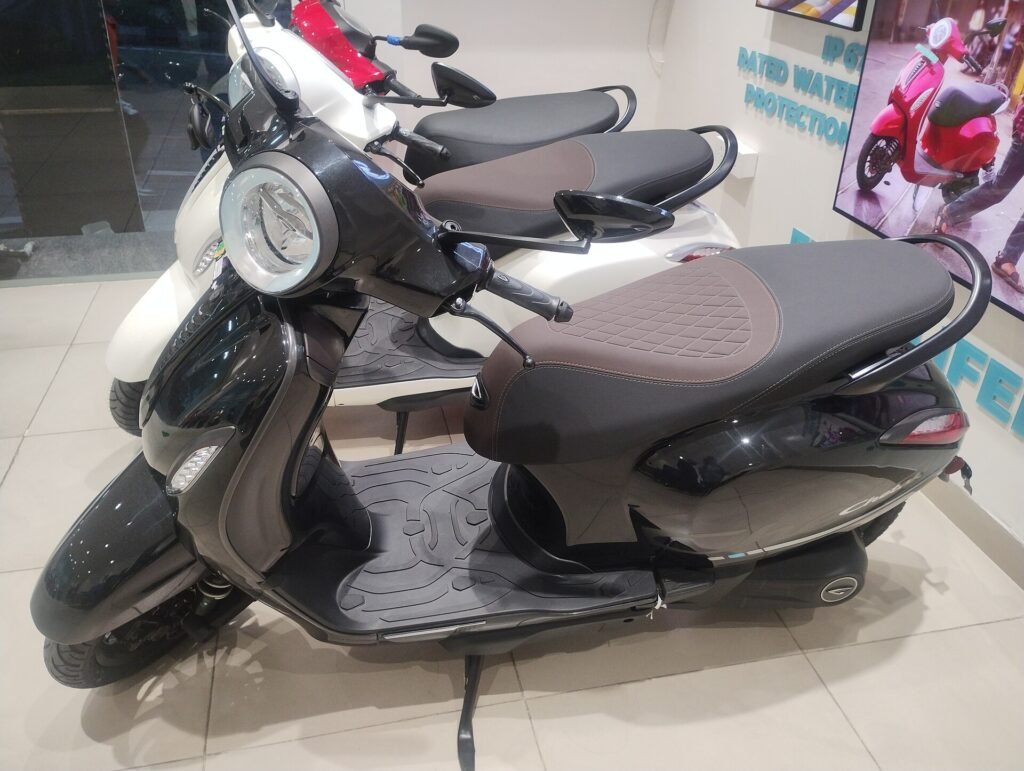
Featured image credit: Image: Gpkp via Wikimedia Commons (CC BY-SA 4.0). Source
Simple Energy spent five years building a reputation on one idea: the longest-range electric scooter you could buy in India. The Simple One chased headline range numbers and enthusiast attention. On 2 September 2026, the Bengaluru company did something rather different. It launched the Simple Wave, a family scooter with a flat single-piece seat, 70 litres of boot space and a starting price of Rs 1,09,999 ex-showroom.
Developed under the internal codename Arrive, the Wave is Simple Energy’s attempt to stop selling to enthusiasts and start selling to households. That is a much larger market, and a much harder one to win. This piece looks at what the Wave offers, how its four battery options actually stack up, and where it sits against the family scooters already established in this segment. By Piyush P. Yadav.
What the Simple Wave is
The Wave is a conventional step-through family scooter, which is a deliberate departure for a company whose previous product was a performance-focused machine with a sculpted, rider-centric seat. The Wave’s specification reads like a list of things commuting families actually ask for.
- Flat single-piece seat, so a pillion sits level rather than perched above the rider.
- 70 litres of boot storage, which is generous by segment standards and enough for a helmet plus a grocery run.
- Front disc brake with dual-shock rear suspension.
- Centre stand, a small detail that matters enormously for home charging and everyday parking.
None of that is exotic. That is rather the point. The family scooter segment rewards practicality, predictable running costs and a comfortable pillion seat far more than it rewards acceleration figures.
Variants, battery packs and claimed range
The Wave comes in three model designations, Wave S, Wave and Wave +, built around four battery pack options. The range spread is unusually wide for a single nameplate.
| Battery pack | Claimed IDC range | Positioning |
|---|---|---|
| 2.2 kWh | 110 km | Entry, city commuting |
| 2.7 kWh | 132 km | City plus occasional longer runs |
| 3.7 kWh | 171 km | Mid-range, mixed use |
| 5.0 kWh | 243 km | Top pack, long-distance capable |
Pricing starts at Rs 1,09,999 ex-showroom Bangalore for the entry configuration and climbs with pack size. A 5 kWh pack in a family scooter is a large battery by any Indian standard, and it is where Simple Energy’s engineering heritage shows through.
A necessary word about IDC range
Every one of those range figures is an IDC number, and IDC is a laboratory test cycle. It is not what you will see on your commute. Real-world range on Indian electric scooters typically lands somewhere in the region of 60-75% of the IDC claim depending on rider weight, terrain, traffic and riding mode.
Applying that band to the Wave gives a more useful picture.
| Battery pack | Claimed IDC | Realistic real-world estimate |
|---|---|---|
| 2.2 kWh | 110 km | Roughly 66-83 km |
| 2.7 kWh | 132 km | Roughly 79-99 km |
| 3.7 kWh | 171 km | Roughly 103-128 km |
| 5.0 kWh | 243 km | Roughly 146-182 km |
Those estimates are our own extrapolation from the published IDC figures, not manufacturer claims, and should be treated as indicative until independent road tests appear. We explain the underlying test cycles and why the gap exists in our guide to IDC range versus TrueRange versus real range on Indian electric scooters.
Which pack should you actually buy?
This is the decision that will cost or save you the most money, and the honest answer for most buyers is: a smaller one than you think.
Work out your genuine daily distance, not your worst imagined trip. A typical urban commuter covers 25-40 km a day. Against a realistic 66-83 km from the 2.2 kWh pack, that is comfortable daily range with a full charge every second or third day.
- Under 35 km a day, charging at home: the 2.2 kWh pack is sufficient and is the cheapest way into the range.
- 35-60 km a day, or no reliable home charging: step up to 2.7 kWh or 3.7 kWh for buffer.
- Over 60 km a day, or regular intercity runs: the 5 kWh pack earns its price.
- Cold or hilly regions: add one step up, because both conditions cut range meaningfully.
The larger packs carry a second hidden cost: charging time. A 5 kWh battery takes roughly twice as long to fill from a standard home point as a 2.7 kWh one. If you charge overnight that is irrelevant. If you need a mid-day top-up, it is not.
Where the Wave sits in the market
The family electric scooter segment has become genuinely crowded, and the Wave enters against established nameplates with large dealer networks behind them.
| Scooter | Approximate starting price | Key strength |
|---|---|---|
| Simple Wave | Rs 1,09,999 | Up to 5 kWh pack, 70 litre boot |
| Bajaj Chetak | Around Rs 1.10 lakh | Metal body, wide service network |
| TVS iQube | Around Rs 1.00 lakh | Dealer reach, proven reliability |
| Honda Activa e | Around Rs 1.10 lakh | Swappable battery, Honda badge |
| Ather Rizta | Around Rs 1.10 lakh | Family focus, software and charging network |
Prices above are indicative ex-showroom starting figures and vary considerably by city and variant, so treat them as a positioning guide rather than a quote. On paper the Wave is competitive on price and clearly ahead on maximum battery capacity. The open question is service.
Simple Energy is a young company with a far smaller physical footprint than TVS, Bajaj or Honda. For a family scooter bought as primary transport, service accessibility is not a footnote. Before booking, confirm what service presence exists in your city and what the response time looks like for a breakdown. Our scorecard on how TVS, Bajaj, Ather and Vida performed through the first million electric two-wheeler sales of 2026 puts the scale difference in context.
The subsidy situation has changed
One piece of context materially affects what the Wave costs you. The PM E-DRIVE incentive for electric two-wheelers, which paid Rs 2,500 per kWh capped at Rs 5,000 in its final phase, closed on 31 July 2026. Electric scooters bought from 1 August 2026 onwards receive no central cash subsidy.
That means the Rs 1,09,999 figure is not going to be reduced by a central incentive. State-level benefits may still apply depending on where you register, and road tax and registration waivers remain significant in several states. Our guide to PM E-DRIVE subsidy status and the e-voucher claim process explains what is still available and to whom.
What to check before you book
- Battery warranty terms. Duration, kilometre cap, and the state-of-health threshold that triggers a claim.
- Charger included or extra. Confirm what ships in the box and what a faster charger costs.
- Service centre distance from your home or workplace.
- Real-world range from an existing owner in your city, not a showroom figure.
- Delivery timeline, which for a newly launched model from a smaller manufacturer can stretch.
It is also worth learning how to monitor pack condition yourself over time. Our walkthrough on how to check electric scooter battery health in India covers the practical methods.
The verdict
The Simple Wave is a credible product in a segment that punishes credible-but-unremarkable. Its 5 kWh top pack is genuinely differentiated, 70 litres of boot space is a real advantage, and the entry price is competitive against far larger companies.
The reservation is not about the scooter. It is about buying primary family transport from a manufacturer whose service network is still being built. For buyers in Bengaluru and other cities where Simple Energy has presence, the Wave deserves a serious look and a test ride. For buyers further from that footprint, the question worth asking at the dealership is not about range. It is about what happens on the day something goes wrong.
Sources & Further Reading
- Autocar India: Simple Wave launched at Rs 1.10 lakh
- Autocar Professional: Simple Energy scooter launch and range details
- BikeDekho: Simple Wave price, range and specifications
Frequently Asked Questions
What is the Simple Wave price in India?
The Simple Wave starts at Rs 1,09,999 ex-showroom Bangalore for the entry configuration. Prices rise with battery pack size across the Wave S, Wave and Wave + variants. No central PM E-DRIVE cash subsidy applies, as that incentive for electric two-wheelers closed on 31 July 2026.
What battery options does the Simple Wave offer?
Four packs are available: 2.2 kWh, 2.7 kWh, 3.7 kWh and 5.0 kWh, with claimed IDC ranges of 110 km, 132 km, 171 km and 243 km respectively. The 5 kWh option is among the largest batteries offered in an Indian family electric scooter.
What is the real-world range of the Simple Wave?
Simple Energy quotes IDC laboratory figures. Indian electric scooters typically deliver 60-75% of IDC range in real use, which would put the 2.2 kWh pack at roughly 66-83 km and the 5 kWh pack at roughly 146-182 km. These are extrapolated estimates, not manufacturer claims, and independent road tests will give firmer numbers.
How does the Simple Wave compare to the Chetak and iQube?
The Wave is priced comparably to the Bajaj Chetak, TVS iQube, Honda Activa e and Ather Rizta, and offers a larger maximum battery and 70 litres of boot space. Its main disadvantage is service network scale, since Simple Energy is a far smaller company than TVS, Bajaj or Honda. Check local service availability before booking.