

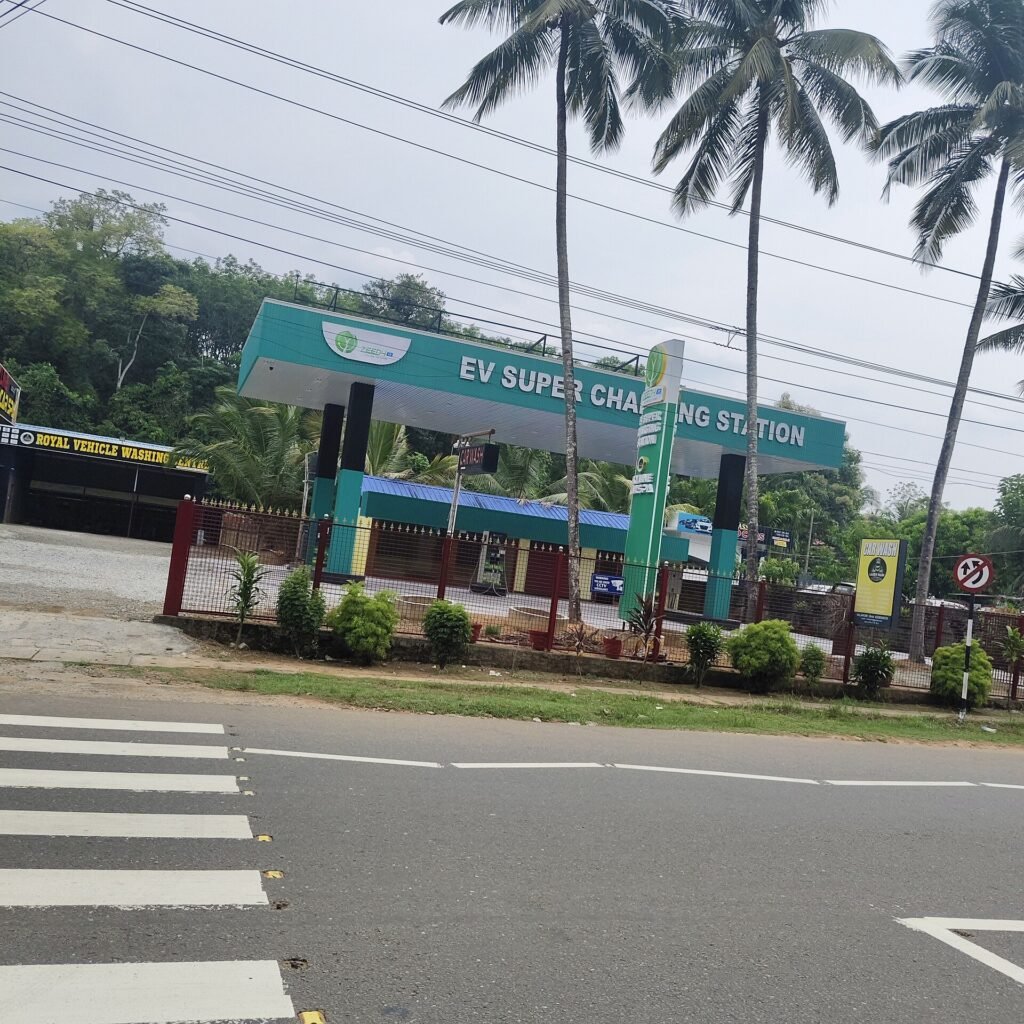
Featured image credit: Image: Sujithshivam511 via Wikimedia Commons (CC BY-SA 4.0). Source
By Piyush P. Yadav
Is an EV charging station profitable in India? At the utilisation most public chargers actually achieve, no. A 60 kW DC fast charger costs about Rs 15 lakh to put in the ground, the Ministry of Power caps what you can charge for the service at Rs 11 to 13 a unit, and the average Indian public charger is in use 1 to 5 per cent of the time. Run those three numbers together and the payback on a typical site is somewhere between eight and eighteen years, which is longer than the equipment lasts. The business turns profitable at about 7 per cent utilisation, which is roughly five car charging sessions a day, and becomes genuinely good above 15 per cent. This guide sets out the setup cost line by line, the revenue rules that apply to every public charger in the country, a break-even model you can adjust for your own site, and the franchise routes that shift the risk onto a bigger operator.
How we worked this out
Hardware and installation costs are from Bolt.Earth’s July 2026 price guide and MyEVCharger’s commercial setup breakdown, checked on 10 September 2026. The tariff rules are the Ministry of Power’s guidelines of 17 September 2024, valid to 31 March 2028, which we took apart in our explainer on how public charging prices are set. Utilisation figures are the SBI (1 to 3 per cent) and S&P Global (about 5 per cent) estimates we reported in our analysis of India’s charger utilisation and operator economics. The model below uses conservative operating costs and assumes the operator prices at the service-charge cap, which is what low-traffic sites do.
What it costs to set up
| Item | 7.4 kW AC point | 30 kW DC | 60 kW DC | 120 kW-plus DC hub |
|---|---|---|---|---|
| Charger hardware | Rs 35,000 to 1.2 lakh | Rs 3 to 6 lakh | Rs 6 to 10 lakh | Rs 15 to 25 lakh |
| Installation, cabling, earthing | Rs 5,000 to 20,000 | Rs 1 to 2 lakh | Rs 1.5 to 4 lakh | Rs 5 to 10 lakh |
| Electrical connection, transformer, DISCOM charges | Usually existing supply | Rs 50,000 to 2 lakh | Rs 2 to 5 lakh | Rs 5 to 10 lakh-plus |
| Civil work, canopy, signage, CCTV | Rs 10,000 to 30,000 | Rs 50,000 to 1 lakh | Rs 1 to 2 lakh | Rs 2 to 5 lakh |
| Software, payment integration, listing on apps | Rs 10,000 to 25,000 | Rs 25,000 to 50,000 | Rs 25,000 to 50,000 | Rs 50,000 to 1 lakh |
| All-in capital cost | Rs 0.7 to 2 lakh | Rs 6 to 11 lakh | Rs 11 to 21 lakh | Rs 28 to 50 lakh |
Land is excluded because most Indian charging sites are on someone else’s property: a fuel station, a hotel, a mall or a housing society, under a revenue share or a nominal rent. On public land the Ministry of Power prescribes a fixed Rs 1 per kWh to the landowning agency. If you own the plot, the opportunity cost of the parking bays is the largest number in the whole model and should be added.
What you are allowed to earn
Public charging is a regulated business. A charge point operator buys electricity from the DISCOM at a special EV tariff, capped at the DISCOM’s average cost of supply and set at 0.7 times that in the 9 am to 4 pm solar window and 1.3 times outside it, and resells it to the driver at the same energy cost plus a service charge. The service charge is the operator’s entire margin, and the Ministry of Power caps it.
| Charger type | Service charge cap, solar hours | Service charge cap, other hours | Typical energy cost to CPO | Typical driver price incl. 18 per cent GST |
|---|---|---|---|---|
| AC (3.3 to 22 kW) | Rs 3 per kWh | Rs 4 per kWh | Rs 4 to 9 per kWh | Rs 9 to 15 per kWh |
| DC fast (30 kW and above) | Rs 11 per kWh | Rs 13 per kWh | Rs 4 to 9 per kWh | Rs 18 to 26 per kWh |
Electricity is a pass-through: whatever the DISCOM charges, the driver pays, so the state tariff does not change the operator’s margin, only the headline price. It does change demand, because a Rs 24 unit in Maharashtra sells fewer kilowatt-hours than a Rs 18 unit in Gujarat or Delhi. The operator’s gross margin on a DC charger is therefore Rs 11 to 13 per unit sold, less GST handling, less the Rs 1 land share on public sites, less payment gateway fees of about 2 per cent. Call it Rs 10.50 net per unit.
The break-even model: a 60 kW DC charger
Assumptions: capital cost Rs 15 lakh; net margin Rs 10.50 per kWh; fixed monthly costs of Rs 6,500 (software and network fees Rs 1,500, maintenance and the mandated 98 per cent uptime contract at 4 per cent of capital a year, or Rs 5,000). Utilisation is the share of the 24-hour day the charger is delivering energy at full power; one 25 kWh car session is about 25 minutes at 60 kW.
| Utilisation | Energy sold per month | Car sessions a day (25 kWh each) | Net margin per month | Simple payback |
|---|---|---|---|---|
| 3 per cent (SBI average) | 1,296 kWh | 1.7 | Rs 7,100 | About 17.6 years |
| 5 per cent (S&P average) | 2,160 kWh | 2.9 | Rs 16,200 | About 7.7 years |
| 7 per cent (break-even for 5-year payback) | 3,024 kWh | 4.0 | Rs 25,300 | About 4.9 years |
| 10 per cent | 4,320 kWh | 5.8 | Rs 38,900 | About 3.2 years |
| 15 per cent | 6,480 kWh | 8.6 | Rs 61,500 | About 2.0 years |
| 20 per cent | 8,640 kWh | 11.5 | Rs 84,200 | About 1.5 years |
Read the third column, not the first. The difference between a losing site and a good one is the difference between two cars a day and six. A DC charger reaches a five-year payback at four sessions a day, which sounds trivial until you remember that 93 per cent of Indian EV owners charge at home and that the average public charger today sees fewer than two. The franchise brochures that promise 20 per cent utilisation and an 18-month payback are describing a highway site on a busy corridor or a fleet depot with contracted vehicles, not a charger in a mall basement.
Why AC chargers are worse, not better
An AC point is cheap, but its margin is capped at Rs 3 to 4 a unit and it dispenses 7.4 kWh an hour at most. At 10 per cent utilisation it sells about 530 units a month for a margin under Rs 2,000, against a Rs 1 lakh installed cost: a four-year payback with no fixed costs, longer with them. AC chargers make sense as an amenity at a hotel or office where the host, not the charger, is the business.
What moves a site above 7 per cent
- A contracted base load. A fleet of ten electric cabs or a bus depot contract guarantees the sessions the model needs. The most reliable revenue in Indian charging is Tata Power’s 1,200 bus-depot points, not its public ones, as we noted in our report on Tata Power’s EZ Charge expansion.
- Highway corridors with no competition within 50 km. Intercity drivers must charge somewhere; a four-gun hub on a corridor with two chargers per 100 km gets them. A sixth charger in Gurugram does not.
- 24-hour access. A charger behind a mall gate that closes at 10 pm loses a third of its available hours.
- Presence on the apps drivers use. A charger that is not on the major aggregator apps does not exist to most drivers; our comparison of India’s charging networks and apps shows which ones matter.
- Daytime pricing. Energy in the solar window costs the operator 0.7 times the base tariff. Passing that on as a cheaper daytime rate pulls fleet and office charging into the hours the charger would otherwise sit idle.
The franchise and host routes
| Route | What you put in | What the operator does | What you get |
|---|---|---|---|
| Own and operate | Full capital cost, site, DISCOM connection, software subscription | Nothing; you list on the apps yourself | Entire service margin, entire risk |
| Franchise (for example Tata Power EZ Charge) | Franchise fee of about Rs 1 to 2.5 lakh plus the installation cost; the site | Site assessment, equipment, installation, app listing, maintenance, billing | A share of the service revenue; brand and traffic |
| Host or partner (for example Statiq’s EV Mitra) | Site and a small investment, quoted at Rs 1.5 to 5 lakh | Owns and runs the charger | Rent or a revenue share; earnings claims of Rs 10,000 to 50,000 a month are the franchisor’s, not ours |
The franchise route trades margin for traffic. A branded charger appears in an app used by lakhs of drivers from day one and inherits the operator’s fleet contracts, which is worth more than the fee if your own site would otherwise start at 2 per cent utilisation. The host route is the right answer for a landowner who wants an amenity and some rent rather than a business.
Who this is for, and the limits
This model is for a private investor or a small business weighing a single site. It excludes land cost, financing cost and the value of the Rs 2,000 crore PM E-DRIVE charging subsidy, which flows to oil companies and large operators through tenders rather than to individuals. Operating costs are conservative estimates; a site with a full-time attendant or a security guard adds Rs 15,000 to 25,000 a month and pushes break-even utilisation above 10 per cent. Tariff caps run to 31 March 2028 and could be revised; utilisation is rising, at 25 per cent a year on Tata Power’s network, but from a base low enough that most sites remain below the line for now.
Sources & Further Reading
- Bolt.Earth: EV fast charger cost in India 2026, price and ROI guide
- MyEVCharger: Commercial EV charging station setup cost in India
- Tata Power: How to start an EV charging station franchise in India
People also ask
Is an EV charging station profitable in India?
Only above about 7 per cent utilisation, or four 25 kWh car sessions a day on a 60 kW charger, which gives a five-year payback on a Rs 15 lakh site. The Indian average is 1 to 5 per cent, at which payback runs 8 to 18 years. Sites with fleet contracts or on uncontested highway corridors do far better.
How much does it cost to set up an EV charging station in India?
About Rs 0.7 to 2 lakh for a 7.4 kW AC point, Rs 6 to 11 lakh for a 30 kW DC charger, Rs 11 to 21 lakh for a 60 kW DC charger and Rs 28 to 50 lakh for a 120 kW-plus hub, including installation, electrical connection, civil work and software but excluding land.
How do EV charging stations make money?
From a per-unit service charge on top of the pass-through electricity cost. The Ministry of Power caps it at Rs 11 (solar hours) to Rs 13 per kWh for DC and Rs 3 to 4 for AC until March 2028. After GST handling, gateway fees and any land share, a DC operator nets about Rs 10.50 per unit sold.
Which EV charging station franchise is best in India?
It depends on your site. Tata Power’s franchise, with a fee of about Rs 1 to 2.5 lakh plus installation, brings the largest network and app traffic. Statiq’s host model needs Rs 1.5 to 5 lakh and suits landowners who want rent rather than a business. Judge any franchise on the traffic it can deliver, not its brochure payback.
Is an EV charging station a good business in India?
For large operators with fleet contracts and highway hubs, increasingly yes: Tata Power’s public-charger revenue rose 65 per cent in FY2026. For an individual with a single urban site and no contracted vehicles, not yet; most such sites sit below break-even utilisation.
Is EV charging free in India?
Rarely. Some hotels, malls and housing societies offer free AC charging as an amenity, and a few manufacturers bundle free public charging credits for the first year. Public DC fast charging costs Rs 18 to 26 per unit including GST; home charging at Rs 6 to 9 per unit is the cheapest option.
Do I need a licence to open an EV charging station in India?
No. Public EV charging is a de-licensed activity under the Ministry of Power’s guidelines, so no electricity distribution or trading licence is required to sell charging. What you do need is a separate metered connection at your DISCOM’s EV tariff, chargers meeting the prescribed standards and connector types, compliance with the service-charge cap and the 98 per cent uptime obligation, and the usual local clearances for land use, fire safety and electrical inspection.
Is there a government subsidy for setting up an EV charging station in India?
Yes, but very little of it reaches individual investors. PM E-DRIVE earmarks Rs 2,000 crore of its Rs 10,900 crore outlay for roughly 72,300 public charging points, with up to 100 per cent support for chargers on government premises that offer free public access, and about 80 per cent of upstream infrastructure plus 70 per cent of equipment cost at bus and metro stations, municipal parking lots, toll plazas, airports and fuel retail outlets. It is disbursed through tenders to nominated agencies and large operators, so a private roadside, mall or hotel site should be modelled without it.
How much does an EV charging station owner earn per month in India?
On the 60 kW DC model above, at the 5 per cent utilisation S&P Global estimates for Indian chargers, the site sells about 2,160 units a month at a net Rs 10.50 per unit, or roughly Rs 16,200 before financing and land costs. At 10 per cent utilisation, close to six car sessions a day, it is about Rs 38,900 a month, and at 15 per cent about Rs 61,500. Franchise brochures quoting Rs 50,000 a month describe the top of that range, not the average Indian site, which today runs at 1 to 5 per cent.