

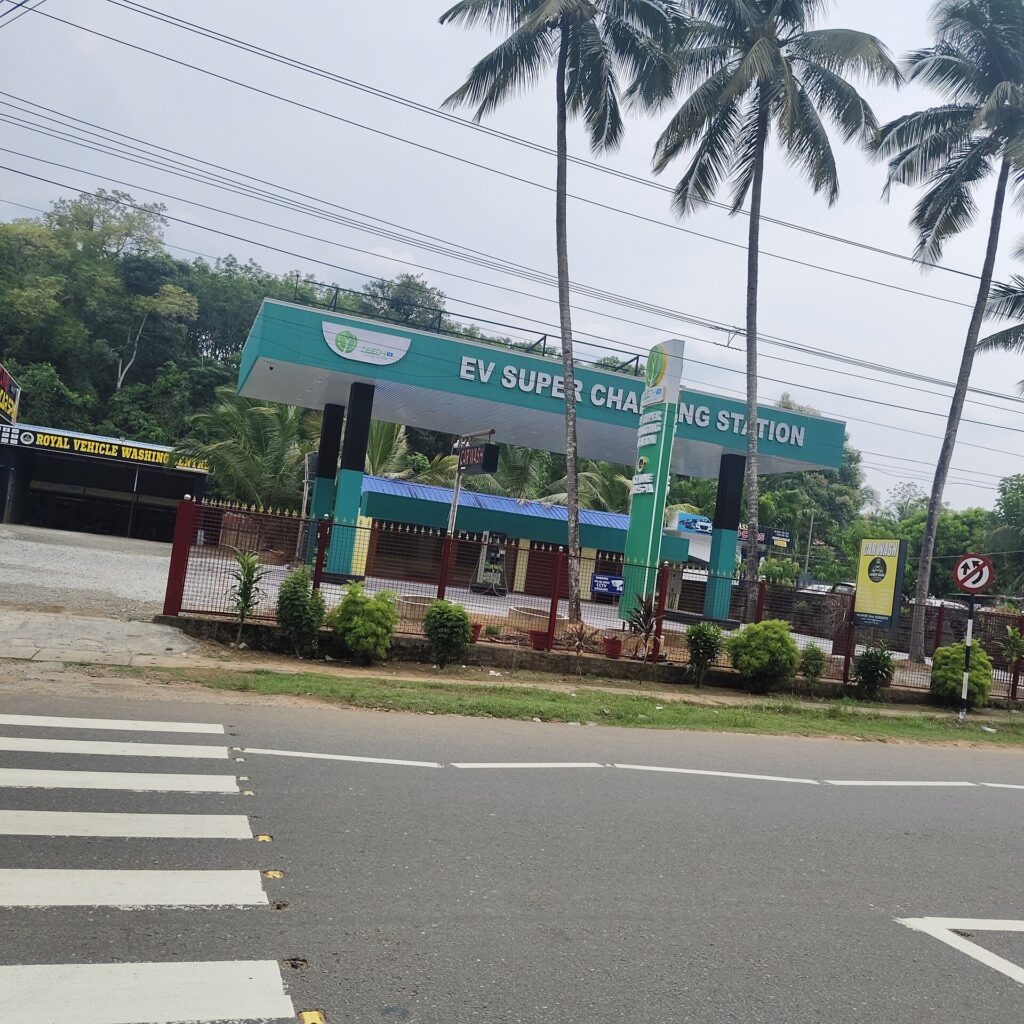
Featured image credit: Image: Sujithshivam511 via Wikimedia Commons (CC BY-SA 4.0). Source
By Piyush P. Yadav
Tata Power, which runs the largest single public charging network in India, has said it is taking the next phase of its EZ Charge expansion out of the metros and into tier-2 and tier-3 towns and the highways that connect them, and it has put numbers on the plan. The company now operates 3,373 charging stations with more than 6,700 public and captive charging points, has installed over 2.5 lakh home chargers and 1,200 bus-depot points, and is present in more than 700 cities and towns. By 2030 it wants 7.5 lakh home chargers, 10,000 public points and a highway network built around hubs with at least four guns each at above 120 kW. Behind the targets is a financial-year report that, for the first time, shows a public charging business growing faster on revenue than on hardware: utilisation up 25 per cent and public-charger revenue up 65 per cent in FY2026. This report sets out the numbers, what they mean for the economics of charging in India, and where the new sites are actually going.
The network today
| Metric | Figure | Source and date |
|---|---|---|
| Charging stations | 3,373 | Financial Express, 7 September 2026 |
| Public and captive charging points | 6,700-plus | Financial Express, 7 September 2026 |
| Public, semi-public and fleet points at FY2026 end | 5,800-plus | Tata Power FY2026 integrated report |
| Fast-charging points on highways | 1,160-plus across 254 corridors | Tata Power FY2026 integrated report |
| Home chargers installed | 2.5 lakh-plus (2.14 lakh at FY2026 end) | Financial Express; FY2026 report |
| Bus charging points | 1,200-plus | Both |
| Cities and towns covered | 700-plus | Both |
| Registered app users | 5.6 lakh-plus | FY2026 report |
| Charging sessions in FY2026 | 30.22 lakh | FY2026 report |
| Energy delivered in FY2026 | 259.64 million units | FY2026 report |
The jump from 5,800-plus points at the end of March to 6,700-plus in early September implies roughly 900 new public and captive points in five months, or about 180 a month. That is the fastest Tata Power has added public capacity, and it is roughly in line with the pace needed to reach 10,000 points by 2030.
Where the stations are
Of the 3,373 stations, 1,889, or 56 per cent, are in just three states: Maharashtra, Karnataka and Uttar Pradesh. Those are the three largest EV markets by registrations and the three with the longest-running state policies for charging, which is why Tata Power says supportive state policy is the trigger for going into smaller towns. The company’s list of expansion levers is telling: real-estate partnerships for residential and mall charging, fuel-retail integration through the Indian Oil tie-up, fleet contracts and state-backed programmes. The tier-2 and tier-3 push is not a standalone network build; it is a set of partnerships in which someone else owns the land.
What the FY2026 numbers say about the business
Our analysis of Indian charge point utilisation found that most public chargers in the country are used 1 to 5 per cent of the time and that the operators are losing money. Tata Power’s report is the first from a large operator to show the curve bending. Utilisation rose 25 per cent over the year and public-charger revenue rose 65 per cent, which means revenue per point grew faster than the number of points. The company does not disclose an absolute utilisation percentage, but the arithmetic gives a sense of the scale: 259.64 million units across 30.22 lakh sessions is about 86 units a session, a figure inflated by the 1,200 bus-depot points that deliver hundreds of units per charge. Strip the buses out and a typical car session on the network is closer to the 20 to 30 units you would expect from a 10-to-80 per cent charge on a 40 to 60 kWh pack.
| FY2026 operating metric | Value | What it implies |
|---|---|---|
| Utilisation growth | +25 per cent | Existing sites are busier, not just more numerous |
| Public-charger revenue growth | +65 per cent | Revenue per point rising; tariff mix shifting toward DC |
| Green kilometres enabled | 41.39 crore | About 1.6 km per unit delivered, consistent with a car-heavy mix |
| Carbon avoided | 15.47 lakh tonnes | Company’s own estimate |
| Renewable-powered points, Mumbai | 1,000-plus | Includes the 16-bay MegaCharger hub near the airport |
The hardware side of the report matters for owners. Tata Power added a 7.4 kW AC home charger during the year, which halves the overnight charge time for a 40 kWh pack against the 3.3 kW box most Tata EVs still ship with, and it signed a supply arrangement with Montra Electric for 600 of those 3.3 kW boxes a month, which is where much of the home-charger volume comes from. The MegaCharger hub near Mumbai’s Terminal 2, opened in September 2025 with eight 120 kW DC chargers and 16 bays, is the template for the highway hubs the 2030 plan describes.
The 2030 plan
| Target | Today | 2030 | Multiple |
|---|---|---|---|
| Home chargers | 2.5 lakh | 7.5 lakh | 3x |
| Public charging points | 6,700 | 10,000 | 1.5x |
| Highway hubs | 1,160 fast points, mostly single or twin guns | Hubs of at least 4 guns each, above 120 kW | Format change |
The ratio is the story. Tata Power expects to install three times as many home chargers as it has today but only half again as many public points, which is an explicit bet that most charging will happen at home and that the public network’s job is highways and fleets rather than daily top-ups. The highway target is about format rather than count: replacing single 30 kW or 60 kW posts with four-gun hubs at 120 kW or more. That matters because, as we reported when the Rubix data came out, 73 per cent of India’s public chargers are under 30 kW, and a single slow post on a highway is the kind of site that shows up on the map but does not get used.
How it compares with the other networks
We compared the six largest operators on size, highway strength and tariffs in our guide to India’s EV charging networks. Tata Power’s 6,700 points make it the largest by public and captive count, though Jio-bp Pulse quotes a higher headline figure that includes a large number of two-wheeler and fleet points, and Statiq and ChargeZone have more highway sites in some corridors. The Tata network’s distinguishing features are the Indian Oil forecourt integration, the Tata Motors relationship that puts EZ Charge into the Tata.ev app used by the country’s largest EV customer base, and the bus-depot business, which is the most reliable revenue line in Indian charging because the utilisation is contracted rather than hoped for.
On tariffs, Tata Power’s DC rates sit in the Rs 18 to 24 a unit band common to the large operators, within the service-charge caps we explained in our guide to how public charging prices are set. The company has not announced a tariff change alongside the expansion, and the 65 per cent revenue growth appears to be a volume and mix effect rather than a price rise.
What it means for an EV owner
- If you live in a tier-2 or tier-3 town: the expansion is aimed at you, but through partners. Expect new EZ Charge points at Indian Oil pumps, hotels and large housing developments before you see standalone Tata Power sites.
- If you drive intercity: the four-gun, 120 kW-plus hub format is what to look for on the map. A hub with four guns is far less likely to be occupied or out of order than a single post, and the 254 corridors already covered are where the hubs will appear first.
- If you are buying a home charger: the 7.4 kW unit is worth the extra cost over the 3.3 kW box for any car with a battery above 40 kWh. It is the difference between a full overnight charge and a partial one.
- If you use the app: Tata Power’s Beckn-based Unified Bharat eCharge platform is designed to let you find and pay for chargers on other networks from within one app, which would remove the largest practical annoyance of Indian public charging. It is in development; the timeline has not been published.
Sources & Further Reading
- Financial Express via RetailIntel: Tata Power takes EZ Charge expansion beyond metros to smaller cities and highways (7 September 2026)
- Tata Power: Inside the FY26 integrated report, EV charging beyond access
- Tata Power EZ Charge network page
Frequently asked questions
How many chargers does Tata Power EZ Charge have?
As of September 2026, 3,373 charging stations with more than 6,700 public and captive charging points, over 2.5 lakh home chargers and 1,200-plus bus charging points, across more than 700 cities and towns.
What are Tata Power’s 2030 EV charging targets?
7.5 lakh home chargers, 10,000 public charging points and highway hubs with a minimum of four charging guns each at above 120 kW.
Where is Tata Power expanding next?
Tier-2 and tier-3 towns and highway corridors, largely through partnerships with fuel retailers, real-estate developers, fleets and state programmes. More than half its current stations are in Maharashtra, Karnataka and Uttar Pradesh.
Is Tata Power’s charging business profitable?
The company does not disclose segment profit, but its FY2026 report shows utilisation up 25 per cent and public-charger revenue up 65 per cent, meaning revenue per charger is rising faster than the number of chargers.
How much does it cost to charge at a Tata Power EZ Charge station?
Roughly Rs 18 to Rs 25 a unit at DC fast chargers and about Rs 12 to Rs 20 at AC points, varying by city because the tariff tracks the local commercial electricity rate plus the operator’s service charge. On a 40 kWh car that is about Rs 720 to Rs 1,000 to fill from near-empty on DC, against roughly Rs 320 at a domestic tariff of Rs 8 a unit — the reason home charging remains two to three times cheaper even on this network. The app shows the live per-unit price for each station before you plug in, and RFID tap-and-go is available at most sites.
Can any electric car use Tata Power EZ Charge, or only Tata EVs?
Any EV with the matching connector. The public points use CCS2 for DC and Type 2 for AC, which is the Indian standard, so a Hyundai, MG, BYD or Mahindra charges there exactly as a Nexon EV does. The TATA.ev MegaCharger hubs that Tata Power runs jointly with Tata Passenger Electric Mobility are also open to all brands, but Tata EV owners get priority access and a tariff up to 25 per cent lower — the one respect in which the network is not brand-neutral.
How much does a Tata Power home charger cost, and is one free with a Tata EV?
The 3.3 kW portable cable that ships with most Tata EVs is included in the car’s price; what it needs is a dedicated 15 A industrial socket, which an electrician will wire for about Rs 3,000 to Rs 5,000. A wall-mounted 7.2 kW unit of the kind Tata Power installs costs roughly Rs 25,000 to Rs 35,000 for the hardware, with standard installation of 10 to 15 metres of cabling adding about Rs 5,000 to Rs 15,000 depending on the run from your meter. Tata Power has now fitted more than 2.5 lakh home chargers, and the installation is usually booked through the dealer at the time of delivery.