

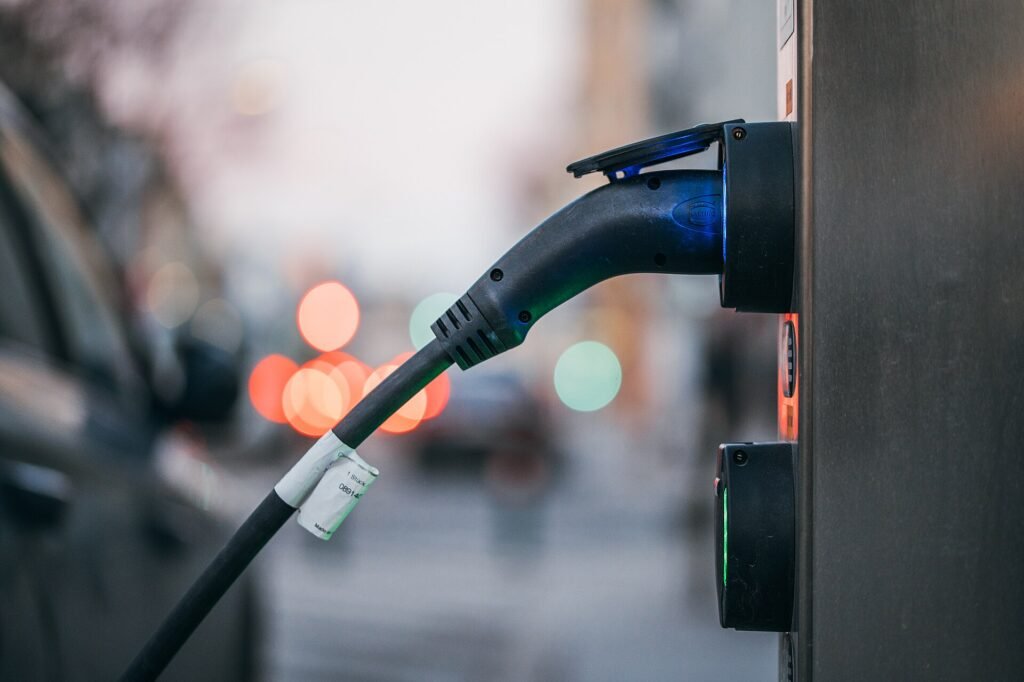
Featured image credit: Image: Ivan Radic via Wikimedia Commons (CC BY 2.0). Source
By Piyush P. Yadav
A growing number of electric cars sold in India can run a kettle, a laptop, a projector or even another EV from their traction battery. The feature is called vehicle-to-load, or V2L, and its cousin vehicle-to-vehicle, or V2V, lets one EV top up another that has run flat. Tata lists both on the Nexon EV, Curvv EV and Harrier EV; Hyundai fits V2L to the Creta Electric; Kia’s Syros EV and EV6 have it; MG’s Windsor has V2L and V2V and the Hector Tomahawk EV goes a step further with vehicle-to-home. This explainer sets out how V2L works, which Indian models offer it and at what power, what you can realistically run, how much range it costs, and where the limits are before you plan to power a wedding pandal from your SUV.
How V2L works
An EV’s battery stores direct current at 300 to 800 volts. The car’s onboard charger normally converts household AC into DC to fill the pack. A V2L-capable car has a bidirectional stage, or a separate inverter, that does the reverse: it takes DC from the pack, steps it down and converts it to 230-volt, 50 Hz AC and delivers it through either a three-pin socket inside the cabin, a socket in the boot, or an adapter that plugs into the charging port itself. The last method is common on Hyundai and Kia cars, where a V2L adapter with a standard socket clips into the CCS2 inlet.
V2V uses the same hardware but the output goes into a portable charging cable, so the donor car behaves like a slow AC charger for the recipient. Vehicle-to-home, or V2H, needs a bidirectional wallbox and a switch on the house side; it is a different and more expensive proposition, and in India only the MG Hector Tomahawk EV has been sold with it, which we described in our report on the Hector Tomahawk EV’s V2H capability.
Which Indian EVs have V2L and V2V
The table lists models where the manufacturer’s own specification page or launch material confirms the feature. Where the maker publishes an output figure it is given; where it does not, the industry-standard 3.3 to 3.6 kW range is noted as an expectation, not a spec.
| Model | V2L | V2V | Published output | Where the socket is |
|---|---|---|---|---|
| Tata Nexon EV (45 kWh) | Yes | Yes | Not published; 3.3 kW class | Cabin socket plus V2V cable |
| Tata Curvv EV (45 / 55 kWh) | Yes, top variants | Yes, top variants | Not published; 3.3 kW class | Cabin socket plus V2V cable |
| Tata Harrier EV | Yes | Yes | Not published; 3.3 kW class | Cabin socket plus V2V cable |
| Hyundai Creta Electric | Yes, 42 kWh Premium and Excellence, 51.4 kWh Excellence | No | Not published; 3.6 kW class | Three-pin socket in cabin plus charge-port adapter |
| Kia Syros EV (42 / 51.4 kWh) | Yes | No | Not published; 3.6 kW class | Cabin socket and charge-port adapter |
| Kia EV6 | Yes | No | 3.6 kW (global spec) | Charge-port adapter and rear-seat socket |
| MG Windsor EV / Windsor EV Pro | Yes | Yes | Not published; 3.3 kW class | Charge-port adapter |
| MG Hector Tomahawk EV | Yes | Yes | V2L plus V2H via bidirectional wallbox | Charge port |
| BYD Atto 3 / Seal / Sealion 7 | Yes | No | 3.3 kW (BYD spec) | Charge-port adapter |
| Mahindra BE 6 / XEV 9e / XEV 9S | Not listed on published specs | Not listed | Not published | Confirm with dealer |
| Tata Tiago EV / Punch EV | Punch EV yes; Tiago EV no | Punch EV yes | Not published | Cabin socket on Punch EV |
The pattern is that V2L has become a standard feature on Tata, Hyundai, Kia, MG and BYD electric cars from about Rs 12 lakh upwards, while Mahindra’s INGLO-platform SUVs, which lead on charging speed and battery size, do not advertise it. If V2L matters to you and you are cross-shopping a BE 6 against a Curvv EV or Creta Electric, ask the Mahindra dealer to demonstrate it before signing; we could not find it in the company’s published specification sheets.
What 3.3 kW actually runs
Most V2L systems are rated at 3.3 or 3.6 kW continuous, roughly the same as a 15-amp household socket. That is enough for a surprising amount, but not for everything.
| Appliance | Typical draw | Runs on 3.3 kW V2L? | Hours from 10 kWh of battery |
|---|---|---|---|
| Laptop, phone chargers, LED lights | 100 to 200 W | Yes | 50 or more |
| Projector and speaker | 300 to 500 W | Yes | About 20 |
| Electric kettle | 1,500 to 2,000 W | Yes | About 5 (or 100-plus boils) |
| Induction cooktop | 1,800 to 2,100 W | Yes, one at a time | About 5 |
| 1-ton inverter air conditioner | 900 to 1,200 W running | Yes | About 8 to 10 |
| 1.5-ton non-inverter AC | 2,000 W running, higher start surge | Marginal; start-up surge may trip it | About 4 to 5 if it runs |
| Geyser or 3 kW heater | 2,500 to 3,000 W | Borderline, nothing else at the same time | About 3 |
| Another EV via V2V | Up to 3.3 kW | Yes | 10 kWh adds about 50 to 60 km |
Two rules govern the practical use. First, watch the surge: motors and compressors draw two to three times their running wattage for a second at start-up, and a V2L inverter that trips on overload will need to be reset from the car. Second, the car will normally cut V2L off at a preset state of charge, often 20 per cent, so you cannot strand yourself; some cars let you set that floor in the infotainment menu.
What it costs in range
Energy drawn is energy not available for driving, and the inverter loses a few per cent in the conversion. A car that returns 6.5 km per kWh will give up about 7 km of range for every kWh delivered through V2L. Running a 1-ton inverter AC for a night’s camping, say eight hours at 1 kW, uses 8 kWh and costs about 55 km of range on a Creta Electric or Curvv EV. Boiling a kettle for tea costs about 0.1 kWh, less than a kilometre. V2V is where the arithmetic bites: giving a stranded Nexon EV 10 kWh takes about three hours at 3.3 kW and costs the donor around 65 km, and the recipient only gains about 55 km after charging losses, so V2V is a get-to-the-next-charger tool, not a substitute for a fast charger. Our explainer on EV charging curves and real 10-80 per cent times shows why a DC charger is always the better plan when one is within reach.
Battery chemistry and V2L
V2L is a light load for the pack: 3.3 kW is less than a tenth of what the motor draws under hard acceleration, and about a twentieth of what a 60 kW DC charger pushes in. It therefore adds negligible wear whether the car uses LFP cells, as most Tata and BYD models do, or NMC cells, as the Creta Electric and Syros EV do; the differences between those chemistries, which we set out in our guide to LFP versus NMC batteries in Indian EVs, matter for fast charging and hot-weather life, not for running a laptop. What does matter is temperature: on a very hot afternoon the battery’s own cooling pump and the cabin blower draw from the same pack, so V2L output in a parked car at 45 degrees will be a little lower than the rated figure, and the car may run its thermal management while it powers your load. The preconditioning systems we described in our piece on EV battery preconditioning in India are the same hardware doing the same job.
Safety and legal points
- Use only the manufacturer’s V2L adapter. Third-party adapters that plug into a CCS2 inlet exist but bypass the car’s protection logic.
- Do not back-feed a house wiring circuit through a socket. That is illegal, dangerous to linemen, and not what V2L is designed for; V2H needs a proper transfer switch.
- Keep extension leads short and rated for 16 amps; a 3.3 kW load on a thin lead is a fire risk.
- Check that the appliance is earthed or double-insulated; most V2L outputs are floating.
- Insurance policies do not exclude V2L use, but damage to the car’s electronics from a faulty appliance may be contested; keep the adapter and appliance to standard.
Is it worth paying for?
On most cars V2L comes bundled in the higher variants rather than as an option, so the real question is whether it tips you towards a top trim. For people who camp, run a small shop or stall from the car, host outdoor events, or live where power cuts are common, a 40 to 50 kWh battery on wheels is a genuinely useful backup: it holds five to ten times what a typical home inverter battery does. For a daily commuter it is a party trick that will be used twice a year. Either way it is one more reason the 800-volt versus 400-volt debate we covered in our 800V versus 400V architecture explainer is less relevant to most buyers than the features list: V2L output is the same 3.3 to 3.6 kW on either.
Sources & Further Reading
- Tata.ev: Nexon EV specifications (V2L and V2V)
- Tata.ev: Curvv EV specifications
- Autocar Professional: Kia launches Syros EV with vehicle-to-load capability
- EVFY: V2L in electric vehicles explained
FAQ
Which electric cars in India have V2L?
The Tata Nexon EV, Curvv EV, Harrier EV and Punch EV, Hyundai Creta Electric, Kia Syros EV and EV6, MG Windsor EV and Hector Tomahawk EV, and the BYD Atto 3, Seal and Sealion 7 all list vehicle-to-load. Mahindra’s BE 6, XEV 9e and XEV 9S do not list it on their published specifications.
How much power does V2L give?
Most systems deliver 3.3 to 3.6 kW of 230-volt AC, about the same as a 15-amp household socket. That runs a kettle, an induction cooktop or a 1-ton inverter AC, but not a large non-inverter AC or several heavy loads together.
Does V2L damage the battery?
No. A 3.3 kW draw is a small fraction of what driving or DC fast charging demands, so the added wear is negligible on both LFP and NMC packs. The car cuts V2L off at a preset state of charge so it cannot fully drain the battery.
Can I charge another EV from my car?
Only if your car supports V2V, which Tata’s Nexon EV, Curvv EV, Harrier EV and Punch EV and MG’s Windsor and Hector Tomahawk do. It works at about 3.3 kW, so 10 kWh takes about three hours and adds roughly 55 km to the other car.
Do you need a special adapter for V2L, and does it come with the car?
Yes. V2L runs through an adapter that plugs into the car’s Type 2 charging port and presents an ordinary Indian three-pin socket; without it the car cannot run appliances at all. Whether one is in the box depends on the variant and the dealer, so confirm it at delivery. Third-party adapters for the Nexon EV 45, Curvv EV and Harrier EV are sold separately, typically with 10 A or 16 A sockets, IP55 weather sealing and ratings of 2.5 to 3.3 kW.
Is V2L available on every variant or only the top models?
Only the higher trims with the larger pack. On the Nexon EV, V2L and V2V come with the 45 kWh variants rather than the mid-range battery, and even within those the entry Creative 45 does not get the function while the Empowered Plus trims do. Variant feature lists differ from the headline model brochure, so if V2L is a reason you are buying, check the specific trim before booking.
How long can an electric car power a home during an outage, and what does it cost in range?
Work it out in kWh. A fridge, ceiling fans, lights and a router together draw roughly 300 to 500 W, so a 45 kWh pack can carry that load for more than a day. Add a 1-ton inverter AC and the draw rises to about 1 to 1.2 kW; ten hours at 1 kW is 10 kWh, roughly a fifth of that pack and about 70 km of real-world range at 7 km per kWh. The car also stops V2L at a preset state-of-charge floor, so the usable share is smaller than the full pack. Running the house itself rather than individual appliances needs an electrician to wire a changeover switch, exactly as for a generator.