

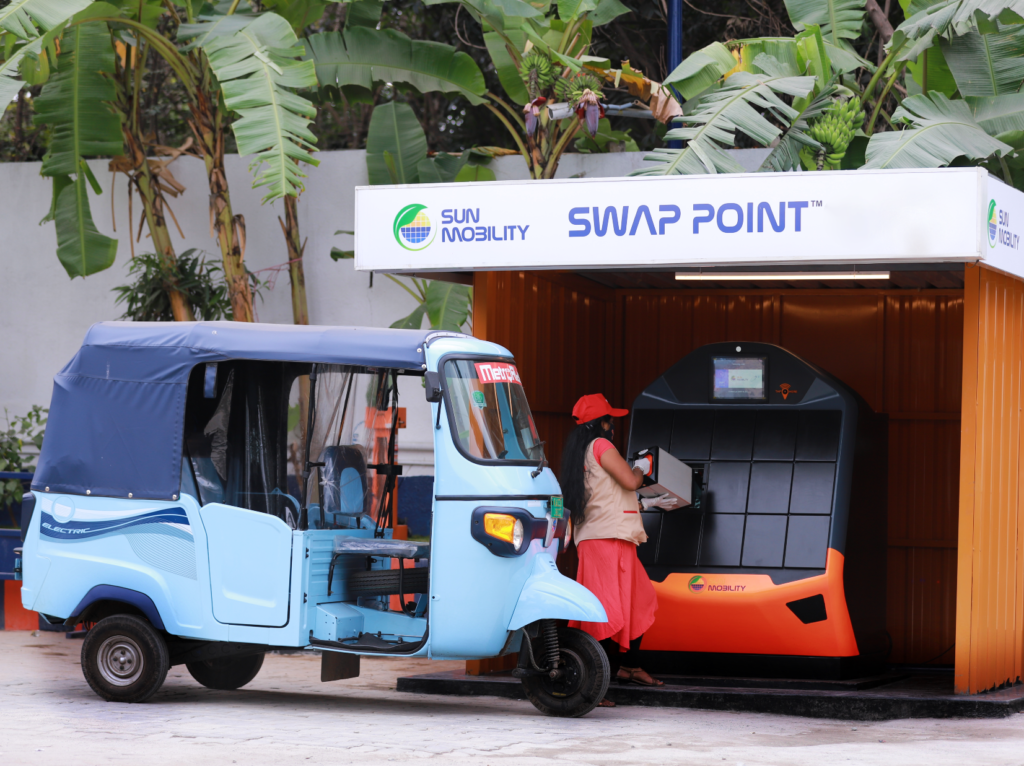
Featured image credit: Image: Eshshiv via Wikimedia Commons (CC0). Source
By Piyush P. Yadav
India’s public charging debate is usually about plugs: how many DC fast chargers there are, how many are above 30 kW, and why they sit idle 95 per cent of the time. But the fastest-growing piece of the country’s EV energy infrastructure does not involve plugging in a vehicle at all. Battery swapping, where a rider pulls a depleted pack out of a scooter or three-wheeler and slots in a charged one in two to five minutes, crossed 100 million swaps at a single operator in December 2025 and now runs from more than 3,000 stations across the two largest networks.
This guide explains how battery swapping works in India in 2026, who operates it, what it costs per kilometre against home and public charging, which retail vehicles can actually use it, what the government subsidises under PM E-DRIVE, and why it has become the default energy model for gig delivery and e-rickshaw fleets while remaining almost irrelevant to private scooter owners.
The networks: who runs swapping in India
Swapping in India is a two-and-three-wheeler business, built around commercial riders who cover 80 to 150 km a day and cannot afford to stop for a two-hour charge. Six operators matter.
| Operator | Stations | Cities | Vehicle focus | Notable |
|---|---|---|---|---|
| Battery Smart | 1,600+ | 50+ | E-rickshaws, e-2W fleets | 100 million swaps (Dec 2025); about 70% of India’s swap infrastructure; 1 lakh+ drivers |
| Indofast Energy | 1,600+ | 23 | E-2W and E-3W | Agreements with 32 OEMs |
| Sun Mobility | 600+ | Multi-city | E-2W, E-3W, now heavy CVs | JV with IndianOil targeting 10,000+ stations in 40+ cities by 2030 |
| Honda e:Swap | About 500 targeted by 2026 | Bengaluru, Delhi, Mumbai | Activa e:, Honda 3W partners | Uses 1.5 kWh Honda Mobile Power Pack e: |
| Gogoro India | Small, fleet-first | Delhi-NCR | Fleet e-2W | Deliberately slow expansion |
| Bounce Infinity | Small | Bengaluru | Infinity E1 retail scooter | Only Indian retail scooter with battery-free purchase option besides Activa e: |
Battery Smart’s scale is the story. Founded in 2019 by IIT-Kanpur graduates Pulkit Khurana and Siddharth Sikka, it runs a franchise model where local shopkeepers host the swap cabinets. By December 2025 it had enabled 3.5 billion kilometres of electric travel, facilitated over Rs 2,800 crore in driver earnings and, on its own accounting, avoided 237,000 tonnes of CO2-equivalent. In July 2026 it raised a further debt facility of over USD 13 million from responsAbility Investments, the fourth such deal in 18 months, taking that lender’s commitment past USD 50 million. Its plan is to expand to 100 more cities during 2026.
Sun Mobility’s importance is the IndianOil joint venture, which brings fuel-station real estate to the model. The JV aims to serve a million customers and operate more than 10,000 stations by 2030. In July 2026 Sun Mobility also unveiled a modular swap platform for heavy commercial vehicles from 3 to 55 tonnes at the PRAWAAS 5.0 show in Gandhinagar, the first serious attempt to bring swapping to trucks and buses in India.
How a swap works
The rider pulls up to a cabinet, authenticates with an app or RFID card, removes the depleted pack (typically 1.5 to 2.5 kWh and 8 to 12 kg for a two-wheeler), slides it into an empty slot and takes a fully charged pack from another. The cabinet charges packs at a controlled rate inside a temperature-monitored enclosure kept at 25 to 35 degrees, which is better for battery life than fast charging in a scooter’s underseat bay in 40-degree heat. The whole exchange takes two to five minutes. A two-wheeler consumes roughly 3 kWh per 100 km, so a 2 kWh pack gives 60 to 70 km between swaps.
The critical limitation is that every network is a closed ecosystem. There is no mandated interoperable battery standard in India, so a Battery Smart pack does not fit a Sun Mobility scooter and vice versa. NITI Aayog’s draft Battery Swapping Policy of April 2022 proposed interoperability standards and GST rationalisation, but a final national policy has never been notified. Safety is governed by AIS 156, tightened after the 2022 scooter fire incidents, and connector standards by BIS IS 17017.
What it costs: swapping vs home charging vs public charging
Swapping is priced per swap or per kilometre, and Battery Smart has no single national tariff; rates vary by city and plan. The effective cost for a two-wheeler works out to about Rs 1.2 to 1.5 per km, which is four to five times the cost of charging at home but still well under petrol.
| Energy method | Cost per 100 km (2-wheeler) | Time to refuel | Who it suits |
|---|---|---|---|
| Home charging at Rs 8-10 per unit | Rs 25-30 | 3-6 hours, overnight | Private owners with a plug point |
| Public AC or fast charging | Rs 60-100 | 45 minutes to 4 hours | Occasional top-ups |
| Battery swapping | Rs 110-150 | 2-5 minutes | Gig riders, e-rickshaws, fleets |
| Petrol scooter at about Rs 100 per litre | Rs 180-250 | 2 minutes | Reference |
Two things the per-kilometre comparison hides. First, swapping bundles the battery into the tariff, so the rider never buys a pack, never faces the Rs 40,000 to 80,000 replacement bill we set out in our guide to electric scooter running costs, and buys a cheaper vehicle upfront. Second, for a rider doing 120 km a day, six days a week, the difference between Rs 30 and Rs 130 per 100 km is about Rs 3,700 a month, which is real money; but a two-hour charging stop in the middle of a delivery shift costs more in lost orders. That trade-off is why swapping dominates fleets and barely exists in private ownership.
For a private owner, home charging remains the cheapest option by a wide margin, as our comparison of home versus public charging costs showed for cars as well as scooters.
Which retail vehicles can use swapping
Almost none. Of the mainstream electric scooters sold to private buyers, only the Honda Activa e: (on Honda’s e:Swap network) and the Bounce Infinity E1 (on Bounce’s network) are designed for swapping. The Ola S1, Ather 450 and Rizta, Bajaj Chetak and TVS iQube all use fixed packs that charge in the vehicle. The Hero Vida VX2 has removable batteries, but they are the owner’s, charged at home, not swapped at a station.
This is the fundamental split in the market. The retail brands have chosen fixed packs and, increasingly, battery subscriptions where the manufacturer leases you a pack that stays in your scooter. The swap networks serve OEMs that build fleet scooters and three-wheelers around their specific pack format. The two models do not cross over, and until an interoperability standard exists, they are unlikely to.
What the government pays for
PM E-DRIVE allocates Rs 2,000 crore to charging infrastructure and, under operational guidelines issued in September 2025, extends that support to battery swapping and battery charging stations. The subsidy covers up to 80 per cent of infrastructure cost, rising to 100 per cent for stations on government premises, and the scheme targets more than 48,400 chargers for two- and three-wheelers. The scheme itself was extended to March 2028 with a Rs 11,900 crore outlay earlier this year.
Separately, Delhi’s EV Policy 2026 and several state policies include capital subsidies and land-use relaxations for swap stations, and Uttar Pradesh in 2025 became the first state to subsidise the upstream electrical connection cost of charging and swapping sites. The tariff a swap operator pays for electricity is governed by the same rules as public chargers, which we set out in our explainer on public EV charging tariffs and the solar-hour discount; the 0.7x solar-hour tariff is particularly valuable to swap cabinets, which can shift most of their charging into daylight hours.
The economics for operators
Swap stations have a structural advantage over plug-in chargers: utilisation. A DC fast charger in India is used 1 to 5 per cent of the time, which is why charge point operators lose money. A Battery Smart cabinet in a dense e-rickshaw corridor turns over every pack several times a day. The operator earns on every swap, controls charging conditions to extend pack life, and can buy packs in bulk at fleet prices. The costs are working capital tied up in batteries (a 1,600-station network holds tens of thousands of packs), reverse logistics for degraded packs, and the recycling obligations that now apply to them under the Battery Waste Management Rules.
The risk is technology lock-in. Every pack in a closed network is a liability if the OEMs that build compatible vehicles stop doing so. That is why the networks sign as many OEM agreements as they can (Indofast has 32) and why Battery Smart’s franchise model, which shifts real-estate and staffing cost to local partners, has scaled faster than company-owned models.
What comes next
Three developments to watch through 2027. First, the IndianOil-Sun Mobility rollout, which if it approaches its 10,000-station target will put swapping at fuel stations on most urban arterial roads. Second, heavy-vehicle swapping: Sun Mobility’s modular platform for 3 to 55-tonne trucks addresses the single biggest barrier to electric trucking, which is charging downtime, and could change the economics we described in our report on the proposed Rs 9,852 crore heavy-duty EV scheme. Third, whether the government finally notifies a national swapping policy with an interoperability mandate. Without it, swapping will remain a fleet tool. With it, the sub-Rs 60,000 battery-free scooter could become a mainstream retail product.
Sources & Further Reading
- Autocar Professional: Battery Smart completes 100 million EV battery swaps
- MeraEV: Battery swapping in India 2026, networks, cost and guide
- Autocar Professional: Sun Mobility advances heavy EV adoption with modular battery swapping
- Entrepreneur India: Battery Smart secures over USD 13 million for network expansion
- CEEW: How can battery swapping policies help India’s EV shift?
Frequently Asked Questions
How much does battery swapping cost in India?
For a two-wheeler, roughly Rs 1.2 to 1.5 per km, or Rs 110 to 150 per 100 km. That is four to five times the cost of home charging (Rs 25 to 30 per 100 km) but well below petrol (Rs 180 to 250 per 100 km). Rates vary by city, operator and plan.
Which electric scooters support battery swapping?
Among retail models, only the Honda Activa e: (Honda e:Swap network) and Bounce Infinity E1 (Bounce network). Ola, Ather, Bajaj Chetak, TVS iQube and Hero Vida scooters use fixed or owner-charged packs and cannot use public swap stations.
Who is the largest battery swapping operator in India?
Battery Smart, with over 1,600 stations in 50-plus cities, more than 1 lakh drivers and 100 million swaps completed by December 2025. It operates roughly 70 per cent of India’s swap infrastructure. Indofast Energy also reports 1,600-plus stations, and Sun Mobility has 600-plus.
Does the government subsidise battery swapping stations?
Yes. Under PM E-DRIVE’s September 2025 guidelines, swap and charging stations can receive up to 80 per cent of infrastructure cost, and 100 per cent on government premises, from a Rs 2,000 crore charging outlay. Several states add capital subsidies and land concessions.
Do you own the battery if you use a swapping network?
No. On a swap network the pack belongs to the operator and you pay per swap or on a monthly subscription, which is why swap-ready fleet vehicles are sold cheaper — the battery, the single costliest part of an electric two- or three-wheeler, is taken out of the purchase price. The trade-off is a recurring energy bill for as long as you run the vehicle, and no residual battery value when you sell it. Retail scooters with fixed packs work the other way: you own the battery and its warranty.
Why can’t electric cars use battery swapping in India?
There is no notified interoperability standard for car packs, and a car battery is a structural, several-hundred-kilogram component bolted into the floor rather than a portable box a driver can lift out. The economics also only work where a vehicle runs high daily kilometres and cannot afford downtime, which describes fleet three-wheelers and delivery two-wheelers far better than a private car. Every operating swap network in India today — Battery Smart, Sun Mobility, Chargeup, RACE Energy — serves two- and three-wheelers only.
What GST applies to battery swapping?
Swapping is taxed as a service at 18 per cent, while an electric vehicle sold with its battery fitted attracts just 5 per cent. That gap is the single biggest tax complaint of the swapping industry, because it penalises exactly the separate-battery model the sector is built on. NITI Aayog’s April 2022 draft policy proposed rationalising it, but no final national policy has been notified, so the 18 per cent rate still stands in 2026.