

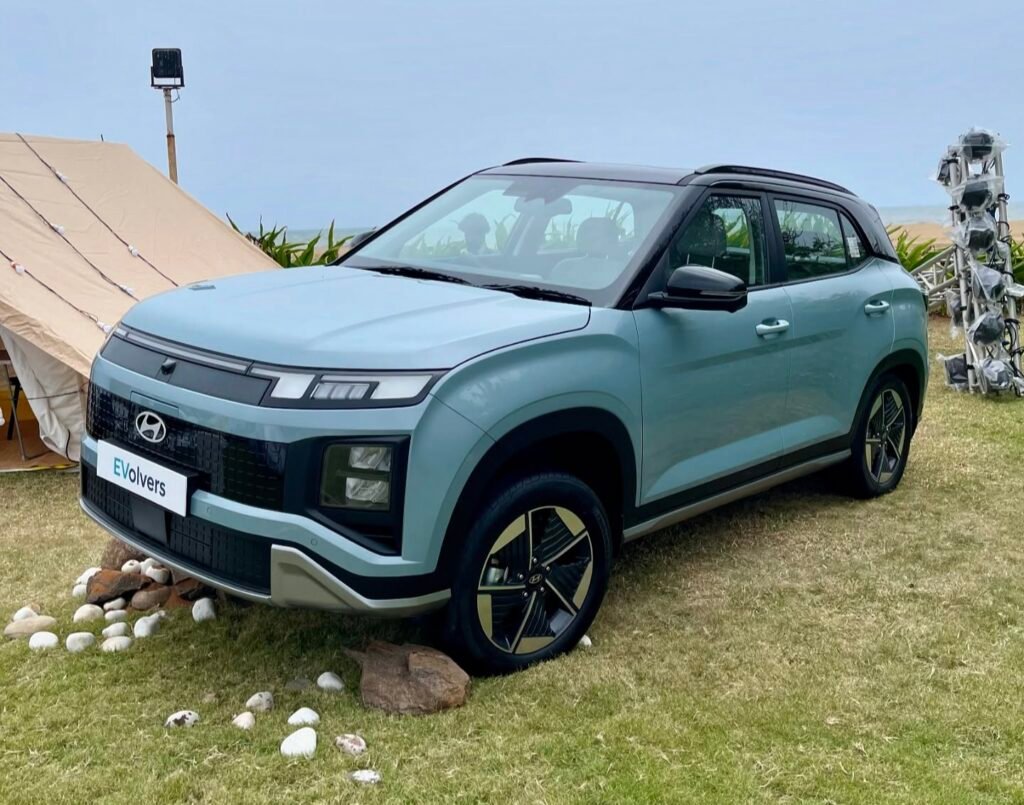
Featured image credit: Image: Avante2025 via Wikimedia Commons (CC BY 4.0). Source
By Piyush P. Yadav
The Rs 16 lakh to Rs 25 lakh band is where India’s electric car market has become genuinely crowded. Two years ago a buyer with that budget had the Tata Nexon EV, the MG ZS EV and not much else. In September 2026 there are seven serious mid-size electric SUVs and crossovers competing for the same money: the Maruti e Vitara, Hyundai Creta Electric, Tata Curvv EV, Mahindra BE 6 Sporteq, MG Windsor EV Pro, MG Hector Tomahawk EV and the lower variants of the Tata Harrier EV. They differ far more than their prices suggest, in battery size, drivetrain, seating, warranty and the way you can pay for them. This guide compares all seven on current ex-showroom prices and real specifications, and then matches each one to the kind of buyer it suits. If your budget is lower, our companion guide to the best electric cars under Rs 15 lakh covers the Tiago EV to Syros EV range.
The seven contenders at a glance
| Model | Ex-showroom price (Sep 2026) | Battery options | Claimed range | Power | Drive | Seats |
|---|---|---|---|---|---|---|
| Maruti e Vitara | Rs 16.19 lakh to Rs 20.21 lakh | 49 / 61 kWh | 440 / 543 km | 142 / 172 bhp | FWD | 5 |
| Tata Curvv EV | Rs 17.19 lakh to Rs 19.69 lakh | 55 kWh | 502 km (MIDC) | 165 bhp | FWD | 5 |
| MG Windsor EV Pro | From Rs 17.49 lakh (introductory) | 52.9 kWh | 449 km (ARAI) | 134 bhp | FWD | 5 |
| Hyundai Creta Electric | Rs 18.03 lakh to Rs 24.70 lakh | 42 / 51.4 kWh | 390 / 473 km (ARAI) | 135 / 171 hp | FWD | 5 |
| Mahindra BE 6 Sporteq | Rs 19.45 lakh to Rs 26.95 lakh | 59 / 79 kWh | Up to 683 km (79 kWh claim) | 286 bhp | RWD | 5 |
| MG Hector Tomahawk EV | From Rs 19.49 lakh | Single pack | 517 km | Not disclosed | FWD | 7 |
| Tata Harrier EV | Rs 21.79 lakh to Rs 30.54 lakh | 65 / 75 kWh | 538 / 627 km | 238 PS (65 kWh) | RWD / QWD | 5 |
Prices are ex-showroom and current as of early September 2026. Tata and Hyundai raised prices from 1 September, which we detailed in our report on the Tata and Hyundai EV price increases; the Curvv EV and Creta Electric figures above reflect the new pricing. The e Vitara took its first hike in June 2026, with the Zeta up Rs 30,000 and the Alpha up Rs 20,000, while the base Delta was unchanged.
Battery size and real-world range
Manufacturer range figures in India come from three different test standards (ARAI, MIDC and manufacturer claims), so they are not directly comparable. A more reliable guide is battery capacity, because real-world consumption for cars of this size clusters between 6 and 7.5 km per kWh in mixed driving with air-conditioning.
| Model (largest pack) | Usable battery | Realistic mixed-use range (6 to 7 km/kWh) | DC fast charge 10 to 80% |
|---|---|---|---|
| Mahindra BE 6 Sporteq 79 kWh | 79 kWh | 475 to 550 km | About 20 minutes at 175 kW |
| Tata Harrier EV 75 kWh | 75 kWh | 450 to 525 km | About 25 minutes (20 to 80%) |
| Tata Harrier EV 65 kWh | 65 kWh | 390 to 455 km | About 25 minutes (20 to 80%) |
| Maruti e Vitara 61 kWh | 61 kWh | 365 to 425 km | 45 minutes |
| Tata Curvv EV 55 kWh | 55 kWh | 330 to 385 km | About 40 minutes at 70 kW |
| MG Windsor EV Pro 52.9 kWh | 52.9 kWh | 315 to 370 km | About 50 minutes at 60 kW |
| Hyundai Creta Electric 51.4 kWh | 51.4 kWh | 310 to 360 km | 39 minutes at about 100 kW |
The e Vitara’s 543 km claim and the Creta Electric’s 473 km look close on paper, but the Maruti carries 10 kWh more battery, which in practice means an extra 60 to 70 km between charges. The Sporteq’s 79 kWh pack is the largest available below Rs 25 lakh and is the reason it is the only car here that can plausibly do Delhi to Jaipur and back without a charging stop. For everything in this table, plan around the realistic column, not the claim. Our guide to home charger installation and connector types explains why a 7.4 kW wallbox matters more than DC speed for daily use.
Three ways to pay: outright, BaaS, or with a buyback
This segment has become the testing ground for new ownership models, and the choice affects total cost as much as the sticker price does.
Battery-as-a-Service (BaaS)
Maruti, Hyundai, Mahindra and MG all offer the car without its battery at a lower price, with the battery paid for per kilometre.
| Model | BaaS entry price | Battery charge | Annual battery cost at 12,000 km |
|---|---|---|---|
| Maruti e Vitara | Rs 10.99 lakh | Rs 3.99 per km | Rs 47,880 |
| Hyundai Creta Electric (42 kWh) | Rs 10.99 lakh | Rs 3.90 per km | Rs 46,800 |
| Mahindra BE 6 Sporteq | Rs 11.45 lakh | Rs 3.75 per km | Rs 45,000 |
| MG Windsor EV Pro | Rs 12.50 lakh | Rs 4.50 per km | Rs 54,000 |
BaaS lowers the entry price by Rs 5 lakh to Rs 8 lakh but adds Rs 45,000 to Rs 54,000 a year at typical mileage, and more for high-mileage users. It also means you do not own the battery, which complicates resale. We ran the break-even maths in detail for the Mahindra plans in our analysis of whether Battery-as-a-Service really works out cheaper; the conclusion, that it suits drivers under about 12,000 km a year who plan to keep the car for the full term, applies to all four brands.
Assured buyback
Maruti offers up to 60 per cent assured buyback on the e Vitara after three years or 45,000 km, and 50 per cent after four years or 60,000 km. Hyundai matched it in August 2026 with 60 per cent for three years or 45,000 km on the Creta Electric. Tata and Mahindra do not offer a manufacturer buyback on the Curvv, Harrier or BE 6. Given how quickly used EV values have fallen, a subject we examined in our report on why used electric cars depreciate faster than petrol cars in India, a guaranteed 60 per cent floor is worth a great deal to anyone who expects to change cars within three years.
Space, seats and practicality
The Hector Tomahawk EV is the only seven-seater in the group and the only one with vehicle-to-home capability, which lets it power household appliances during an outage. That combination makes it the default choice for large families, as we noted at its Rs 19.49 lakh launch. The Windsor EV Pro is the roomiest five-seater, with reclining rear seats and a flat floor that make it popular with chauffeur-driven buyers. The Creta Electric and e Vitara are conventional five-seat SUVs with generous boots. The Curvv EV’s coupe roofline costs some rear headroom, and the BE 6 Sporteq is the least practical of the seven, with a low roof and a small boot; it is bought for how it drives, not for what it carries.
Warranty
Battery warranty terms vary widely and are worth reading before choosing. Mahindra offers a lifetime battery warranty to the first private owner on the BE 6. Tata offers lifetime cover on the Curvv EV and Harrier EV batteries for the first owner. Hyundai covers the Creta Electric battery for eight years or 1,60,000 km. Maruti covers the e Vitara battery for eight years or 1,60,000 km. MG offers a lifetime battery warranty on the Windsor for the first owner. The definitions of “lifetime” and the transfer conditions differ, and we compared them clause by clause in our guide to EV battery warranties across Indian brands.
Which one should you buy
- Best all-rounder under Rs 20 lakh: Maruti e Vitara 61 kWh (Zeta or Alpha). The largest battery in its price band, a five-star Bharat NCAP rating, Level 2 ADAS, Maruti’s service network and a 60 per cent buyback. Slow 45-minute DC charging is the main compromise.
- Best for a chauffeur-driven or comfort-first buyer: MG Windsor EV Pro. Unmatched rear-seat comfort and a lifetime battery warranty. Range and charging speed are mid-pack.
- Best for families needing seven seats: MG Hector Tomahawk EV. The only three-row option, plus vehicle-to-home. Wait for detailed specifications before comparing range claims.
- Best for driving enjoyment: Mahindra BE 6 Sporteq 79 kWh. 286 bhp, rear-wheel drive, the biggest battery and fastest charging in the group. Expect to sacrifice practicality.
- Best brand network with a buyback: Hyundai Creta Electric. The safe choice for buyers who value Hyundai’s dealer coverage and the new 60 per cent buyback. Its batteries are the smallest here, so range is the trade-off.
- Best value from Tata: Curvv EV. A 55 kWh pack under Rs 20 lakh with a lifetime battery warranty. If your budget stretches to Rs 22 lakh, the Harrier EV 65 kWh is a significantly larger, more capable car.
Sources & Further Reading
- CarWale: Maruti e Vitara prices, variants and specifications (September 2026)
- Autocar India: Hyundai introduces assured buyback programme for the Creta Electric
- Rushlane: Mahindra BE 6 Sporteq launch prices and variants
- CarWale: Tata Curvv EV prices and specifications (September 2026)
- CarWale: Tata Harrier EV prices and variants (September 2026)
Frequently asked questions
Which electric SUV under Rs 20 lakh has the longest real-world range?
The Maruti e Vitara 61 kWh, with a 543 km claim and a realistic 365 to 425 km in mixed use. Among cars up to Rs 25 lakh, the Mahindra BE 6 Sporteq 79 kWh (Rs 22.95 lakh) goes furthest with 475 to 550 km realistic range.
Is Battery-as-a-Service a good idea for a mid-size electric SUV?
Only for low-mileage buyers. At 12,000 km a year the battery charge adds Rs 45,000 to Rs 54,000 annually across the e Vitara, Creta Electric, BE 6 Sporteq and Windsor Pro, and you never own the battery, which affects resale.
Which electric SUVs in this price band offer a buyback guarantee?
Maruti (e Vitara, up to 60 per cent at three years or 45,000 km) and Hyundai (Creta Electric, 60 per cent at three years or 45,000 km). Tata and Mahindra do not offer a manufacturer buyback.
Is there a seven-seat electric SUV under Rs 25 lakh?
Yes, the MG Hector Tomahawk EV, launched at Rs 19.49 lakh with seven seats, a 517 km claimed range and vehicle-to-home charging capability.