

Featured image credit: Image: Alexander-93 via Wikimedia Commons (CC BY-SA 4.0). Source
By Piyush P. Yadav
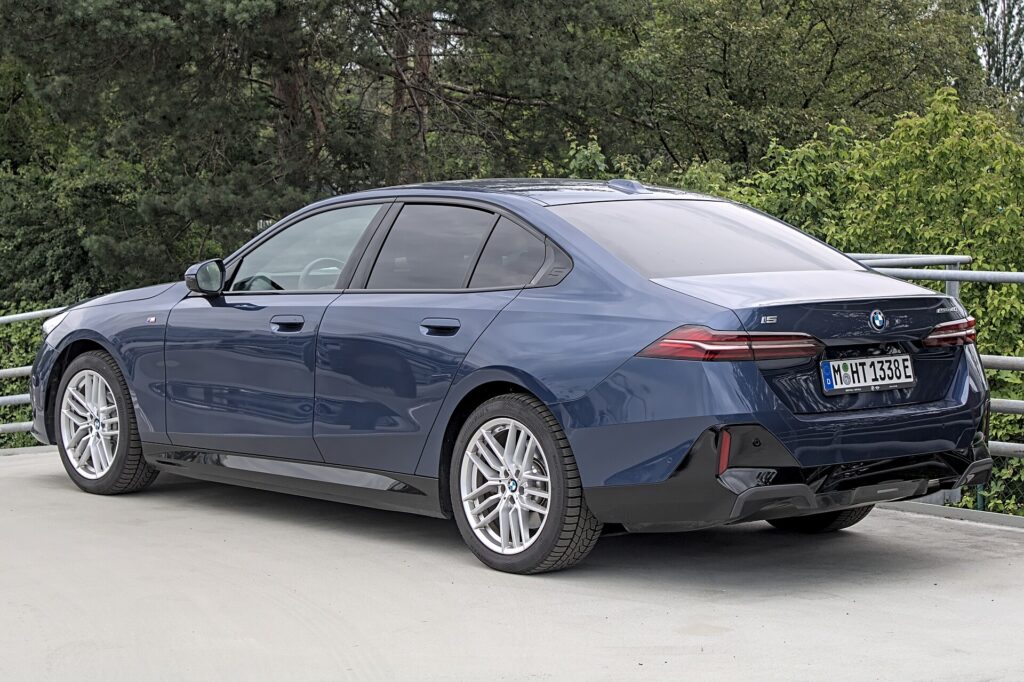
BMW has put a locally assembled electric sedan on sale in India for the first time. The BMW i5 LWB, the long-wheelbase version of the i5 that BMW builds only for the Chinese and now the Indian market, was launched on 7 September 2026 at an introductory ex-showroom price of Rs 79.6 lakh. It is assembled at BMW Group’s Chennai plant, comes in a single eDrive35L M Sport variant, and packs an 81.6 kWh battery good for a claimed 669 km on the MIDC cycle. A 99-unit First Edition, priced the same, sold out before the public launch. This piece walks through what the car is, what it costs to run, how it charges on India’s network, and how it compares with the BMW i7 facelift that landed a week later and the Lexus ES 500e it is aimed at.
What was launched and at what price
The i5 LWB is BMW India’s third locally assembled electric car after the iX1 and the i4, and the first electric sedan of any brand to be assembled in India rather than imported as a completely built unit. Local assembly matters because a fully imported car of this size would attract customs duty that pushes the sticker well past a crore, which is exactly where the i7 facelift sits.
| Item | BMW i5 LWB eDrive35L M Sport |
|---|---|
| Ex-showroom price (introductory) | Rs 79.6 lakh |
| Battery | 81.6 kWh |
| Claimed range (MIDC) | 669 km |
| Motor | Single, rear-mounted, 268 hp / 410 Nm, rear-wheel drive |
| 0-100 km/h | 6.7 seconds |
| Top speed | 195 km/h |
| DC fast charging | Up to 160 kW, 10-80 per cent in a claimed 33 minutes |
| AC charging | Up to 11 kW, BMW Wallbox and installation included |
| Length / width / height | 5,175 mm / 2,156 mm / 1,520 mm |
| Wheelbase | 3,105 mm (110 mm longer than the standard i5) |
| Assembly | BMW Group Plant Chennai |
| First Edition | 99 units, same price, sold out |
The 110 mm stretch in the wheelbase goes entirely to the rear cabin, which is why BMW is pitching this as a chauffeur-driven car as much as a driver’s car. The kit list backs that up: four-zone climate control, a 17-speaker Bowers and Wilkins audio system, a panoramic glass roof, adaptive air suspension on the rear axle, a 360-degree camera, eight airbags and adaptive cruise control with stop-and-go. The cockpit carries BMW’s curved display with a 12.3-inch instrument screen and a 14.9-inch touchscreen. Outside, the illuminated kidney grille, adaptive LED headlights and 20-inch M alloys on staggered 245/45 front and 275/40 rear tyres mark it out from the petrol 5 Series LWB that has been on sale since 2024.
Why local assembly changes the price conversation
The Chennai plant already builds the petrol and diesel 5 Series LWB, and the i5 LWB shares its body-in-white with that car, so adding the electric version was a matter of a new drivetrain line rather than a new factory. That is how BMW gets to Rs 79.6 lakh for a car that, as a full import, would have carried the same 70 to 100 per cent duty structure that puts the Mercedes-Benz EQS and BMW i7 north of Rs 1.5 crore.
It also means the i5 LWB is priced closer to the petrol 530Li than most luxury EVs are to their combustion twins. Buyers in Delhi, Maharashtra, Telangana and several other states pay zero or heavily reduced road tax on electric cars, which narrows the on-road gap further. We explained how ex-showroom becomes on-road, state by state, in our guide to electric car on-road prices in India; the same arithmetic applies here, just with bigger numbers.
How it stacks up against the i7 facelift and the Lexus ES 500e
BMW launched the i5 LWB and the i7 facelift within four days of each other, which invites the obvious question of why anyone would pay nearly three times as much for the 7 Series. The short answer is that the i7 is a fully imported flagship with a 112.4 kWh battery, all-wheel drive and 250 kW charging, while the i5 LWB is a locally built rear-wheel-drive car with a smaller pack. We covered the flagship in detail in our report on the BMW i7 facelift launch on 11 September.
| Spec | BMW i5 LWB | BMW i7 facelift | Lexus ES 500e |
|---|---|---|---|
| Ex-showroom price | Rs 79.6 lakh | About Rs 2.10 crore (expected) | Rs 91.2 lakh |
| Battery | 81.6 kWh | 112.4 kWh | 74.68 kWh |
| Claimed range | 669 km MIDC | 727 km WLTP | 580 km |
| Power | 268 hp | 544 hp (xDrive60) | 343 hp |
| Drive | Rear-wheel | All-wheel | All-wheel |
| Peak DC charging | 160 kW | 250 kW | 150 kW class |
| Built in India? | Yes, Chennai | No, CBU | No, CBU |
Against the Lexus, the BMW is Rs 11.6 lakh cheaper, has a larger battery and a longer claimed range, and gives up power and all-wheel drive. On paper the i5 LWB is the more rational buy; the Lexus counters with a quieter, more hybrid-familiar dealer network and the ES nameplate’s reputation for reliability. Neither runs an 800-volt system, so both sit in the 400-volt camp we described in our explainer on 800V versus 400V electric cars in India.
Charging the i5 LWB on India’s network
The 160 kW peak is the number to keep in mind when you plan a highway run. Most Indian DC fast chargers today are 60 kW or 120 kW units; a 60 kW charger will add roughly 45 to 50 km of MIDC range every ten minutes on an 81.6 kWh pack, and a 120 kW charger about twice that. To actually see the claimed 33-minute 10-80 per cent time you need a 180 kW or 240 kW station, which restricts you to the newer Tata Power, Statiq, ChargeZone and Zeon highway hubs on routes like Mumbai-Pune, Delhi-Jaipur and Bengaluru-Chennai.
At home, the bundled 11 kW BMW Wallbox needs a three-phase connection. On a single-phase 7.2 kW supply the car will take about 12 hours from empty; on 11 kW three-phase it is closer to eight. The rear-wheel-drive layout and the heat pump fitted to the i5 mean winter range loss in the hills should be modest, an issue we looked at in our piece on whether electric car range drops in Indian winters.
Running cost: what 669 km actually costs
Take a conservative real-world figure of 520 km from the 81.6 kWh pack, which is about 78 per cent of the MIDC claim and in line with what larger luxury EVs deliver in mixed Indian driving. At a home tariff of Rs 8 per unit and a charging efficiency of 90 per cent, a full charge costs about Rs 725, or Rs 1.40 per km. A petrol 530Li returning 11 km per litre at Rs 102 a litre costs about Rs 9.30 per km. Over 15,000 km a year that is a fuel saving of about Rs 1.18 lakh, before the road-tax benefit.
| Scenario | Energy cost per km | Annual cost at 15,000 km |
|---|---|---|
| i5 LWB, home charging at Rs 8 per unit | About Rs 1.40 | About Rs 21,000 |
| i5 LWB, public DC at Rs 22 per unit | About Rs 3.85 | About Rs 58,000 |
| 530Li petrol, 11 km per litre at Rs 102 | About Rs 9.30 | About Rs 1.39 lakh |
Who should consider it
The i5 LWB makes the most sense for a buyer who was already looking at a petrol 5 Series LWB or an E-Class and drives mostly within a city with the occasional 300 to 400 km intercity run. It is not a track car; the 268 hp motor is tuned for effortless rather than explosive performance, and the extra wheelbase is felt in ride comfort rather than agility. Buyers who want the performance and the badge of a full-size electric flagship will look at the i7, the Mercedes EQS or the incoming Porsche and Volvo entries, all of which cost at least double.
Bookings opened in August and the First Edition allocation is gone, so deliveries of regular cars should begin around the festive season. BMW has not said how long the introductory price will hold.
Sources & Further Reading
- Autocar India: BMW i5 LWB launched at Rs 79.6 lakh
- India TV: BMW i5 LWB set for India launch, 81.6 kWh battery, 669 km range
- ZigWheels: 2026 BMW i5 LWB launched at Rs 79.60 lakh onwards
FAQ
Is the BMW i5 LWB made in India?
Yes. It is assembled at BMW Group’s Chennai plant alongside the petrol and diesel 5 Series LWB, which is why it is priced at Rs 79.6 lakh rather than well over a crore like the imported i7.
What is the real-world range of the BMW i5 LWB?
BMW claims 669 km on the MIDC cycle from the 81.6 kWh battery. Expect roughly 500 to 550 km in mixed Indian driving, and less on sustained highway runs above 110 km/h.
How fast does the i5 LWB charge?
It accepts up to 160 kW DC, for a claimed 10-80 per cent in 33 minutes on a charger that can deliver that power. On a common 60 kW public charger the same top-up takes roughly 80 to 90 minutes. Home AC charging is up to 11 kW with the bundled Wallbox.
How does the i5 LWB compare with the Lexus ES 500e?
The BMW is about Rs 11.6 lakh cheaper, has a bigger 81.6 kWh battery and a longer claimed range, but is rear-wheel drive with 268 hp against the Lexus’s 343 hp all-wheel-drive setup.