

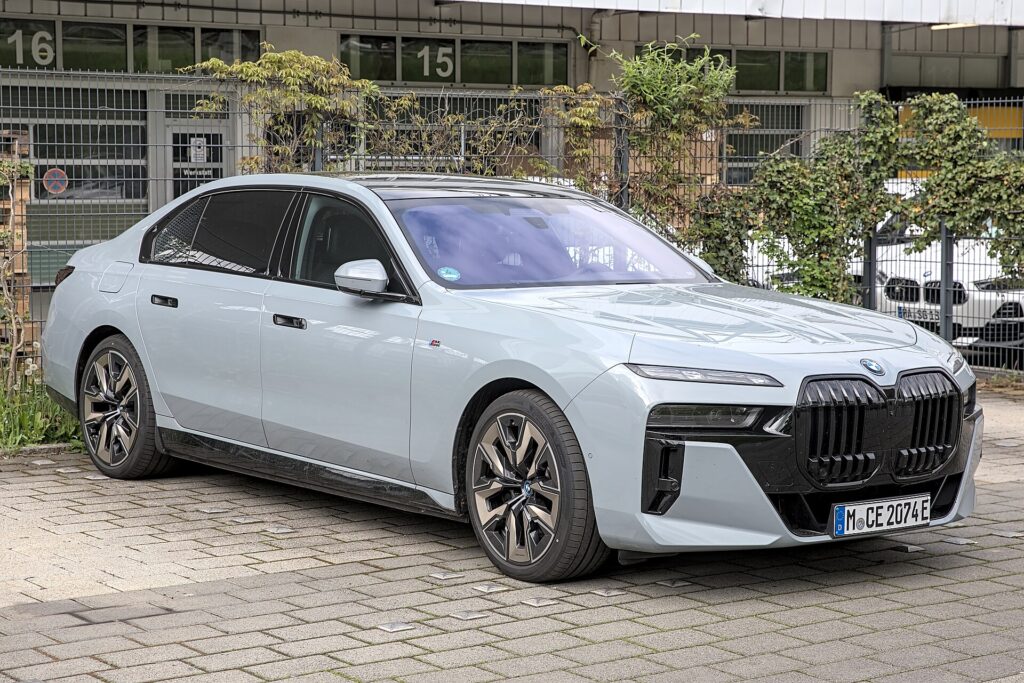
Featured image credit: Image: Alexander-93 via Wikimedia Commons (CC BY-SA 4.0). Source
By Piyush P. Yadav
BMW India will launch the facelifted 7 Series and i7 on 11 September 2026, three days from now. Bookings opened on 1 August. The petrol and diesel 7 Series is expected to start around Rs 1.85 crore, and the electric i7 around Rs 2.10 crore, both ex-showroom. The i7 is the more significant of the two because it is not a cosmetic refresh: BMW has replaced the 101.7 kWh prismatic-cell battery of the outgoing car with a 112.4 kWh pack built from cylindrical cells, lifted the WLTP range to 727 km on the i7 60 xDrive, raised peak DC charging to 250 kW, and made all-wheel drive standard on both variants. It also introduces the Panoramic iDrive dashboard to India for the first time. This report sets out the confirmed specifications, what has changed from the current i7, and how the new car lines up against the Mercedes-Benz EQS, the Porsche Cayenne Electric due on 30 September and the Range Rover Electric.
Launch details at a glance
| Item | Detail |
|---|---|
| Launch date | 11 September 2026 |
| Bookings | Open since 1 August 2026 at BMW dealers |
| Expected price, i7 | Rs 2.10 crore onwards, ex-showroom; the outgoing i7 was Rs 2.10 crore |
| Expected price, 7 Series | Rs 1.85 crore onwards, ex-showroom |
| Assembly | Expected to continue at BMW’s Chennai plant, as with the current 7 Series and i7 |
| Variants, electric | i7 50 xDrive and i7 60 xDrive |
| Variants, combustion | 740i xDrive (3.0-litre petrol, 400 bhp, 580 Nm) and 740d xDrive (3.0-litre diesel, 313 bhp, 670 Nm), both 48V mild hybrid |
What is new on the i7
Battery: 112.4 kWh, cylindrical cells, 20 per cent more energy density
The current-generation i7 uses a 101.7 kWh battery with prismatic cells. The facelift moves to 112.4 kWh using BMW’s sixth-generation cylindrical cells, the same cell format the company introduced on its Neue Klasse iX3. BMW says the new cells offer about 20 per cent higher energy density, which is how the pack grows by nearly 11 kWh without a change in floor packaging. The chemistry is nickel-manganese-cobalt; BMW has not adopted lithium iron phosphate on its flagship. The distinction matters for how the car should be charged in daily use, and our guide to EV battery degradation and state of health in India explains why an NMC pack of this size is best kept between 20 and 80 per cent on days when the full range is not needed.
Range: 727 km WLTP
BMW quotes up to 727 km on the WLTP cycle for the i7 60 xDrive. The outgoing i7 xDrive60 was rated at up to 625 km WLTP, so the gain is roughly 100 km, or 16 per cent, from a battery that is 10.5 per cent larger. The balance comes from the higher-efficiency cells and revised motor control. Indian real-world driving with air-conditioning on and a mix of expressway and city typically returns 70 to 80 per cent of a WLTP figure for a car of this size, which points to 510 to 580 km in normal use. That would make the i7 the longest-range electric sedan sold in India in practice, though the Mercedes EQS quotes a higher headline number on the older, more lenient ARAI cycle.
Charging: 250 kW DC, 10 to 80 per cent in 28 minutes
Peak DC charging rises from 195 kW to 250 kW. BMW’s claim is 10 to 80 per cent in 28 minutes on a charger capable of the full rate. India has very few public chargers above 240 kW, so most owners will see the car limited by the charger rather than by the car. The 400 kW Tata.ev MegaCharger hubs on the Mumbai-Ahmedabad and Delhi-Jaipur corridors and a small number of 360 kW units in metro cities are the exceptions. AC charging remains 11 kW as standard with an optional 22 kW onboard charger; a full charge at 11 kW takes just over 10 hours.
Drivetrain: all-wheel drive on both variants
| Variant | Power | Torque | Drive | Battery | WLTP range |
|---|---|---|---|---|---|
| i7 50 xDrive | 455 PS | 660 Nm | AWD, two motors | 112.4 kWh | Not yet stated for India; expected close to 700 km |
| i7 60 xDrive | 544 PS | 745 Nm | AWD, two motors | 112.4 kWh | Up to 727 km |
| Outgoing i7 eDrive50 (reference) | 455 PS | 650 Nm | RWD | 101.7 kWh | Up to 611 km |
| Outgoing i7 xDrive60 (reference) | 544 PS | 745 Nm | AWD | 101.7 kWh | Up to 625 km |
The change buyers will notice most is that the entry i7 50 is no longer rear-wheel drive. The previous eDrive50 was the value pick for chauffeur-driven owners who did not need the extra motor. Every facelifted i7 sold in India will be a dual-motor car. The M70 performance variant, sold in some markets with 659 PS, has not been confirmed for India.
Cabin: Panoramic iDrive arrives in India
The facelift brings BMW’s Panoramic iDrive layout, which replaces the conventional instrument cluster with a projection strip running the full width of the windscreen base. The centre screen is a 17.9-inch hexagonal touchscreen running BMW Operating System X, with a 14.6-inch display ahead of the front passenger. The rear retains the 31.3-inch 8K Theatre Screen that folds down from the roof, now with expanded streaming and video-call support. The Bowers & Wilkins system is quoted at up to 36 speakers with Dolby Atmos in top configuration, against 18 in the standard fit. Four-zone climate, a panoramic glass roof and the BMW Digital Key are standard.
Exterior
Changes are restrained: a redesigned illuminated kidney grille, revised split headlamps with a slimmer upper daytime-running-light element, new bumpers, slimmer rear lamps and new wheel designs. The body-in-white and dimensions are unchanged at 5,391 mm long on a 3,215 mm wheelbase.
How the i7 compares with the electric luxury field in India
The electric luxury segment in India has moved quickly in 2026. Mercedes updated the EQS SUV with a 122 kWh battery. Porsche is about to launch the Cayenne Electric, which we covered in our Porsche Cayenne Electric India preview. Range Rover has opened bookings for its electric flagship, detailed in our Range Rover Electric bookings report. The i7 is the only pure sedan among them.
| Model | Body | Battery | Claimed range | Peak DC | Power | Ex-showroom price |
|---|---|---|---|---|---|---|
| BMW i7 60 xDrive (facelift) | Sedan | 112.4 kWh | 727 km WLTP | 250 kW | 544 PS | Rs 2.10 crore expected |
| Mercedes-Benz EQS 580 SUV | SUV, 7 seats | 122 kWh | 809 km (ARAI) | 200 kW | 536 bhp | Rs 1.48 crore |
| Mercedes-Benz EQS 450 SUV | SUV, 5 seats | 122 kWh | 775 km (ARAI) | 200 kW | 355 bhp | Rs 1.34 crore |
| Porsche Cayenne Electric | SUV | 113 kWh | 643 km WLTP | 400 kW | Up to 1,156 PS (Turbo) | Rs 1.77 crore, launching 30 September |
| Range Rover Electric | SUV | 118.5 kWh | 600 km WLTP | 350 kW | 550 PS | About Rs 3.5 crore expected |
Three observations. First, the EQS SUV undercuts the i7 by Rs 60 lakh or more on sticker because it is locally assembled at Chakan with a high localisation share. The i7 is also assembled in Chennai, but BMW has kept its pricing at the top of the segment. Second, the ARAI range figures Mercedes quotes are not directly comparable with WLTP; the EQS’s 809 km is likely to be closer to 600 km in Indian real-world use, similar to the i7’s likely 550 km. Third, on charging speed the i7’s 250 kW peak is now mid-pack rather than leading: the Porsche and Range Rover run 800V architectures with 350 to 400 kW peaks, while the i7 stays on a 400V system.
Who buys an i7 in India
BMW India sold electric vehicles at a 19.7 per cent share of its total August 2026 volume, the highest EV mix of any luxury brand in the country. The i7 is a small part of that by unit count; the iX1 and i4 make up the bulk. But the 7 Series is BMW’s flagship and the i7 has outsold the combustion 7 Series in India since the second year of the current generation, a pattern BMW attributes to chauffeur-driven owners valuing the silence and the rear Theatre Screen more than the badge under the bonnet. The facelift’s larger battery addresses the one complaint owners raised, which was range on the Delhi to Chandigarh or Mumbai to Pune corridors with the rear-seat entertainment running.
For buyers weighing whether to wait: the September launch prices are introductory, and BMW India has a track record of raising them within a quarter. The GST structure for EVs, at 5 per cent on the vehicle, is unchanged, as we set out in our GST on electric vehicles explainer, and there is no road-tax exemption for a car at this price in most states.
Sources & Further Reading
- CarDekho: BMW i7 Facelift expected price, launch date and specifications
- CarWale: BMW 7 Series facelift launch details
- MyCarJunction: New BMW 7 Series and i7 launch on 11 September
- Autocar India: Mercedes-Benz EQS SUV price, range and specifications
Frequently Asked Questions
When is the BMW i7 facelift launching in India and at what price?
BMW India launches the facelifted 7 Series and i7 on 11 September 2026. The i7 is expected to start at about Rs 2.10 crore ex-showroom, in line with the outgoing car, with the 7 Series petrol and diesel from about Rs 1.85 crore. Bookings have been open since 1 August.
What is the range of the new BMW i7?
BMW quotes up to 727 km on the WLTP cycle for the i7 60 xDrive with the new 112.4 kWh battery, up from 625 km for the outgoing i7 xDrive60. In Indian driving with air-conditioning, expect roughly 510 to 580 km.
How fast does the facelifted i7 charge?
Peak DC charging is 250 kW, up from 195 kW, and BMW claims 10 to 80 per cent in 28 minutes on a suitable charger. In India, few public chargers exceed 240 kW, so most sessions will be limited by the charger rather than the car. AC charging is 11 kW standard.
Is the new i7 rear-wheel drive or all-wheel drive?
Both facelifted variants, the i7 50 xDrive and i7 60 xDrive, are all-wheel drive with two motors. The outgoing entry-level i7 eDrive50 was rear-wheel drive; that configuration has been dropped.