

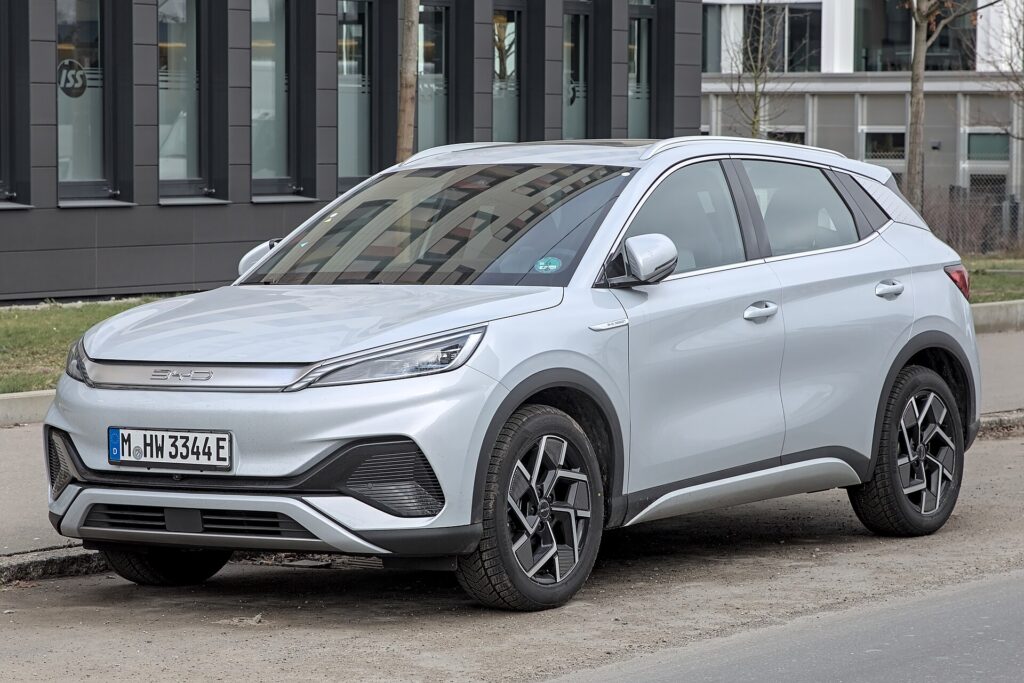
Featured image credit: Image: Alexander Migl via Wikimedia Commons (CC BY-SA 4.0). Source
By Piyush P. Yadav | 11 September 2026
BYD is the largest electric carmaker in the world, and in India it sold 542 cars in August 2026. That is up 9 per cent on August 2025 but down 32 per cent on July, it puts BYD eighth in the Indian EV table behind Hyundai and Kia, and it comes 18 months after VinFast, which arrived in India years later, overtook it. For a company that outsells Tesla globally and builds cars for less than anyone else, that is a strange position, and it is not a product problem. This article sets out where BYD India stands in September 2026: the sales trend, the four battery-electric models and the plug-in hybrid it added in June, the 48-showroom network, the 2,500-car import ceiling that shapes everything it does, the rejected billion-dollar plant, and what the Atto 2 and a change in localisation policy would mean.
The numbers
BYD India’s trajectory is one of strong percentage growth from a small base that has now stalled in absolute terms. It sold around 5,500 cars in 2024, about 6,000 in 2025 for an 84 per cent rise on the company’s own account, and told Outlook Business in March 2026 that “at least double-digit growth in 2026” was the baseline expectation. The monthly run rate since then has not delivered that.
| Period | BYD India sales | Change | Context |
|---|---|---|---|
| Calendar 2024 | About 5,500 | About +88 per cent | Atto 3, Seal, eMax 7 on sale |
| Calendar 2025 | About 6,000 | +84 per cent (company figure) | Sealion 7 launched; India EV market +77 per cent to 1,76,817 |
| July 2026 | 802 | Not stated | Best recent month |
| August 2026 | 542 | +9 per cent YoY, -32 per cent MoM | Market +51 per cent to 30,418; price increases implemented |
Put against the August 2026 EV market, BYD’s 542 units are 1.8 per cent of the 30,418 electric cars sold. Tata sold 13,070, Mahindra 6,408, JSW MG 4,602, VinFast 2,198, Maruti 1,405, Hyundai 802 and Kia 640. BYD is growing slower than the market by a wide margin, and August’s drop followed price increases across the range. We track the full table monthly in our August 2026 electric car sales report.
The line-up: four EVs and a plug-in hybrid
| Model | Type | Segment | Assembly | Notes |
|---|---|---|---|---|
| Atto 3 | Battery electric SUV | Rs 25 to 35 lakh mid-size | CKD, Sriperumbudur | Fully homologated; BYD’s volume seller in India |
| eMax 7 | Battery electric MPV | Rs 27 to 30 lakh six and seven seater | CKD, Sriperumbudur | Fully homologated; competes with Carens Clavis EV and XEV 9S |
| Seal | Battery electric sedan | Rs 41 to 53 lakh | CBU import | Homologation in process as of March 2026 |
| Sealion 7 | Battery electric SUV coupe | Rs 49 to 55 lakh | CBU import | Homologation in process as of March 2026 |
| Sealion 6 | Plug-in hybrid SUV (DM-i) | Premium | CBU import | Launched 9 June 2026; claimed combined range over 1,000 km |
Price ranges are indicative from published listings and BYD revised prices upward in mid-2026. The important column is the fourth. Only the Atto 3 and eMax 7 are assembled in India from knocked-down kits at BYD’s Sriperumbudur facility in Tamil Nadu and only those two are fully homologated. The Seal, Sealion 7 and Sealion 6 come in as completely built units, and India allows a manufacturer to import up to 2,500 such units a year without full homologation. That ceiling is why BYD’s premium models are sold in the hundreds, not thousands, and why the company cannot simply meet demand by shipping more cars.
The Sealion 6 and the plug-in hybrid gamble
The Sealion 6, launched on 9 June 2026, is BYD’s first plug-in hybrid in India and the first car here to carry its DM-i system, in which a large electric motor and Blade battery do most of the driving while a 1.5-litre petrol engine acts mainly as a generator. BYD claims a combined range of more than 1,000 km and a 0 to 100 km/h time of 5.9 seconds. Strategically it is an odd fit. Plug-in hybrids pay 28 per cent GST plus cess in India, against 5 per cent for battery-electric cars, and they get none of the road-tax waivers most states give EVs. BYD is betting that a premium buyer who cannot charge at home will pay for a car that does 80 to 100 km on electricity and then keeps going on petrol, and that Toyota and Maruti’s strong hybrids have already built the market. It also signals that BYD does not expect India’s EV incentive structure to remain as generous as it is, a theme we explored when asking whether India should move from subsidies to a ZEV mandate.
The plant that was not built
Everything about BYD’s Indian position traces back to one decision. In 2023 BYD, with Hyderabad-based Megha Engineering, proposed a roughly 1 billion dollar plant in Telangana to build EVs and batteries. The government declined to approve it under the Press Note 3 rules that require prior clearance for investment from countries sharing a land border with India. Without a plant, BYD cannot get past CKD assembly, cannot qualify for the PLI scheme, cannot benefit from the 2024 EV manufacturing policy that cuts import duty to 15 per cent for companies investing 500 million dollars, and cannot import more than 2,500 built-up cars a year. In January 2026 electrive reported that BYD was “exploring localising additional models” through the existing Sriperumbudur CKD route, which is the only expansion path open to it.
The contrast with VinFast is direct. The Vietnamese company, which faces no such restriction, built a plant at Thoothukudi, launched the VF6 and VF7 in 2025, and in August 2026 sold four times as many cars as BYD. We covered that reversal when VinFast overtook BYD in India.
The network: 48 showrooms and a premium footprint
BYD India had 48 showrooms across about 40 cities as of March 2026, the latest a 9,000 square foot facility in Moti Nagar, Delhi, its sixth in the National Capital Region. That is a premium-brand footprint, comparable to Volvo or Lexus rather than to Tata’s 1,000-plus outlets, and it matches the pricing: the cheapest BYD is the Atto 3 at around Rs 25 lakh, which is above the Creta Electric and level with the top Mahindra BE 6 and XEV 9S variants. The dealers are mostly multi-brand luxury groups, and after-sales coverage outside the big cities is thin. For a buyer in a Tier 2 city, the nearest BYD service point can be several hundred kilometres away, which is a real consideration on a car with a proprietary Blade battery.
What the Atto 2 would change
The product BYD India most needs is the Atto 2, the compact SUV sold as the Yuan Up in China, with 45.1 kWh and 51.1 kWh Blade LFP packs, a 176 hp motor and around 410 km of claimed range. It has been testing on Indian roads since 2025 and was expected in mid-2026 at an estimated Rs 17 to 25 lakh. It has not launched. If it comes as a CBU, it consumes the same 2,500-unit ceiling as the Seal and Sealion 7 and cannot be a volume car. If it comes as a CKD from Sriperumbudur, it could be BYD’s first genuine mass-market product in India, competing with the Creta Electric, Curvv EV and BE 6, and with the incoming Hyundai HE1i at the lower end. Which route BYD takes will tell you whether it has decided India is a volume market or a showcase.
| Scenario | What changes | Realistic volume |
|---|---|---|
| Status quo: CKD Atto 3 and eMax 7, CBU premium cars | Nothing | 500 to 900 a month |
| Atto 2 as CKD at Sriperumbudur | First sub-Rs 25 lakh BYD; competes on price with Creta Electric and BE 6 | 1,500 to 3,000 a month |
| Plant approval under Press Note 3 | PLI eligibility, 15 per cent duty on imports, local Blade battery | Multiples of today; not expected in 2026 |
What buyers should take from this
None of this makes a BYD a bad car. The Atto 3 and Seal have strong reliability records, the Blade LFP battery is among the safest and longest-lived chemistries on sale, and BYD’s warranty terms are competitive. What it means is that BYD in India is a low-volume premium importer with a constrained supply, not the price-disrupting mass brand it is in China, Thailand or Brazil, and buyers should price the service-network gap and the resale risk of a low-volume brand accordingly. We compared where the Chinese and Vietnamese brands sit against Tata and Mahindra in our EV brand rankings for 2026, and BYD’s position has not improved since.
Sources & Further Reading
- Autocar India: August 2026 EV sales, VinFast takes fourth spot
- Outlook Business: BYD India expects double-digit growth in 2026 after 84 per cent sales jump
- electrive: BYD explores localising additional models in India
- Cartoq: BYD Sealion 6 PHEV with DM-i launching 9 June
Frequently Asked Questions
How many cars does BYD sell in India?
BYD sold 542 cars in India in August 2026, up 9 per cent on a year earlier but down 32 per cent from 802 in July. It sold about 6,000 cars in calendar 2025, an 84 per cent rise, against an Indian EV market that grew 77 per cent.
Which BYD cars are sold in India?
Four battery-electric models, the Atto 3 SUV, eMax 7 MPV, Seal sedan and Sealion 7 SUV coupe, plus the Sealion 6 plug-in hybrid launched on 9 June 2026. The Atto 3 and eMax 7 are assembled from kits at Sriperumbudur; the rest are imported.
Why doesn’t BYD build cars in India?
Its 2023 proposal for a roughly 1 billion dollar plant in Telangana with Megha Engineering was not approved under Press Note 3, which requires clearance for investment from countries sharing a land border with India. Without a plant BYD is limited to CKD assembly and 2,500 built-up imports a year without full homologation.
When will the BYD Atto 2 launch in India?
BYD has not confirmed a date. The Atto 2 has been testing in India since 2025 and was expected in mid-2026 at an estimated Rs 17 to 25 lakh, but has not launched. Whether it comes as a locally assembled car or an import will determine whether it can be a volume product.