

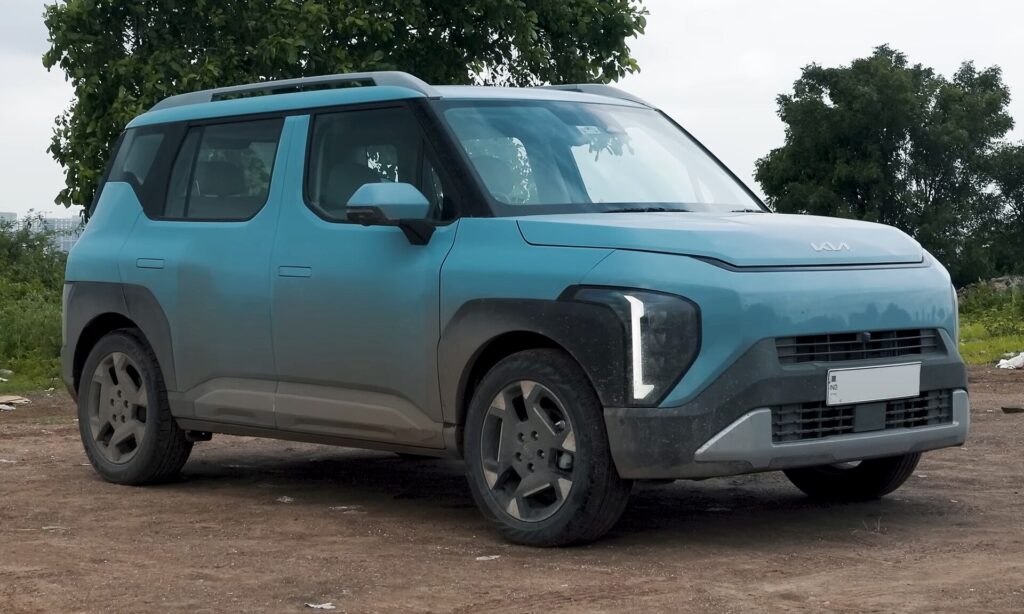
Featured image credit: Image: The Drivers Hub via Wikimedia Commons (CC BY 3.0). Source
By Piyush P. Yadav
Kia India launches the Sorento today, September 4, as its new flagship and first strong-hybrid SUV. That is the headline, but the more consequential Kia news of the last two months has been electric. In late July the company put its first India-made EV, the Syros EV, on sale from Rs 13.50 lakh. In mid-August it confirmed it is evaluating a new 2 lakh-unit production line at Anantapur. And in the first half of 2026 its EV sales grew by more than 900 per cent from a tiny base, at the same time as its sibling Hyundai’s EV sales fell by a third. This is a look at how Kia has quietly assembled the most coherent EV plan of any Korean brand in India, what it is building, and where the gaps are.
Kia India in 2026: the numbers
| Metric | Figure |
|---|---|
| Sales, January to July 2026 | 1,91,949 units, up 17 per cent |
| Previous annual sales peak | About 2,70,000 units |
| Growth in last financial year | About 13 per cent, against 8 per cent for the market |
| Anantapur plant capacity (current) | About 3,00,000 units a year |
| Proposed new line | About 2,00,000 units a year (early-stage evaluation) |
| 2030 domestic target | About 4,10,000 units, 7.6 per cent market share |
| Electric sales, H1 2026 | 2,643 units, up 941 per cent year on year |
| Hyundai electric sales, H1 2026 (for comparison) | 2,725 units, down 36 per cent |
| Electrification plan | Eight of ten models launching from 2026 to have some form of electrification |
The capacity figure needs a caveat. Autocar Professional, which broke the expansion story on August 15, put current capacity at around 3 lakh units; other reports quote a higher installed figure closer to 4.3 lakh. The difference is likely between practical and nameplate capacity. Either way, the all-new Seltos averaging about 10,000 units a month since launch has pushed the plant toward its limit, which is the trigger for the new-line study.
Syros EV: the car that changed Kia’s EV position
Until July, Kia’s EVs in India were imports: the EV6 and EV9, both above Rs 60 lakh, plus the Carens Clavis EV, its first locally assembled electric MPV launched in 2025. The Syros EV is different. It is built at Anantapur on the K1 platform shared with the global Hyundai Inster, it is priced from Rs 13.50 lakh, and it comes with a lifetime battery warranty that Kia describes as a first for NMC packs in India.
| Specification | Syros EV standard range | Syros EV extended range |
|---|---|---|
| Battery | 42 kWh NMC | 51.4 kWh NMC |
| Claimed range | 443 km | 526 km |
| Motor | 99 kW, 255 Nm | 126 kW, 255 Nm |
| 0 to 100 kmph | Not stated | 8.1 seconds |
| DC fast charging | 10 to 80 per cent in 39 minutes at 100 kW | 10 to 80 per cent in 39 minutes at 100 kW |
| Starting price (ex-showroom) | Rs 13.50 lakh | Rs 17 lakh |
| Top price | Rs 20 lakh (X-Line) | |
| Battery-as-a-service | From Rs 7.99 lakh plus Rs 3.30 per km | |
| Other | 16-litre frunk, vehicle-to-load port, seven variants, deliveries from July 30 | |
Two decisions stand out. First, Kia kept the Syros EV visually almost identical to the petrol Syros and integrated the charging port into the front-left quarter panel, which kept tooling cost down and let it price aggressively against the Tata Nexon EV and Mahindra XUV 3XO EV. Second, it chose NMC chemistry over the LFP that Tata and MG use in this segment, which explains the higher claimed range per kWh, and then backed it with a lifetime warranty to neutralise the perception that NMC degrades faster. That combination of Nexon EV money, 500-plus km claimed range and a lifetime warranty is why the Syros EV is the car most responsible for the 941 per cent growth figure, and why it features in our September 2026 guide to electric cars under Rs 15 lakh.
The roadmap to 2030
Kia’s stated plan is ten new models from 2026, eight of them electrified in some form. From the reporting so far, the product cadence looks like this:
| Year | Product | Powertrain |
|---|---|---|
| 2025 | Carens Clavis EV | Battery electric (locally assembled MPV) |
| July 2026 | Syros EV | Battery electric (first India-made Kia EV) |
| September 2026 | Sorento | 1.6-litre turbo-petrol strong hybrid (238 hp, 380 Nm) and 2.0 diesel |
| 2027 | Seltos hybrid | Strong hybrid |
| Planned | Carnival hybrid | Strong hybrid |
| Planned | Carens CNG | CNG |
| 2028 | B-segment electric SUV | Battery electric, positioned between Syros and Seltos |
| In development | C-segment utility vehicle | SUV or MPV, between Seltos and Sorento |
The pattern is that Kia is hedging. Its two confirmed pure EVs are at the affordable end, where India’s EV growth is concentrated, and its premium volume products are going hybrid rather than electric. That is a bet that India’s EV adoption curve will stay steepest below Rs 20 lakh through the decade, and that above it strong hybrids will win. It is the opposite of Mahindra’s approach, which has gone all-in on dedicated electric SUVs in the Rs 18 lakh to Rs 30 lakh band, and it is the same bet Toyota and Maruti are making.
Why Kia is growing in EVs while Hyundai is shrinking
Hyundai and Kia share platforms, batteries and a parent company, yet in the first half of 2026 Kia’s Indian EV sales rose 941 per cent while Hyundai’s fell 36 per cent to 2,725 units and its EV market share dropped from 5 per cent to under 2 per cent. The difference is product placement. Hyundai’s volume EV is the Creta Electric, which starts above Rs 18 lakh and now costs slightly more after the company’s September price rise, in a segment where Mahindra’s BE 6 and Tata’s Curvv EV are heavily discounted. Kia’s volume EV is the Syros EV at Rs 13.50 lakh, in a segment where the competition is the Nexon EV and where a lifetime warranty and 100 kW charging are differentiators. Hyundai’s Inster, its global small EV on the same K1 platform, has not launched in India, which has left the affordable end of Hyundai’s line-up empty while Kia fills it.
In the brand rankings we compiled for the first half of the year, in our H1 2026 EV brand rankings, Kia was still outside the top five by volume. On the current run-rate it will pass Hyundai on full-year EV sales, which would be the first time the junior Korean brand has outsold its parent on electric cars in any major market.
What the Anantapur expansion means for EVs
The proposed new line is described as being evaluated for both domestic and export volume, with total production requirement approaching 5 lakh vehicles a year. Kia has not said whether the new line will be EV-dedicated. Given that the Syros EV and the petrol Syros share a line today, the more likely outcome is a flexible line that builds ICE, hybrid and EV on the same platform family, which is also what JSW MG’s new ADAPT architecture is designed for. The relevance for EV buyers is supply: the Syros EV’s waiting periods, if they lengthen, are a capacity problem that a second line solves in 2028, not before.
There is also a localisation dimension. Kia imports its NMC cells, and the September 1 traction-motor localisation rule covers passenger EVs claiming PM E-DRIVE benefits as well as commercial vehicles. Domestic cell supply from Exide and others, which we covered in our report on Exide’s cell plant going commercial, would help Kia’s cost position on the Syros EV and the 2028 B-segment EV.
Where Kia is vulnerable
- A thin EV line-up. Kia has one affordable EV on sale and the next is two years out. Tata has six, Mahindra four. A single-model EV strategy is exposed if the Syros EV’s novelty fades.
- Charging. Kia has no equivalent of Tata’s Mega Charger programme with charge-point operators. Syros EV buyers rely on public networks.
- The VinFast factor. VinFast, which we profiled in our report on VinFast overtaking BYD in India, is bringing the VF3 at an expected Rs 10 lakh in October, undercutting the Syros EV’s outright price and its BaaS price.
- Price positioning. The extended-range Syros EV at Rs 17 lakh to Rs 20 lakh runs straight into the discounted Curvv EV and BE 6. Kia’s lifetime warranty is its answer; whether buyers value it over Rs 3 lakh of cash discount is untested.
Bottom line
Kia’s India EV strategy is narrow, disciplined and, so far, working. One well-priced locally built EV with a class-leading warranty has taken the brand from irrelevance to the fastest-growing EV seller in the country in six months. The Sorento launch today shows where Kia thinks the premium market is going, and it is not battery-electric yet. The question for 2027 is whether Kia can keep the Syros EV’s momentum with no new EV until 2028, or whether Tata’s price hikes and VinFast’s arrival change the competitive picture faster than Kia’s product plan can respond.
Sources & Further Reading
- Autocar Professional: Kia studies new 2 lakh-unit production line at Anantapur plant
- Autocar India: Kia Syros EV launched at Rs 13.50 lakh
- electrive: Kia unveils Syros EV as first India-made electric SUV
- Autocar India: EV sales H1 2026, brand-wise
FAQ
What is Kia’s first made-in-India electric car?
The Kia Syros EV, launched on July 23, 2026 at Rs 13.50 lakh to Rs 20 lakh ex-showroom, built at Anantapur with 42 kWh and 51.4 kWh NMC battery options and a lifetime battery warranty.
How much did Kia’s EV sales grow in 2026?
Kia sold 2,643 EVs in the first half of 2026, a 941 per cent increase year on year, while Hyundai’s EV sales fell 36 per cent to 2,725 units.
Is Kia expanding its Anantapur plant?
Kia is evaluating a new production line of about 2 lakh units a year at Anantapur, which would take total capacity toward 5 lakh units. The proposal is at an early stage and no final investment decision has been made.
What is Kia’s next EV for India?
A B-segment electric SUV positioned between the Syros and Seltos, expected in 2028. Before that, Kia’s launches are hybrids: the Sorento in September 2026 and a Seltos hybrid in 2027.