

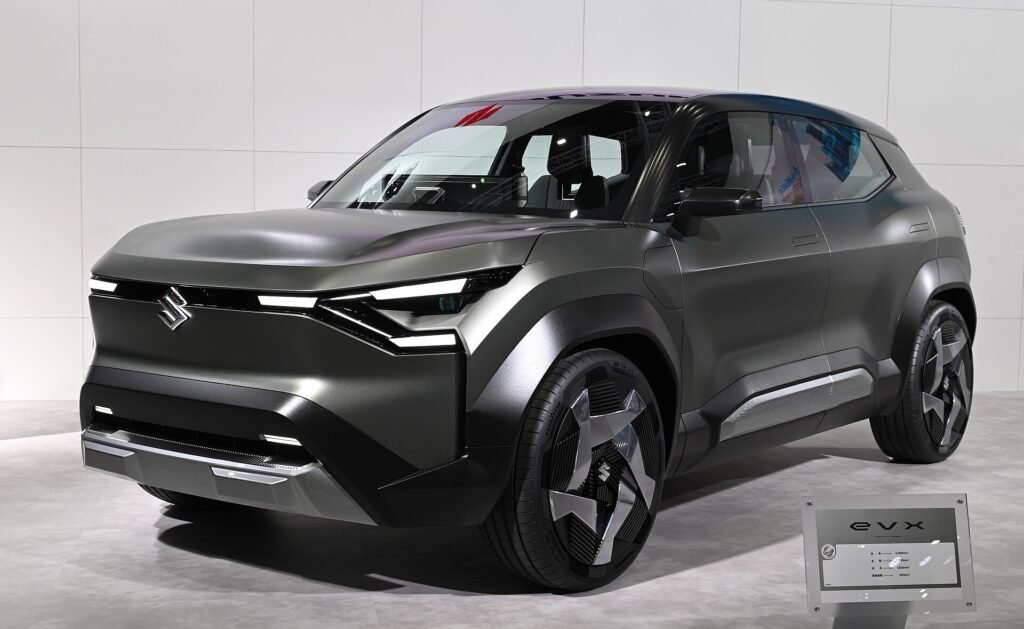
Featured image credit: Image: TTTNIS via Wikimedia Commons (CC0). Source
By Piyush P. Yadav
Maruti Suzuki sells fewer electric cars in India than Tata, Mahindra and MG, and in most months fewer than half of what the market leader manages in a week. Yet by one measure it is already India’s most important EV company: it ships more electric cars out of the country than every other manufacturer combined. In the April to June 2026 quarter, 15,210 e Vitaras left Indian ports, 97 per cent of the nation’s entire electric car export volume. This piece looks at how a company that launched its first EV only in February 2026 became the country’s EV export engine, what the domestic numbers really look like, and what its published roadmap says about the next four years.
The export numbers
| Metric | Figure | Period |
|---|---|---|
| e Vitara exports | 15,210 units | April to June 2026 (Q1 FY27) |
| India’s total electric car exports | 15,641 units | Q1 FY27 |
| Maruti’s share of India EV exports | 97 per cent | Q1 FY27 |
| Cumulative e Vitara exports | 40,759 units | August 2025 to June 2026 |
| Countries receiving the e Vitara | 48 | As of June 2026 |
| Maruti EV exports, FY26 | 25,549 units (89 per cent of India’s 28,652) | April 2025 to March 2026 |
| e Vitara rank among all Indian PV exports | 3rd, behind Fronx (23,803) and Jimny (21,840) | Q1 FY27 |
| Rival EV exports | Tata 401, Hyundai 24, Kia 6 | Q1 FY27 |
The sequence explains the scale. Maruti began exporting the e Vitara from its Gujarat plant in August 2025, six months before the car went on sale in India in February 2026. The main destinations are Europe and Japan: the UK, Germany, France, the Netherlands, Sweden, Denmark, Switzerland, Austria and Belgium, plus the Japanese market where it is sold as a Suzuki. The car was designed from the outset as a global product with India as the sole manufacturing base, which is why exports were running at four to five times domestic sales through the first half of 2026.
Maruti’s total exports fell 7 per cent in August 2026 to 33,844 units, but April to August exports were still up 14 per cent at 188,636 units, and the company reported total August sales of 219,220 units, up 21 per cent year on year, with utility vehicles including the e Vitara up 46 per cent to 79,045.
The domestic numbers, honestly
At home the story is more modest. The e Vitara launched at Rs 15.99 lakh ex-showroom, with an introductory Battery-as-a-Service option at Rs 10.99 lakh plus Rs 3.99 per km for the battery. Monthly retail volumes have been:
| Month, 2026 | e Vitara India sales |
|---|---|
| January | 528 |
| February | 870 |
| March | 2,254 |
| April | 2,006 |
| May | 1,439 |
| January to May total | 7,097 |
For the April to June quarter Maruti sold 4,894 EVs in India, placing it fourth behind Tata, Mahindra and JSW MG. That is a real position, ahead of VinFast, BYD, Hyundai and Kia, but a long way from the leaders. Tata alone took a record 44 per cent of the market in August, as our August 2026 EV sales report detailed. The e Vitara’s domestic peak of 2,254 units in March coincided with launch-period deliveries and has since eased, which is normal for a new model but also reflects a crowded Rs 16 to 25 lakh electric SUV segment that we compared in our mid-size electric SUV buyer’s guide.
Why the export-first strategy makes sense for Suzuki
- Scale before demand. Building 40,000 cars for export in the first ten months gave the Gujarat line volume that the Indian EV market, at roughly 2 lakh cars a year in FY26, could not yet supply. That volume lowers unit cost for the domestic car too.
- Europe needs affordable EVs. Suzuki has no European EV plant. An India-built compact electric SUV at a competitive price is its answer to Chinese entrants in the UK and EU.
- The India-UK trade agreement. Reduced tariffs on Indian-built cars entering the UK improve the e Vitara’s position in what is already its largest export market.
- Policy alignment. Exports count towards the government’s manufacturing and PLI goals, and a high-volume export EV strengthens Maruti’s case in localisation and incentive discussions.
The roadmap: four EVs by FY2031, 1 lakh chargers by 2030
Suzuki’s mid-term plan now calls for four EV launches in India by FY2031, revised down from an earlier target of six. The published sequence is:
| Model | Segment | Timing | Status |
|---|---|---|---|
| e Vitara | Mid-size electric SUV | Launched February 2026 | On sale, exported to 48 countries |
| YMC electric MPV | Seven-seat electric MPV | Production version expected end 2026 | Second India EV |
| Electric hatchback | Compact hatch | 2026-27 (reported) | Unconfirmed by Maruti |
| Fourth model | Not disclosed | By FY2031 | Planned |
Alongside the product plan, Maruti has committed to an ecosystem build-out that is unusual for a company with one EV on sale. It has installed more than 2,000 charging points across 1,100-plus cities through 13 charge point operator partners and its dealer network, invested Rs 250 crore in charging and the E For Me app, and set a target of 1 lakh charging points by 2030. It also says it is training 1.5 lakh EV-ready sales and service staff. The e Vitara was the first electric SUV to receive a five-star Bharat NCAP rating under the new protocol, which Maruti has leaned on heavily in marketing given the safety perception it has historically fought.
Export engine versus home market: the numbers side by side
The clearest way to see how unusual Maruti’s position is compared with the rest of the industry is to put export and domestic volumes for the same quarter next to each other.
| Manufacturer | EV exports, Q1 FY27 | EV domestic sales, Q1 FY27 | Orientation |
|---|---|---|---|
| Maruti Suzuki | 15,210 | 4,894 | Export-led, about 3 exports per home sale |
| Tata Motors | 401 | Market leader, 44 per cent share in August | Domestic-led |
| Hyundai | 24 | Creta Electric volumes | Domestic-led |
| Kia | 6 | Syros EV and Carens Clavis EV | Domestic-led |
Through FY26 the ratio was even more lopsided: 25,549 e Vitaras exported against 1,416 sold in India, because the car was on sale abroad for six months before it reached Indian showrooms. Since the February launch the gap has narrowed to roughly three to one, and AutoPunditz calculated an export-to-domestic ratio of 4.9 times for the January to May period. India’s total EV retail market grew 84 per cent to about 2 lakh cars in FY26, so the domestic opportunity is expanding quickly, but Maruti’s production planning still treats India as one market among 48 rather than the anchor.
There is a practical upside for Indian buyers in this. A car engineered and certified for the UK, Germany and Japan, and crash-tested to a five-star Bharat NCAP result, carries a level of validation that a domestic-only product cannot claim. The downside is that specification and pricing decisions are made with European margins in mind, which is one reason the e Vitara was launched at Rs 15.99 lakh rather than undercutting the Tata Curvv EV and Mahindra BE 6 outright. As the VinFast and BYD volumes show, import-oriented brands are now competing in exactly this price band, so Maruti’s next domestic move will be watched closely.
How it compares with the other legacy players
Maruti’s approach differs sharply from its Korean rivals. Hyundai has committed Rs 45,000 crore to 26 launches by 2030 including six EVs and an entry electric SUV this year, as we reported in our Hyundai 2030 plan analysis, and Kia has anchored its strategy on the Rs 13.50 lakh Syros EV and an Anantapur expansion. Both are building for Indian volume first. Maruti is building for global volume first and letting the Indian line-up follow at the pace of demand, which is consistent with its long-stated view that its goal is to expand the overall EV market rather than compete on model count. The risk is obvious: if Indian EV penetration accelerates faster than Suzuki’s four-model plan, Tata and Mahindra will have locked in the buyers Maruti has spent forty years cultivating in petrol.
What to watch
- The YMC MPV reveal. A seven-seat electric MPV under Rs 20 lakh would address a segment where Maruti’s Ertiga and XL6 already dominate in petrol and CNG.
- e Vitara pricing after the introductory period. The Rs 10.99 lakh BaaS entry point was labelled introductory; a firm price ladder will tell us how aggressive Maruti intends to be.
- Export trajectory into Q2 FY27. Whether e Vitara shipments hold at 15,000 a quarter as European stock builds up.
- Domestic monthly run-rate. A sustained 2,000-plus a month would put Maruti in contention for third place with MG.
Sources & Further Reading
- Channel I’M: Maruti e Vitara leads India’s EV exports (2 September 2026)
- Autocar Professional: Maruti Suzuki August 2026 sales rise 21 per cent
- AutoPunditz: Maruti e Vitara sales analysis, India and exports
- MotorBeam: Maruti Suzuki EV roadmap and 1 lakh charger target
- Maruti Suzuki press release: e Vitara India launch
Frequently Asked Questions
How many e Vitaras has Maruti exported?
Cumulative exports reached 40,759 units between August 2025 and June 2026, to 48 countries. In the April to June 2026 quarter alone Maruti shipped 15,210 units, 97 per cent of India’s electric car exports.
How many e Vitaras are sold in India each month?
Between 528 and 2,254 a month in the first five months of 2026, totalling 7,097. For the April to June quarter Maruti sold 4,894 EVs in India, fourth behind Tata, Mahindra and JSW MG.
What is Maruti’s next electric car after the e Vitara?
A seven-seat electric MPV codenamed YMC, with the production version expected by the end of 2026. Suzuki’s plan calls for four EVs in India by FY2031.
What is the e Vitara’s price in India?
The e Vitara launched at Rs 15.99 lakh ex-showroom, with an introductory Battery-as-a-Service option at Rs 10.99 lakh plus Rs 3.99 per km for battery use.