

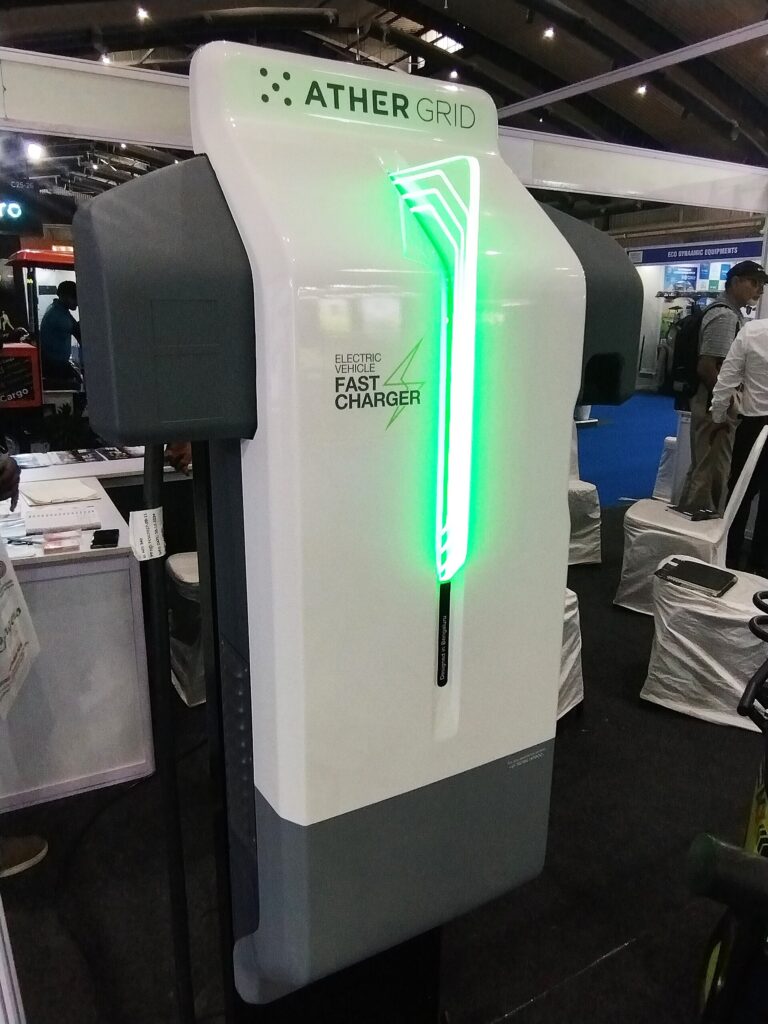
Featured image credit: Image: Gpkp via Wikimedia Commons (CC BY-SA 4.0). Source
By Piyush P. Yadav | 11 September 2026
On World EV Day, 9 September 2026, charging network operator Bolt.Earth published its “State of Charge” data report, drawn from telemetry across its own chargers in six metro markets over three financial years. The headline finding is a paradox that anyone planning a charging business, a housing-society charger or a city policy needs to understand: two-wheelers now account for 78.1 per cent of all charging sessions on the network, yet four-wheelers, with just 16 per cent of sessions, consume 67.3 per cent of the energy. The two vehicle classes are using the same word, “charging”, to describe completely different behaviours, and India’s charging infrastructure is still largely being built as if they were the same thing. This article sets out the report’s numbers, explains what they mean for where chargers should go, and puts them against the national charger count and the wider data on utilisation.
The headline numbers
Bolt.Earth’s report covers FY2024-25, FY2025-26 and the year-to-date of FY2026-27, across Bengaluru, Hyderabad, Chennai, Delhi-NCR, Mumbai and Kochi. Because it is one operator’s data, it is not a census of Indian charging, but Bolt.Earth’s network skews toward the AC and low-power chargers that serve two-wheelers and apartment parking, which is precisely the segment national statistics say little about.
| Metric | FY2024-25 | FY2026-27 year to date |
|---|---|---|
| Two-wheeler share of sessions | 71.6 per cent | 78.1 per cent |
| Four-wheeler share of sessions | Not stated | 16 per cent |
| Four-wheeler share of energy | 58.1 per cent | 67.3 per cent |
| Average DC session length | Not stated | 26.5 minutes |
| Average AC session length | Not stated | 194.3 minutes |
| Peak hour for sessions | 6 pm, driven by two-wheelers | |
| Peak hour for energy demand | 9 pm | |
| Largest city by sessions | Bengaluru, 1,90,954 sessions and 5,26,990 kWh | |
| Emissions avoided, FY2025-26 | About 473 tonnes of CO2 across six metros | |
Divide Bengaluru’s energy by its sessions and the average session delivered about 2.8 kWh. That is roughly one full charge of a scooter, or one-fifteenth of a Nexon EV’s 45 kWh pack. It is the single most useful number in the report, because it says that the typical charging event on an urban Indian network is a scooter topping up, not a car filling up.
Why the two curves are pulling apart
The gap between session share and energy share is widening in both directions at once. Two-wheelers went from 71.6 to 78.1 per cent of sessions in two years, which tracks the growth of electric scooter sales: electric two-wheelers passed 10 lakh units in the first eight months of 2026 and took more than 10 per cent of the two-wheeler market in August. Four-wheelers went from 58.1 to 67.3 per cent of energy, which tracks the growth in car battery sizes: the mass-market electric car has moved from 30 kWh to 45 to 55 kWh in the same period, as we detailed in our guide to standard versus long-range battery packs. More scooters plugging in for less energy each, and fewer cars plugging in for more energy each, is exactly what the data shows.
Bolt.Earth’s head of marketing, Nithin TS, summarised the implication in the report: two-wheelers need “broad, repeatable, reachable access”, while four-wheelers need “substantially greater energy capacity”. In plain terms, a scooter rider needs a 3.3 kW socket within walking distance of wherever the scooter is parked, and does not much care how fast it is. A car owner needs a 30 to 60 kW charger somewhere on the route, and cares a great deal how fast it is.
The 6 pm versus 9 pm problem
The report’s most operationally interesting finding is the three-hour gap between the session peak and the energy peak. Sessions peak at 6 pm, when delivery riders and commuters plug scooters in at the end of the working day. Energy demand peaks at 9 pm, when car owners who arrived home at 7 or 8 pm have plugged into a 7.2 kW home or society charger that is now pulling at full power. For a distribution company, the 9 pm peak is what matters, because it lands on top of the residential evening peak for lighting, cooling and cooking. For a charge point operator, the 6 pm peak is what matters, because that is when scooter sockets are contested and a rider who cannot find one goes elsewhere.
This is the strongest argument yet for time-of-day EV tariffs, which several states have introduced on paper. We explained the tariff rules and the solar-hours discounts in our guide to public EV charging tariffs and service-charge caps. A tariff that is 20 per cent cheaper before 5 pm and after 11 pm would move a good share of that 9 pm car-charging energy, because most car owners can schedule charging from the app, while barely affecting scooter riders, who charge when they stop.
DC versus AC: speed does not buy loyalty
The report’s finding that AC users return more often within 90 days than DC users, despite DC sessions averaging 26.5 minutes against 194.3 minutes for AC, is counter-intuitive until you think about who uses each. AC chargers are used by people who charge where they park anyway, at home, at the office or in a mall, so the charger becomes part of a routine. DC chargers are used by people who need a top-up on a journey, so the same person might use a given DC charger twice a year. For an operator, that means AC chargers in apartments and offices build a captive customer base, while DC chargers on highways compete on location and uptime for transient traffic. It is also why the profitability maths differs so sharply between the two, which we worked through in our analysis of whether an EV charging station is profitable in India.
Where the growth is: not where the chargers are
Bolt.Earth’s city data shows Bengaluru as the largest market, Hyderabad and Kochi as the fastest-growing metros, and Delhi-NCR and Mumbai as underutilised relative to their size. Beyond the metros, the fastest acceleration is in Vijayawada, Rajamahendravaram and Thiruvananthapuram. That is consistent with what registration data has been saying all year: Tier 2 cities in Andhra Pradesh, Kerala and Telangana are adopting electric two-wheelers faster than the big northern metros, partly because state subsidies and road-tax waivers there are more generous and partly because commute distances suit scooters.
| Market | Bolt.Earth finding |
|---|---|
| Bengaluru | Largest by sessions and energy |
| Hyderabad, Kochi | Fastest-growing metros |
| Delhi-NCR, Mumbai | Underutilised relative to vehicle population |
| Vijayawada, Rajamahendravaram, Thiruvananthapuram | Fastest acceleration outside the metros |
The Delhi-NCR and Mumbai finding deserves a caveat. Both cities have large charging networks run by other operators, Tata Power and the municipal-backed networks in particular, so low utilisation on Bolt.Earth’s chargers there may reflect competition rather than low demand. It is nonetheless consistent with the national picture we reported from the Rubix study, that 73 per cent of India’s chargers are rated under 30 kW and that utilisation on public chargers overall remains in single digits.
What this means for anyone putting in a charger
- Housing societies: Install several 3.3 kW sockets for scooters before one 7.2 kW car charger. Sessions are the constraint, not kilowatts. A scooter rider who cannot find a free socket at 6 pm is your most likely complainant.
- Offices and malls: AC chargers build repeat users. A 7.2 kW charger used for a three-hour session by the same employee every day is a better asset than a 30 kW DC charger used twice a week.
- Highway operators: The 26.5-minute DC session is the target. Anything longer means the charger is undersized for the packs now on the road, and 60 kW is the minimum that makes sense for cars with 45 kWh-plus batteries.
- Distribution companies: The 9 pm energy peak is a car-charging peak. Time-of-day tariffs aimed at car owners, who can schedule, will shift more load than anything aimed at scooter riders, who cannot.
- Policy: The PM E-DRIVE charging outlay of Rs 2,000 crore is weighted to DC chargers for cars, buses and trucks. The data says the missing infrastructure for the majority of EV users is cheap, dense AC access.
The national context
India had 67,657 public chargers as of 7 August 2026, including 1,139 at battery-swapping stations, according to the Ministry of Heavy Industries figures reported around World EV Day. That is up from 29,151 stations in December 2025 and about 5,000 in 2022. The count is rising fast, but it is a count of chargers, not of sessions or energy, and it says nothing about the split between scooter sockets and car fast chargers. Bolt.Earth’s report is valuable because it is the first public dataset that puts numbers on that split. It also lines up with the wider trend we documented in our report on Tata Power’s move beyond the metros: the big operators are now chasing Tier 2 and Tier 3 demand because that is where sessions are growing.
Sources & Further Reading
- Business News This Week: Bolt.Earth State of Charge report, two-wheelers 78 per cent of sessions, four-wheelers 67 per cent of energy
- EMobility+: World EV Day 2026, India’s electric mobility transition enters a new phase
- Business Standard: India’s EV charging stations cross 29,000, six-fold since 2022
Frequently Asked Questions
What did the Bolt.Earth State of Charge 2026 report find?
Across six metros, two-wheelers accounted for 78.1 per cent of charging sessions in FY2026-27 to date, up from 71.6 per cent in FY2024-25, while four-wheelers made up 16 per cent of sessions but consumed 67.3 per cent of energy. DC sessions averaged 26.5 minutes against 194.3 minutes for AC, and sessions peaked at 6 pm while energy demand peaked at 9 pm.
Why do four-wheelers use so much more energy per session?
A car battery is 30 to 80 kWh against 2 to 4 kWh for a scooter. The average Bolt.Earth session in Bengaluru delivered about 2.8 kWh, which is one scooter charge or a small fraction of a car pack, so a single car session can equal 10 to 20 scooter sessions in energy.
Which Indian cities are growing fastest in EV charging?
Bolt.Earth’s data shows Hyderabad and Kochi as the fastest-growing metros, Bengaluru as the largest market, and Vijayawada, Rajamahendravaram and Thiruvananthapuram as the fastest-accelerating Tier 2 cities. Delhi-NCR and Mumbai were underutilised on its network.
How many public EV chargers does India have?
67,657 as of 7 August 2026, according to Ministry of Heavy Industries figures, including 1,139 at battery-swapping stations. That compares with 29,151 charging stations in December 2025 and about 5,000 in 2022.
How much does it cost to charge an electric scooter at a public charging station in India?
Public AC points for two-wheelers typically bill around Rs 8 to Rs 15 per unit and DC fast chargers Rs 15 to Rs 25 per unit, against Rs 4 to Rs 8 per unit for domestic electricity at home. On the 2.8 kWh average session size Bolt.Earth recorded in Bengaluru, that works out to roughly Rs 25 to Rs 70 at a public point versus Rs 12 to Rs 22 at home. Small in absolute terms, but two to three times the cost per kilometre.
Why did AC charging sessions average more than three hours?
The 194.3-minute AC average reflects what is actually installed. Most public AC points in India are 3.3 kW LEV-AC or 7.4 kW Type 2 units, and a scooter’s onboard charger usually draws only 0.65 kW to 1.5 kW of that, so the vehicle is the bottleneck rather than the connector. It also explains why AC points sit at kerbsides, offices and malls where a vehicle is parked for hours anyway, rather than on highways.
Is it worth buying an electric scooter if I cannot charge at home?
It is workable but more expensive and less convenient. With public AC sessions averaging over three hours, you need a predictable parking spot you use regularly, such as an office bay or a society visitor slot, rather than ad-hoc top-ups between errands. For riders with no dedicated parking point, a removable-battery scooter that lets you carry the pack to an indoor wall socket is usually the better answer.