

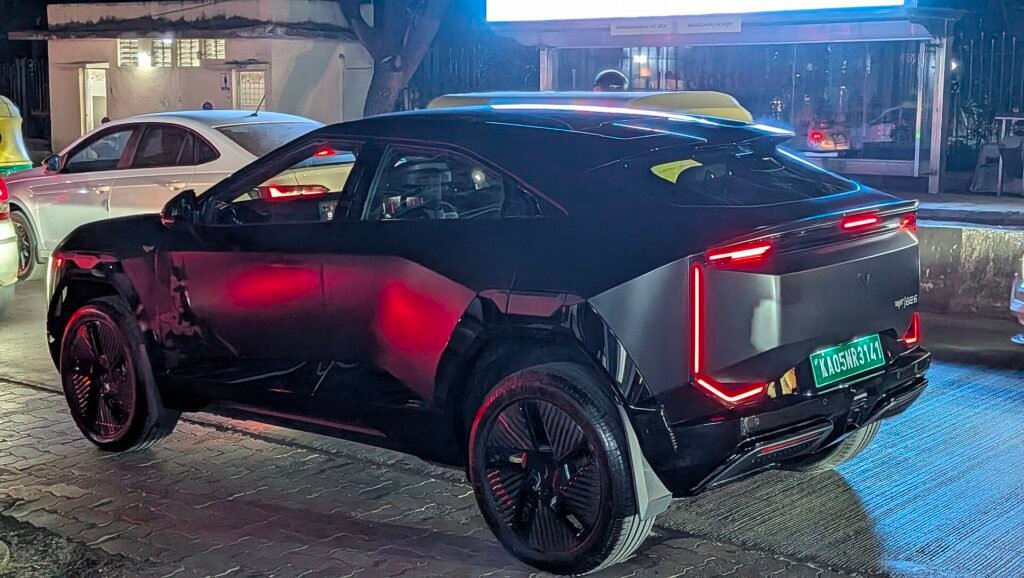
Featured image credit: Image: SerChevalerie via Wikimedia Commons (CC BY-SA 4.0). Source
By Piyush P. Yadav
No brand has bet on electric vehicles as broadly as Mahindra. Where most Indian manufacturers have one or two EVs anchoring an otherwise petrol and hybrid range, Mahindra now fields electric products across five completely different vehicle classes: premium electric SUVs, an electric small commercial van, and two categories of electric three-wheeler that between them define the last-mile logistics and passenger-auto segments. This is a full map of that portfolio as it stands in September 2026, and what ties it together.
The Mahindra EV portfolio at a glance
| Model | Segment | Ex-showroom price | Key specification |
|---|---|---|---|
| Mahindra BE 6 (BE 6e / Sporteq) | Premium electric SUV | Rs 18.90 lakh to Rs 27.7 lakh | 59, 70 and 79 kWh battery options; up to 500-plus km claimed range; 10-year/2,00,000 km battery warranty for first owner |
| Mahindra XEV 9e | Premium electric coupé-SUV | Rs 21.90 lakh to Rs 30.50 lakh | Coupé-inspired SUV body; multiple variants; same 10-year/2,00,000 km first-owner battery warranty as BE 6 |
| Mahindra XUV 3XO EV | Compact electric SUV | From Rs 13.89 lakh | Mahindra’s newest and most affordable EV, positioned against the Tata Nexon EV and Kia Syros EV |
| Mahindra Zeo | Small commercial vehicle (4-wheeler) | Rs 7.52 lakh to Rs 7.88 lakh | 160 km certified range; 30 kW motor; 32 per cent gradeability, class-leading under 2 tonnes |
| Mahindra Treo | Electric passenger three-wheeler | Rs 3.23 lakh to Rs 3.38 lakh | 7.37 kWh battery; up to 139 km range; minimum 5-year battery life |
| Mahindra Treo Zor | Electric cargo three-wheeler | Rs 3.13 lakh to Rs 3.94 lakh | Purpose-built cargo platform for last-mile delivery |
Six distinct products, spanning roughly Rs 3 lakh to Rs 30 lakh, is a breadth no other Indian manufacturer currently matches. Tata has more individual passenger EV nameplates, which we mapped in our Tata Motors EV brand deep-dive, but Tata’s commercial EV push is concentrated in trucks and the Ace EV rather than three-wheelers. Mahindra, through its Last Mile Mobility subsidiary, treats three-wheelers as a core business line rather than an afterthought, and that unit alone makes Mahindra one of India’s largest EV sellers by volume even before counting the BE 6 and XEV 9e.
The BE 6 and XEV 9e: Mahindra’s premium electric bet
These two SUVs, launched together, represent Mahindra’s most direct assault on the Rs 20 lakh to Rs 30 lakh electric SUV segment, competing with the Hyundai Creta Electric and, at the upper end, imported premium EVs. The three battery options on the BE 6, 59, 70 and 79 kWh, give it more range tiers than most rivals, and Mahindra’s 10-year, 2,00,000 km battery warranty for the first private owner, while not technically “lifetime” like Tata’s or Kia’s terms on comparable cars, is longer in years than the industry-standard 8-year cover and covers more kilometres than most owners will put on the car in that time. We compared this and other brands’ warranty terms in detail in our EV battery warranty guide.
The XEV 9e shares its underlying platform and warranty terms with the BE 6 but wears a coupé-SUV body aimed at buyers who want a more distinctive silhouette than the more conventional BE 6. Both cars’ battery-as-a-service option, which lowers the upfront price in exchange for a per-kilometre battery rental, is explained in full in our Mahindra BaaS cost-maths explainer.
The XUV 3XO EV: Mahindra’s move into the mass segment
Starting from Rs 13.89 lakh, the XUV 3XO EV is Mahindra’s answer to the Tata Nexon EV and Kia Syros EV, the segment we detailed in our guide to electric cars under Rs 15 lakh. It is Mahindra’s newest entrant and the least documented so far in terms of battery size and range specifics, which is worth watching as full details emerge. Its significance is strategic: until its arrival, Mahindra’s electric range started above Rs 18 lakh with the BE 6, leaving the large and fast-growing sub-Rs-15-lakh segment to Tata, Kia and MG. The XUV 3XO EV closes that gap.
Where Mahindra actually leads: commercial and three-wheeler EVs
It is easy to overlook, amid the SUV headlines, that Mahindra’s Treo and Treo Zor sit inside the single fastest-electrifying vehicle category in India. Electric three-wheelers already account for the highest EV penetration of any segment in the country, and Mahindra’s Last Mile Mobility unit is one of the two or three largest players in that market. The Zeo, meanwhile, competes directly with the Tata Ace EV in small electric commercial vehicles, undercutting it on price while offering better certified range and notably higher gradeability, a genuine advantage for operators in hilly terrain or those loading from raised docks. We covered the full competitive picture for this segment in our electric three-wheeler and small commercial vehicle buying guide.
How Mahindra’s strategy differs from its rivals
Where Kia has bet narrowly on one well-specified affordable EV, described in our report on Kia India’s EV playbook, and Tata has spread wide across passenger nameplates while concentrating commercial EV effort on trucks, Mahindra has built genuine strength in three separate markets at once: premium electric SUVs, mass-market electric SUVs and commercial or three-wheeler EVs. That breadth carries execution risk, since it means competing simultaneously against Tata and Kia in passenger cars and against a different set of specialists in commercial three-wheelers. But it also means Mahindra is less exposed than a single-segment player if any one part of the EV market slows, and it explains why Mahindra has consistently ranked among the top electric brands in India by total volume even in years when its flagship SUVs were not the best-selling passenger EVs, a pattern visible in our H1 2026 EV brand rankings.
Bottom line
Mahindra’s EV strategy is the opposite of narrow. Six products across three price bands and three vehicle classes give it more surface area in India’s electric market than any rival, anchored by a genuinely competitive premium SUV pairing in the BE 6 and XEV 9e, a newly arrived contender in the crowded sub-Rs-15-lakh segment, and a commercial and three-wheeler business that quietly does as much for the company’s EV volume as its headline SUVs.
Sources & Further Reading
- Mahindra: Mahindra launches BE 6e and XEV 9e
- Mahindra: Mahindra Last Mile Mobility launches the Zeo electric SCV
- CarDekho Trucks: Mahindra Treo price and specifications
FAQ
What electric vehicles does Mahindra sell in India?
Six models across three segments: the BE 6 and XEV 9e premium electric SUVs, the XUV 3XO EV compact electric SUV, the Zeo electric small commercial vehicle, and the Treo and Treo Zor electric three-wheelers for passenger and cargo use.
What is the battery warranty on the Mahindra BE 6 and XEV 9e?
10 years or 2,00,000 km, whichever comes first, for the first private owner.
What is the price of the Mahindra XUV 3XO EV?
Starting from Rs 13.89 lakh ex-showroom, positioning it against the Tata Nexon EV and Kia Syros EV.
Is Mahindra a major player in electric three-wheelers?
Yes. Through its Last Mile Mobility subsidiary and the Treo and Treo Zor models, Mahindra is one of the largest players in India’s electric three-wheeler segment, which has the highest EV penetration of any vehicle category in the country.