

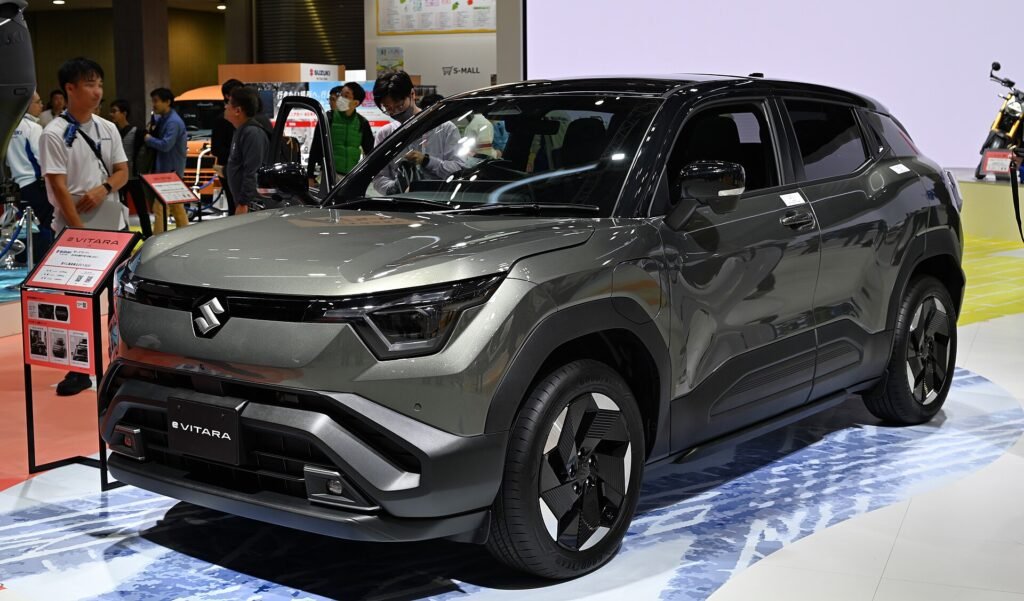
Featured image credit: Image: TTTNIS via Wikimedia Commons (CC0). Source
By Piyush P. Yadav
Toyota sold 161 Urban Cruiser Ebellas in India in August 2026. That is up 30 per cent on July’s 124, and it puts the world’s largest carmaker tenth in India’s electric car table, behind Citroen’s rounding error and a long way behind Tata’s 13,070. For a company whose Indian arm sells more than 30,000 cars a month and whose hybrid strategy has been the loudest counter-argument to battery EVs in the country, the number tells a story worth reading properly.
This is a deep dive into Toyota’s EV position in India as of September 2026: what the Ebella is and what it costs, why it is a Maruti built in a Maruti plant, how the Battery-as-a-Service offer works, why sales are where they are, what Toyota is spending on EV components here, and what the CAFE-III norms from April 2027 will do to its hybrid-first strategy. It continues our series on how each manufacturer is approaching electrification, following our pieces on Maruti Suzuki’s export-led EV strategy and Hyundai’s Rs 45,000 crore India plan.
The Urban Cruiser Ebella: what Toyota launched
Toyota Kirloskar Motor unveiled the Ebella in January 2026, opened bookings on 20 January, and announced the price of the top E3 variant on 29 May 2026 at Rs 23.60 lakh ex-showroom. Deliveries began in June. It is Toyota’s first battery-electric vehicle in India and, mechanically, it is the Maruti Suzuki e Vitara with Toyota badges, a different grille and a slightly different equipment list. Both are built at Suzuki Motor Gujarat’s Hansalpur plant on the Heartect-e platform.
| Specification | Ebella E1 | Ebella E2 / E3 |
|---|---|---|
| Battery | 49 kWh LFP | 61 kWh LFP |
| Claimed range | 440 km (ARAI/MIDC) | 543 km (ARAI/MIDC) |
| Motor | 106 kW (144 PS), 193 Nm | 129 kW (174 PS), 193 Nm |
| DC fast charging | Up to 67 kW | Up to 67 kW |
| AC charging | 3.3 kW standard, 7.2 kW optional | 3.3 kW standard, 7.2 kW optional |
| Ex-showroom price | Not announced | E3: Rs 23.60 lakh |
| BaaS price | Not announced | Rs 15.25 lakh + Rs 4.99 per km |
| Battery warranty | 8 years | 8 years |
| Vehicle warranty | 3 years / 1,00,000 km | 3 years / 1,00,000 km |
| Assured buyback | 60% | 60% |
The E3 is well equipped: Level 2 ADAS, seven airbags, a 360-degree camera, a 10.1-inch touchscreen with a 10.25-inch digital cluster, a glass roof, ventilated front seats, a 10-way power driver’s seat and a 10-speaker JBL system. It measures 4,285 mm long on a 2,700 mm wheelbase with 184 mm of ground clearance and a 306-litre boot. Autocar India’s real-world highway estimate for the 61 kWh car is around 370 km.
Some outlets quote 150 kW DC charging from Toyota’s launch material; the Autocar India specification page lists 67 kW, which matches the e Vitara. Buyers should assume 67 kW until Toyota confirms otherwise.
The price problem: Rs 23.60 lakh for a Rs 16.19 lakh car
The Maruti e Vitara starts at Rs 16.19 lakh. Toyota has announced only its top variant at Rs 23.60 lakh, and has not priced the E1 or E2 at all. Even allowing for the E3’s equipment, the premium over the equivalent top-spec e Vitara runs to several lakh rupees, and against the direct rivals the gap is wider still.
| Model | Starting price (ex-showroom) | Battery | Claimed range | August 2026 brand sales |
|---|---|---|---|---|
| Toyota Urban Cruiser Ebella E3 | Rs 23.60 lakh | 61 kWh | 543 km | 161 |
| Maruti Suzuki e Vitara | Rs 16.19 lakh | 49 / 61 kWh | Up to 543 km | 1,405 |
| Mahindra BE 6 | Rs 19.45 lakh | 59 / 79 kWh | Up to 683 km | 6,408 (all Mahindra EVs) |
| Hyundai Creta Electric | Rs 17.99 lakh | 42 / 51.4 kWh | Up to 473 km | 802 |
| MG Windsor EV | Rs 14.70 lakh | 38 / 52.9 kWh | Up to 449 km | 4,602 (all MG EVs) |
| Tata Nexon EV | Rs 12.49 lakh | 30 / 45 kWh | Up to 489 km | 13,070 (all Tata EVs) |
Toyota’s answer to the price gap is Battery-as-a-Service. On BaaS the Ebella costs Rs 15.25 lakh plus Rs 4.99 per kilometre for the battery. That headline number puts it under the e Vitara, but the per-km rate is the highest of any BaaS car in India: Mahindra charges Rs 3.75 per km on the BE 6, Tata Rs 2.60 on the Punch EV, MG Rs 3.90 to 4.50 on the Windsor. At 1,000 km a month, Toyota’s rental is Rs 4,990 a month or about Rs 3 lakh over five years, which brings the effective price back above the e Vitara’s outright figure. We worked through the general BaaS arithmetic in our Mahindra BaaS cost analysis and the same logic applies here, only less favourably.
The 60 per cent assured buyback and eight-year battery warranty are genuine value, and the Toyota dealer network is a real advantage outside the metros. But at Rs 23.60 lakh the Ebella is competing with the Mahindra BE 6, which has a bigger battery, more range and more performance, and losing.
Why the numbers are what they are
Three reasons. First, Toyota has priced the Ebella as a premium product in a segment where the same car is available for less with a Suzuki badge. Second, Toyota India’s dealer network and sales culture are built around hybrids; the Hyryder and Innova Hycross are the volume products, and the Ebella sits awkwardly beside them in the showroom. Third, Toyota has not marketed the car with any urgency because, until now, it has not needed the volume.
That last point is about to change. India’s CAFE-III fuel-efficiency norms take effect on 1 April 2027 and, in the current draft, cut the super-credit multiplier for strong hybrids from 2.0 to 1.6 while keeping battery EVs at 3.0. Toyota and Maruti lobbied to retain small-car and hybrid concessions; Tata, Mahindra, Hyundai and Kia opposed them and largely won. Under the new formula, each Ebella Toyota sells counts as three cars in its fleet average, while each Hyryder hybrid counts as 1.6. Toyota’s Indian fleet is heavy with Innova Crysta diesels and Fortuners, and its compliance position from FY2027-28 depends on selling more electric cars than 161 a month.
What Toyota is spending in India
Toyota Group has committed Rs 4,800 crore (about USD 624 million) to make electric vehicle components in India, including e-axles and battery-related parts, as part of its global carbon-neutrality programme. Toyota Kirloskar is adding a third plant at Bidadi in Karnataka and has said its Indian production capacity will roughly triple to one million units a year by 2030. Globally, Toyota plans 15 in-house electric models by 2027, developed on its own platforms rather than rebadged from Suzuki.
For India the pipeline is narrower. The next product is an electric MPV codenamed YMC, on the same Heartect-e platform as the Ebella, which has been spotted in road testing. It would be Toyota’s version of the electric Maruti MPV and could arrive in 2027. Beyond that, Toyota has not confirmed any India-specific EV, though its bZ series and the Lexus electric range are candidates for import under the SPMEPCI scheme, which allows 8,000 cars a year at 15 per cent duty in return for a Rs 4,150 crore local investment commitment. Toyota has not applied.
How Toyota compares with the other late entrants
Toyota is not the only global brand that arrived late and small. The August 2026 table is instructive.
| Brand | August 2026 EV sales | August 2025 | Change | India EV models |
|---|---|---|---|---|
| VinFast | 2,198 | Not on sale | New | VF6, VF7 |
| Maruti Suzuki | 1,405 | Not on sale | New | e Vitara |
| Hyundai | 802 | 686 | +17% | Creta Electric, Ioniq 5 |
| Kia | 640 | 501 | +28% | Carens Clavis EV, Syros EV, EV6, EV9 |
| BYD | 542 | 495 | +9% | Atto 3, Seal, eMax 7, Sealion 7 |
| Toyota | 161 | Not on sale | New | Urban Cruiser Ebella |
VinFast, which entered India in September 2025, sold 13 times as many EVs as Toyota in August and has, as we reported, overtaken BYD and committed Rs 7,000 crore to its Tamil Nadu plant. Maruti, selling the same car from the same factory, sold nearly nine times as many. Toyota’s 161 is not a supply constraint; the Hansalpur line is the same one that shipped 40,759 e Vitaras for export. It is a pricing and positioning choice.
What would change the picture
Three moves would make Toyota a serious EV player in India within 18 months. Pricing the E1 and E2 variants at or near e Vitara levels, which would bring the entry Ebella under Rs 18 lakh. Cutting the BaaS per-km rate to the Rs 3.50 to 4.00 range where Mahindra and MG sit. And bringing the YMC electric MPV to market in 2027 with a family-focused pitch that the Innova brand already owns. Toyota has the dealer reach, the brand trust and, from April 2027, a regulatory reason to do all three. Whether it does is the question the next twelve months of sales data will answer.
Sources & Further Reading
- Autocar India: August EV sales, VinFast takes fourth spot from Maruti Suzuki
- electrive: Toyota launches the Urban Cruiser Ebella as its first EV in India
- ZigWheels: Toyota Urban Cruiser Ebella launched with top spec at Rs 23.60 lakh
- Autocar India: Toyota Urban Cruiser Ebella specifications and prices
- Gulf News: Toyota plans to invest USD 624 million to make EV parts in India
Frequently Asked Questions
What is the price of the Toyota Urban Cruiser Ebella?
The top E3 variant with the 61 kWh battery is Rs 23.60 lakh ex-showroom. Toyota has not announced prices for the E1 (49 kWh) and E2 variants. A Battery-as-a-Service option is offered at Rs 15.25 lakh plus Rs 4.99 per km.
Is the Toyota Ebella the same as the Maruti e Vitara?
Mechanically yes. Both use the Heartect-e platform, the same 49 kWh and 61 kWh LFP batteries and motors, and are built at Suzuki Motor Gujarat’s Hansalpur plant. The Ebella has Toyota styling, a different equipment mix and a higher price.
How many Ebellas has Toyota sold?
161 units in August 2026, up from 124 in July. Deliveries began in June 2026. By comparison, Maruti sold 1,405 e Vitaras and VinFast 2,198 EVs in the same month.
What is Toyota’s EV plan for India?
Toyota Group has committed about Rs 4,800 crore to EV component manufacturing in India and is tripling Indian capacity to one million units by 2030. An electric MPV codenamed YMC on the Ebella’s platform is in testing. Globally, Toyota plans 15 in-house EVs by 2027.