

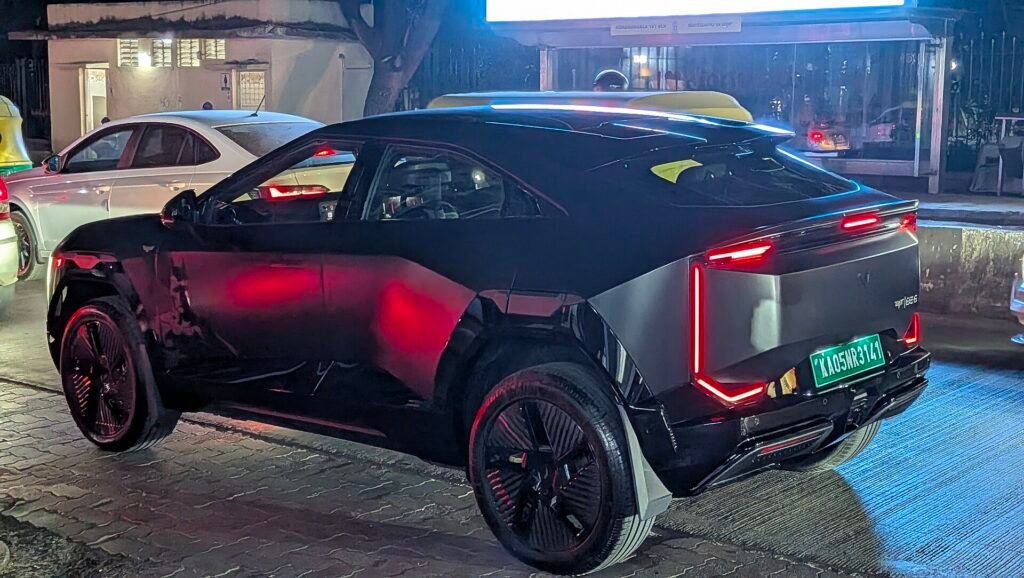
Featured image credit: Image: SerChevalerie via Wikimedia Commons (CC BY-SA 4.0). Source
By Piyush P. Yadav
Mahindra has quietly reworked its best-known electric SUV. The BE 6 Sporteq, launched on 15 August 2026, replaces the original BE 6 line-up with a new variant ladder that starts at Rs 19.45 lakh (ex-showroom) and stretches to Rs 26.95 lakh for the Sporteq Four Launch Edition. The Battery-as-a-Service route brings the entry point down to Rs 11.45 lakh plus Rs 3.75 per kilometre. The headline changes are inside the cabin rather than under the floor: a triple 12.3-inch screen layout, the removal of the “halo loop” divider between the front seats, and a Qualcomm Snapdragon chipset running six new “TEQ” software features. This article lays out every variant, what has changed, what the range claims actually mean, and how the Sporteq stacks up against the mid-size electric SUVs it now competes with.
What the BE 6 Sporteq is, and what it replaces
The BE 6 arrived in late 2024 as the first of Mahindra’s INGLO-platform “Born Electric” SUVs, alongside the XEV 9e. Nine months of customer feedback fed into the Sporteq update. The dual-screen dashboard has grown to three 12.3-inch displays, the cockpit-style barrier that separated driver from passenger has gone, a proper centre-console cup-holder has appeared, and a new Black and Tan interior theme joins the existing dark cabin. Under the skin, the rear-wheel-drive single-motor layout continues with 286 bhp and 380 Nm, and the two battery options remain 59 kWh and 79 kWh.
Mahindra’s claimed figure for the 79 kWh pack is “up to 683 km” on a full charge, with the company itself quoting “500+ km with AC on” as a real-world figure. That second number is the one to plan around. If you want to understand why manufacturer range claims and real-world results diverge so consistently, our explainer on EV battery degradation and state of health in India covers how test cycles, temperature and load change the outcome.
BE 6 Sporteq variant-wise prices (ex-showroom, September 2026)
| Variant | Battery | Ex-showroom price | BaaS price (plus Rs 3.75/km) |
|---|---|---|---|
| Sporteq One | 59 kWh | Rs 19.45 lakh | Rs 11.45 lakh |
| Sporteq Two | 59 kWh | Rs 20.95 lakh | Available |
| Sporteq Three | 59 kWh | Rs 21.95 lakh | Available |
| Sporteq Three | 79 kWh | Rs 22.95 lakh | Available |
| Sporteq Three+ | 59 kWh | Rs 23.95 lakh | Available |
| Sporteq Three+ | 79 kWh | Rs 24.95 lakh | Available |
| Formula E Freedom Edition | 59 / 79 kWh | Rs 24.45 lakh to Rs 26.95 lakh | Available |
| Sporteq Four Launch Edition | 79 kWh | Rs 26.95 lakh | Available |
Two things stand out in that table. First, the Rs 1 lakh step between the 59 kWh and 79 kWh packs within the same trim is one of the cheapest battery upgrades in the Indian market: you are buying 20 kWh of extra capacity for roughly Rs 5,000 per kWh. Second, the gap between the base Sporteq One and the top Launch Edition is Rs 7.5 lakh, which is a wider spread than the Hyundai Creta Electric (Rs 18.03 lakh to Rs 24.70 lakh) or the Maruti e Vitara (Rs 16.19 lakh to Rs 20.21 lakh).
The BaaS route: Rs 11.45 lakh plus Rs 3.75 per km
The Battery-as-a-Service option lets a buyer take the car without paying for the battery upfront. The sticker drops to Rs 11.45 lakh for the Sporteq One, and the battery is paid for through a per-kilometre charge of Rs 3.75. The break-even maths depends entirely on how far you drive: at 10,000 km a year the annual battery rental is Rs 37,500, while at 25,000 km a year it is Rs 93,750. We ran the full comparison across Mahindra’s range in our piece on whether Mahindra’s Battery-as-a-Service pricing is really cheaper. The short version is that BaaS suits low-mileage urban buyers and hurts high-mileage users, and it also complicates resale because the battery is never yours to sell.
What is actually new in the Sporteq
Cabin and screens
The most visible change is the third 12.3-inch display, which sits in front of the passenger. The original BE 6’s twin-screen layout drew criticism for a cluttered centre stack and a divider that made the front cabin feel cramped. Both complaints have been addressed. The new Black and Tan theme is offered alongside the existing all-dark interior.
Six TEQ features
Mahindra groups the software additions under six names: TEQ_Me (driver profiles), TEQ_Drive (drive-mode and regen customisation), TEQ_Play (in-car media and games), TEQ_Talk (voice assistant), TEQ_Secure (vehicle security and tracking) and TEQ_xting (messaging integration). All run on a Qualcomm Snapdragon chipset that replaces the earlier hardware and is designed to accept over-the-air updates.
Unchanged mechanicals
Motor output, torque, battery capacities and the rear-drive layout carry over. The 79 kWh pack uses BYD Blade LFP cells, which is relevant for buyers weighing warranty terms: Mahindra offers a lifetime battery warranty to the first owner on its Born Electric SUVs, a structure we compared against Tata, Hyundai and MG in our guide to EV battery warranties in India and what the fine print says.
How the Sporteq compares with rivals at Rs 19 lakh to Rs 27 lakh
| Model | Price range (ex-showroom) | Battery | Claimed range | Power | Drive |
|---|---|---|---|---|---|
| Mahindra BE 6 Sporteq | Rs 19.45 lakh to Rs 26.95 lakh | 59 / 79 kWh | Up to 683 km (79 kWh) | 286 bhp | RWD |
| Hyundai Creta Electric | Rs 18.03 lakh to Rs 24.70 lakh | 42 / 51.4 kWh | 390 / 473 km (ARAI) | 135 / 171 hp | FWD |
| Maruti e Vitara | Rs 16.19 lakh to Rs 20.21 lakh | 49 / 61 kWh | 440 / 543 km | 142 / 172 bhp | FWD |
| Tata Curvv EV | Rs 17.19 lakh to Rs 19.69 lakh | 55 kWh | 502 km (MIDC) | 165 bhp | FWD |
| Tata Harrier EV | Rs 21.79 lakh to Rs 30.54 lakh | 65 / 75 kWh | 538 to 627 km | 238 PS (65 kWh RWD) | RWD / QWD |
| MG Hector Tomahawk EV | From Rs 19.49 lakh | Not disclosed at launch | 517 km | Not disclosed at launch | FWD |
On paper the Sporteq is the performance pick of the segment: 286 bhp and rear-wheel drive against front-driven 135 to 172 hp rivals. It is also the only car here offering a battery above 61 kWh below Rs 25 lakh. Where it gives ground is in boot practicality and rear-seat space, where the Creta Electric and the seven-seat MG Hector Tomahawk EV are more family-oriented. The Tomahawk also brings vehicle-to-home capability, which no Mahindra currently matches.
Where the Sporteq sits in Mahindra’s electric line-up
The BE 6 Sporteq is the sportier, coupe-roofed sibling of the XEV 9e, and both sit below the recently added XEV 9S three-row SUV. Mahindra’s stated ambition is to have electric models account for a large share of its SUV volumes by the end of the decade, and the Sporteq is the car most likely to bring younger buyers into the brand. For the full picture of how the BE 6, XEV 9e, XEV 9S and the Treo three-wheeler fit together, see our deep dive into Mahindra’s electric vehicle portfolio.
Who should buy which variant
- Sporteq One, 59 kWh (Rs 19.45 lakh): the value pick if you want the drivetrain and the new cabin without paying for the big pack. Real-world range in the 380 to 420 km band is realistic for mixed driving.
- Sporteq Three, 79 kWh (Rs 22.95 lakh): the sweet spot. You get the larger battery for a Rs 1 lakh premium over the 59 kWh version of the same trim and most of the desirable equipment.
- Sporteq Three+, 79 kWh (Rs 24.95 lakh): for buyers who want the full ADAS and comfort suite. Above this the Launch Edition and Formula E edition are mainly cosmetic upgrades.
- BaaS at Rs 11.45 lakh: only if your annual running is well under 12,000 km and you plan to keep the car for its full term rather than sell early.
Sources & Further Reading
- Rushlane: Mahindra BE 6 Sporteq launch price Rs 19.45 lakh, new interior, BaaS
- CarDekho: 2026 Mahindra BE 6 Sporteq launched, prices start at Rs 19.45 lakh
- Team-BHP: Mahindra BE 6 Sporteq launched at Rs 19.45 lakh
- Autocar India: Hyundai Creta Electric pricing and buyback programme (rival reference)
Frequently asked questions
What is the price of the Mahindra BE 6 Sporteq?
The BE 6 Sporteq is priced from Rs 19.45 lakh for the Sporteq One (59 kWh) to Rs 26.95 lakh for the Sporteq Four Launch Edition (79 kWh), ex-showroom. Under the Battery-as-a-Service plan the entry price is Rs 11.45 lakh plus Rs 3.75 per km.
What is the real-world range of the BE 6 Sporteq 79 kWh?
Mahindra claims up to 683 km on a full charge but itself quotes “500+ km with AC on” as a real-world figure. Expect 450 to 520 km in mixed Indian driving depending on speed and climate control use.
What changed in the Sporteq compared with the original BE 6?
The cabin gains a third 12.3-inch screen, loses the divider between the front seats, adds a cup-holder and a Black and Tan theme, and runs on a Qualcomm Snapdragon chipset with six new TEQ software features. Motor, battery sizes and rear-wheel-drive layout are unchanged.
Is the BE 6 Sporteq BaaS plan worth it?
It suits buyers who drive under roughly 12,000 km a year and want a lower upfront price. For high-mileage users the Rs 3.75 per km charge adds up quickly, and the battery remains the property of the finance partner, which affects resale.