

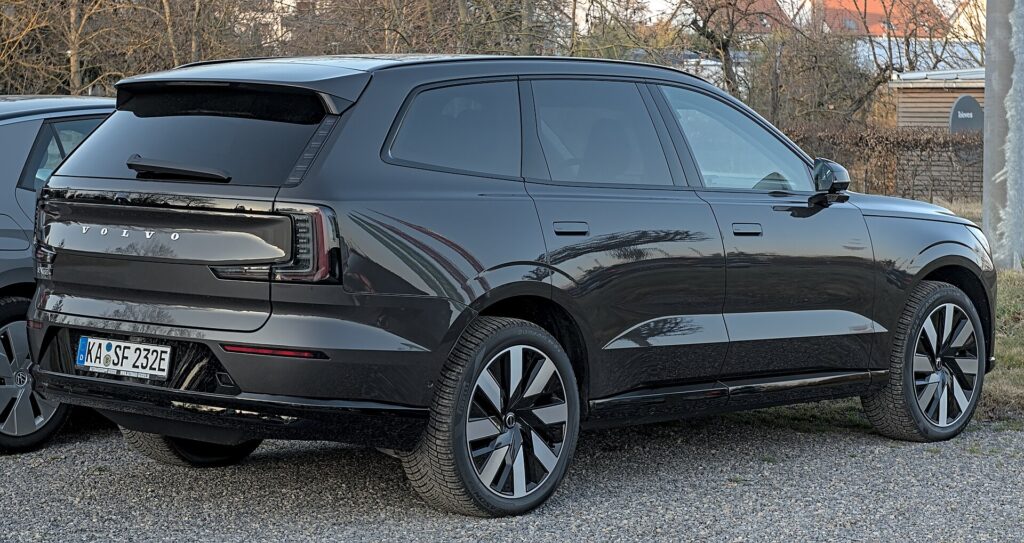
Featured image credit: Image: Alexander Migl via Wikimedia Commons (CC BY-SA 4.0). Source
By Piyush P. Yadav
Volvo Car India has fixed 12 October 2026 as the launch date for two flagship electric cars at once: the EX90, a seven-seat SUV, and the ES90, a sedan that returns the brand to a segment it left when the S90 was discontinued in June 2025. Both sit on Volvo’s SPA2 platform with an 800-volt electrical system, both accept up to 350 kW from a DC charger, and both are being positioned against the Mercedes-Benz EQS SUV, Kia EV9 and BMW i5 rather than against anything Volvo currently sells here. This report sets out what is confirmed, what the global specifications tell us about the India cars, how they compare on paper with the Porsche Cayenne Electric and Range Rover Electric arriving in the same quarter, and why a 350 kW charging claim matters less in India than the brochure suggests.
What Volvo has confirmed
The confirmed facts are the date, the two models, the platform and the intent. Volvo announced the 12 October launch in the third week of August. Autocar India reports that both cars use the SPA2 architecture and its 800V system, and that they will be the company’s most expensive electric offerings in India. Pricing has not been announced. Autocar India’s own estimate, quoted by several outlets, puts the EX90 at around Rs 1.5 crore ex-showroom, while listing sites carry placeholder ranges of Rs 1.0 crore to Rs 1.3 crore for the SUV and around Rs 1.1 crore for the sedan. Treat every one of those as a guess until 12 October.
India-specific variant choices are also unconfirmed. Globally each car comes with a 92 kWh single-motor pack or a 106 kWh twin-motor pack, and Volvo has not said which of those it will bring, or whether the cars will be assembled at its Hosakote plant near Bengaluru, where the EX30 is built from kits, or imported fully built. Some reports point to CKD assembly for the EX90; we will confirm on launch day.
The global specifications, variant by variant
Because the India cars will be drawn from the same global catalogue, the international figures are the best available guide. Autocar India’s breakdown, reproduced below, covers the three powertrain configurations.
| Variant | Battery | Drive | Power / torque | 0-100 km/h (EX90 / ES90) | WLTP range (EX90 / ES90) |
|---|---|---|---|---|---|
| Single Motor | 92 kWh | Rear-wheel drive | 333 hp / 480 Nm | 6.6 s / 6.6 s | 565 km / 664 km |
| Twin Motor | 106 kWh | All-wheel drive | 456 hp / 670 Nm | 5.3 s / 5.4 s | 602-608 km / 696 km |
| Twin Motor Performance | 106 kWh | All-wheel drive | 680 hp / 870 Nm | 4.0 s / not quoted | About 600 km / not quoted |
Two points stand out. First, the ES90 sedan’s 696 km WLTP figure on the 106 kWh pack is the longest range Volvo has ever quoted, and it comes from a drag coefficient of 0.25, which the company describes as its most aerodynamic car to date. The EX90 manages 0.29, which is very good for a 5,037 mm long, 1,964 mm wide SUV on a 2,985 mm wheelbase. Second, the 680 hp Performance variant is a halo model; if Volvo brings one configuration of each car to India, the 456 hp Twin Motor is the likely candidate because it pairs the large battery with the price-sensible motor.
Charging: 350 kW and 22 minutes, with a caveat
Every variant of both cars supports up to 350 kW DC charging and a claimed 10 to 80 per cent time of 22 minutes. That is the same headline as the Range Rover Electric, and it comes from the same place: an 800V pack that can accept high power without the current, and therefore the heat, that a 400V pack would need for the same kilowatts. We explained the mechanics in our guide to why EVs never charge at the charger’s rated speed.
The caveat is the Indian network. As the September 2026 Rubix data showed, 73 per cent of India’s 67,657 public chargers are rated under 30 kW, and the handful of 240 kW and 350 kW units are concentrated on a few expressways and at a few dealer hubs. On a 120 kW highway charger, filling 70 per cent of a 106 kWh pack, roughly 74 kWh, takes about 45 to 55 minutes as the curve tapers. On a common 60 kW metro unit it is closer to 90 minutes. A buyer at this price will do almost all charging at home on an 11 kW wallbox, where a full charge takes about ten hours overnight, and the 350 kW figure will matter perhaps a few times a year.
Cabin, seating and practicality
The EX90 is a seven-seater as standard, with a six-seat captain’s-chair option, and offers 384 litres of boot space behind the third row plus a 45-litre front trunk. The ES90 seats five, with a 424-litre boot and a 27-litre frunk. Both cars share a 14.5-inch portrait touchscreen running Google’s built-in software, a 9-inch driver display, a 13.2-inch head-up display, four-zone climate control and 5G connectivity for over-the-air updates. Volvo describes the driver-assistance package as Level 3 capable, although the functions that will be enabled in India depend on regulation and mapping rather than hardware.
On safety, the EX90 already holds five-star ratings from Euro NCAP and Australasian NCAP. The ES90 has not yet been crash-tested by either body.
How they stack up against the other flagship EV launches this quarter
October’s Volvo launch closes a remarkable six-week run of flagship electric arrivals in India. The BMW i7 facelift lands on 11 September, the Porsche Cayenne Electric on 30 September, and Range Rover Electric bookings opened on 2 September. The table compares them on the figures each maker has published.
| Model | Expected price | Battery | Claimed range (WLTP) | Architecture / peak DC | 10-80 per cent claim |
|---|---|---|---|---|---|
| Volvo EX90 Twin Motor | Rs 1.0 to 1.5 crore (estimates) | 106 kWh | 602-608 km | 800V / 350 kW | 22 min |
| Volvo ES90 Twin Motor | About Rs 1.1 crore (estimate) | 106 kWh | 696 km | 800V / 350 kW | 22 min |
| Porsche Cayenne Electric | Rs 1.77 crore | 113 kWh | 643 km | 800V / 390-400 kW | About 16 min |
| BMW i7 facelift | About Rs 2.10 crore (expected) | 112.4 kWh | 727 km | 400V / 250 kW | 28 min |
| Range Rover Electric | Rs 3.5 to 3.7 crore (expected) | 118.5 kWh | 600 km | 800V / 350 kW | 22 min |
If the Autocar estimate of Rs 1.5 crore holds, the EX90 undercuts the Porsche Cayenne Electric by roughly Rs 27 lakh while offering seven seats the Porsche does not, and comes in at less than half the Range Rover Electric. If the lower listing-site figures of around Rs 1 crore prove right, it lands in Kia EV9 and Mercedes EQS SUV territory, which is exactly where Volvo says it wants to be. The ES90, meanwhile, would be the only long-range electric sedan between the BMW i5 and the far pricier i7, whose 727 km WLTP claim it nearly matches on a smaller battery.
Where this leaves Volvo in India
Volvo’s Indian electric line-up has been thin for a year. The EX40 has been quietly withdrawn from the website, leaving the EC40 at about Rs 59 lakh and the EX30, launched at Rs 41 lakh (with a Rs 39.99 lakh introductory price for early bookings) and assembled at Hosakote, as the only electric models on sale. The company has said it wants electric cars to be about a third of its Indian volume, and it told the press at the EX30 launch that two more EVs, an SUV and a sedan, would follow in 2026. The EX90 and ES90 are those two cars.
What they cannot do is add volume. The Indian luxury EV market above Rs 1 crore is measured in hundreds of units a year across all brands. What they can do is give Volvo dealers a halo product that shares showroom space with a Rs 41 lakh EX30, and give the brand a credible answer when a Mercedes or BMW customer asks what Volvo has at the top of the range. That is the job the S90 used to do with a diesel engine.
What to watch on 12 October
- Which battery comes to India. A 92 kWh single-motor EX90 would allow a lower entry price; a 106 kWh-only line-up would push the car toward the Rs 1.5 crore estimate.
- CKD or CBU. Local assembly at Hosakote would materially change the price, as it did for the EX30, and would be the first SPA2 assembly outside Volvo’s main plants.
- Range certification. Volvo quotes WLTP globally. If it publishes an ARAI figure for India, expect a number well above the WLTP one; our guide to claimed versus real-world EV range in India explains how to read the two.
- Warranty and charging bundles. Rivals at this price include a home wallbox and a charging-network subscription. Volvo’s package will be compared line by line.
Sources & Further Reading
- Autocar India: Volvo EX90, ES90 India launch on October 12
- autoX: Volvo EX90, ES90 India launch set for October 12
- India TV News: Volvo EX90, ES90 India launch: price, features and rivals
- Autocar Professional: Volvo EX30 launched in India at Rs 41 lakh
FAQ
When do the Volvo EX90 and ES90 launch in India?
Both cars launch on 12 October 2026. Prices, India-specific variants and the assembly arrangement will be announced on that date.
How much will the Volvo EX90 cost in India?
Volvo has not announced pricing. Autocar India estimates around Rs 1.5 crore ex-showroom for the EX90; listing sites carry placeholder figures of Rs 1.0 to 1.3 crore. The ES90 is expected to be a little cheaper.
What is the range of the Volvo ES90?
Globally the ES90 is rated at 664 km WLTP with the 92 kWh single-motor pack and 696 km with the 106 kWh twin-motor pack. India-specific certification has not been published.
How fast do the EX90 and ES90 charge?
Both cars have an 800V system that accepts up to 350 kW DC, with a claimed 10 to 80 per cent time of 22 minutes. On the 60 kW and 120 kW chargers that make up most of India’s fast-charging network, expect roughly 90 and 50 minutes respectively.